The Long-Term Consequences of the Treaty of Versailles (Cambridge International IGCSE History)
Europe's Reaction to the Treaty
- There was a mixed reaction in Europe to the Versailles Settlement in 1919
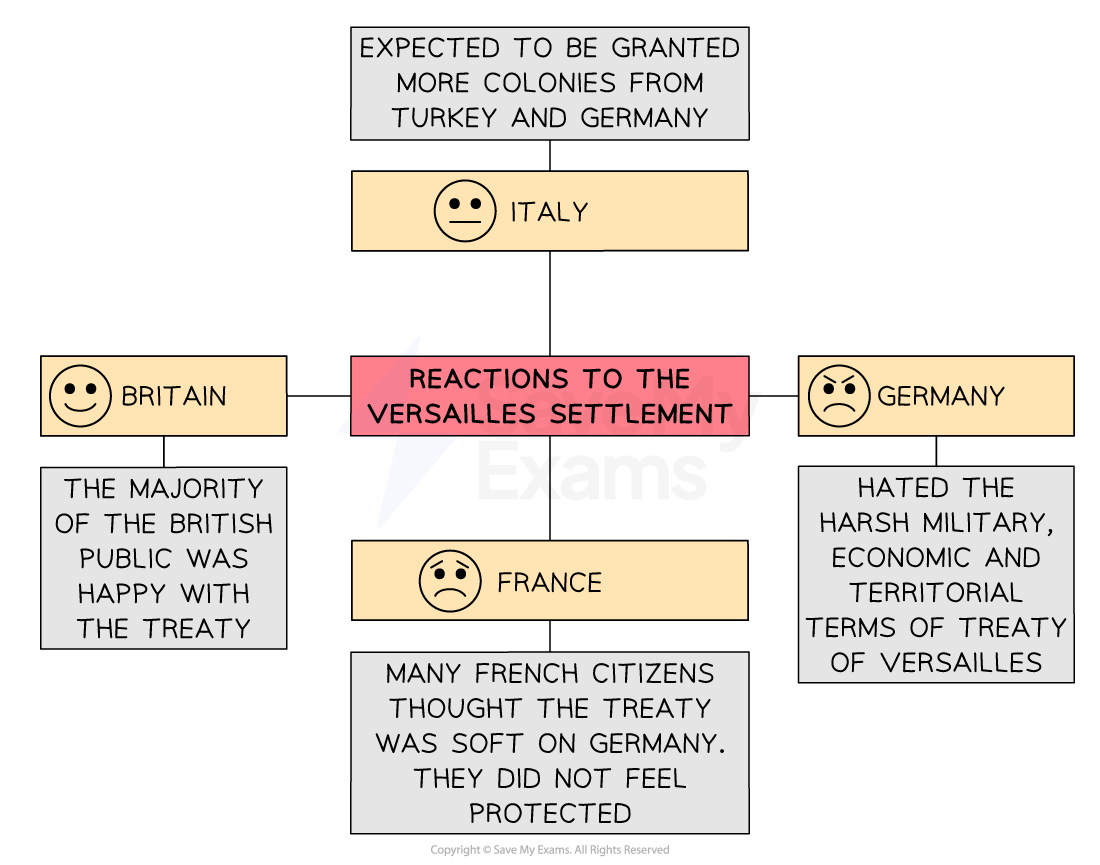
A concept map showing the initial reactions of European countries to the Versailles Settlement
-
By 1923, Europe’s reaction to the Treaty of Versailles began to change
-
In Britain, the public thought that the treaty was too harsh on Germany
- People began to fear the USSR **more than Germany
- Britain wanted a strong Germany to** defend Europe from communism
-
November Criminals and the 'Dolchstoss'
-
Many Germans argued that the Weimar Republic should not have signed the Treaty of Versailles
-
They believed that German politicians committed a ‘dolchstoss’ - or a ‘stab in the back’
-
The politicians who signed the Treaty of Versailles were called ‘November Criminals’. This was because November was the month the government signed the armistice
-
Many Germans felt humiliated and weaker than the rest of Europe
-
The Treaty of Versailles’ territorial terms increased nationalism in Germany
- The Polish Corridor **separated Germany **into two
- Around** 4 million Germans lived in the Sudetenland**, Czechoslovakia
-
The Rise of Hitler
-
The Treaty of Versailles had a devastating impact on Germany
-
Reparations *caused two economic depressions in a decade
-
The German government continued to follow the treaty’s terms
- This caused public resentment
-
Extremist *parties like the KPD and the NSDAP gained support
-
-
The government arrested Hitler after he attempted the Munich Putsch
- While in prison, Hitler wrote Mein Kampf (‘My Struggle’)
| **A key belief in Mein Kampf | Summary of the belief |
|---|---|
| The superiority of the Aryan **race | - Hitler believed the German race was the best in the world - He was against Germans marrying Jewish people as he stated this weakened the Aryan race |
| Lebensraum | - ‘Living space’ in German - A theory that Germany needed more territory so that the population could grow - Germany should expand into Eastern Europe to destroy communism |
| Revise the Treaty of Versailles | - Hitler wanted to** recover all of the land** that Germany lost in the treaty - Germany deserved a strong military. Hitler wanted to ignore the treaty and rearm |
| Grossdeutschland | - ‘Greater Germany’ in German - The idea that Germany should unite under one Reich (state) - All German speakers should live together. This included Anschluss with Austria |
-
Hitler believed that, when he gained power, it was right to break the Treaty of Versailles because:
-
Some of the terms had already been reversed
- For example, the Allies changed Germany’s reparations in the Dawes and Young plans
-
Other countries had not kept promises made at the Paris Peace Conference
-
The ‘Big Three’ agreed to the creation of the League of Nations
- The League aimed to encourage worldwide disarmament
- Countries like France refused to disarm
-
-
Hitler feared the power of the countries bordering Germany
- France had already invaded the Ruhr in 1923
- Germany had no air force and 100,000 soldiers. It could not defend itself
-
Hitler had public support
- In July 1932, the Nazi Party received 38% of the vote
- It became the biggest party in the Reichstag
-
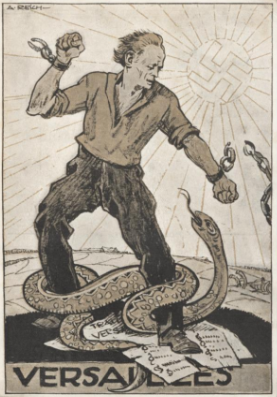
A Nazi postcard, date unknown. It shows a ripped version of the Treaty of Versailles. The sun contains a swastika, the symbol of the Nazi Party. Image courtesy of the University of Wisconsin–Madison
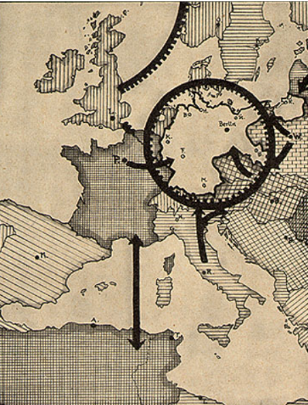
A map in a 1935 book titled Army, Navy and Air Force by Hans Riegler. The map’s caption stated: “With an insufficient military, Germany can be blockaded both by land and sea.”
Worked Example Describe the main aims of Hitler’s foreign policy
4 marks
Final answer: Answers:
Hitler wanted to create a Grossdeutchland (1). He wanted to incorporate all German speakers into Germany including through achieving Anschluss with Austria (1). He wanted to revise the terms of the Treaty of Versailles (1). He wanted to expand eastwards to achieve Lebensraum (1).
Exam Hint This style of question does not require you to explain your answer. The Cambridge IGCSE gives you a point for each relevant piece of information that you write. Therefore, do not spend any additional time trying to describe or explain each reason.
How did Hitler Break the Treaty of Versailles?
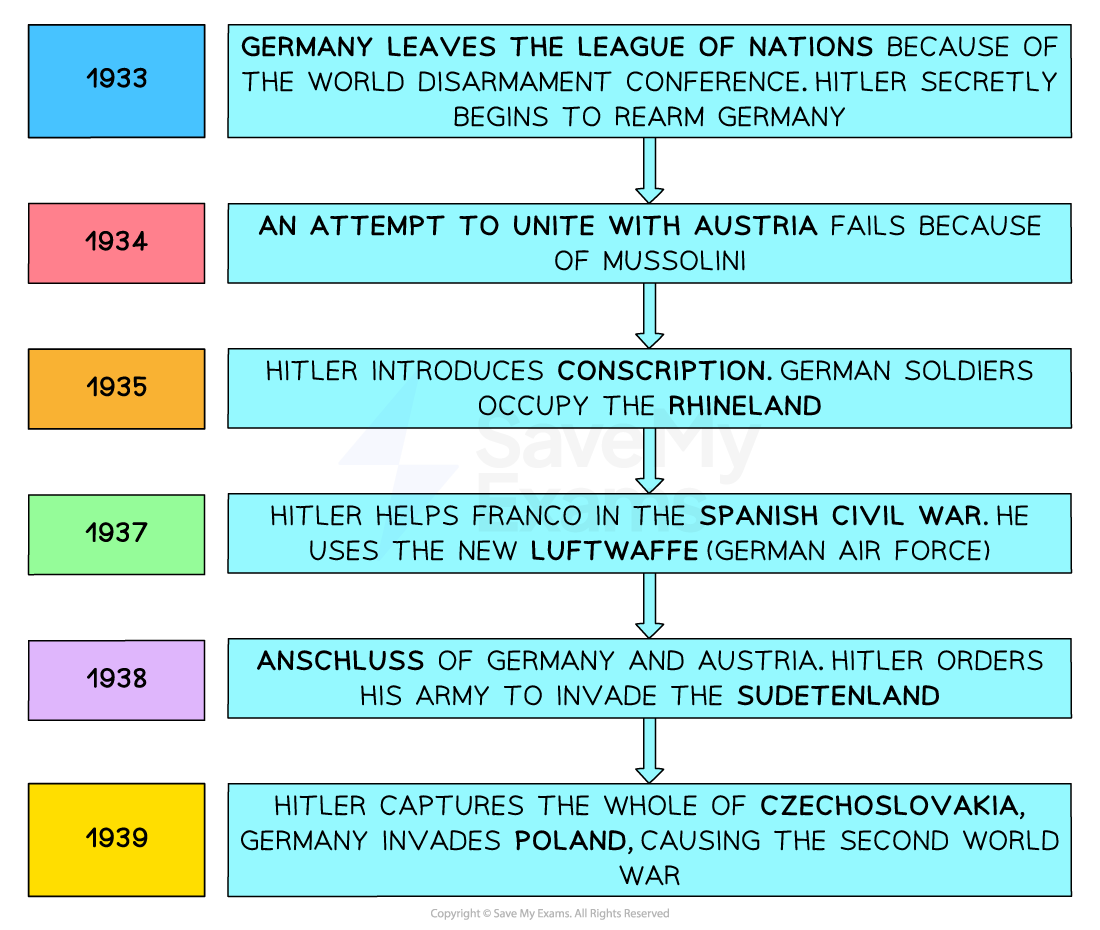
A flow diagram showing the steps that Hitler took to reverse the Treaty of Versailles
Worked Example Describe how Hitler broke the terms of the Treaty of Versailles
4 marks
Answers:
When Hitler became Chancellor in 1933, he broke many terms of the Treaty of Versailles. In 1933, he began to secretly rearm (1). In 1937, he tested out the Luftwaffe in the Spanish Civil War (1). In 1938, he successfully captured the Sudetenland (1). In 1939, he captured the whole of Czechoslovakia (1).
Exam Hint In four-mark questions, ensure each detail you select is as specific as possible. The worked example above provides dates for each of Hitler’s actions that broke the Treaty of Versailles.
Was this revision note helpful?