Slippery slopes
Excerpt: Students are presented with graphs of related (but unknown) functions and asked to determine the gradients of these graphs at certain points.
Problem
Here are the graphs of four functions. The equations of the graphs are
-
The -coordinates of , , and are all the same. What can you deduce about the gradients of the curves at , , and ?
-
The gradient of the tangent at is . What are the gradients of the tangents at , and ?
Here are the graphs of another four functions. The equations of these graphs are
-
The -coordinates of points , , and are , , and respectively. What can you deduce about these points?
-
The gradient of the tangent at is What are the gradients of the tangents at , and ?
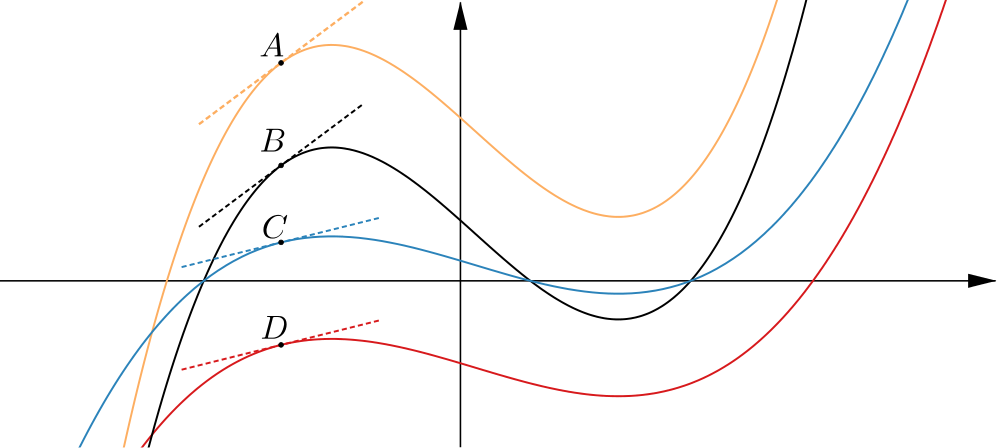

Solution
Which graph is which?
In order to sort out which curve is which, we can consider these questions.
-
Which graphs could be translations of each other?
-
Which graphs could be stretches of each other parallel to the -axis?
-
What do the slopes of the tangents at , , and tell us?
By answering these questions we can deduce that the graphs through and must be and respectively and the graphs through and must be and respectively.
Gradients of tangents
Since the graphs through and are translations of each other parallel to the -axis, and and have the same -coordinate, the tangent at is parallel to the tangent at Therefore the gradient of the tangent at is
We know the equations of the graphs, so we know that the values of the functions whose graphs pass through and are changing three times as rapidly as the values of the functions whose graphs pass through and Therefore the gradient of the tangents at and is .
Here are the graphs of another four functions. The equations of these graphs are
-
The -coordinates of points , , and are , , and respectively. What can we say about these points?
-
The gradient of the tangent at is What are the gradients of the tangents at , and ?
The transformations of these curves look a bit more complicated than those in the first set of functions, but we can use similar ideas to work out which curve is which and find the coordinates of points , , and .
Which graph is which?
From the equations we can see that and are translations of each other, so these must be the graphs through points and As is a translation of in the negative and directions, must be the graph through
Of the remaining equations, only involves a reflection of in the -axis. To use this information, let’s consider the behaviour of the functions shown as increases:
-
the functions shown by the graphs through and increase, then decrease, then increase again
-
the function shown by the graph through decreases, then increases, then decreases again.
Therefore the equation of the graph through is and the equation of the graph through is
We can also see that the local maximum of the graph through is higher than (and occurs to the right of) the local maximum of the graph through This gives us a different way to see that the equation of the graph though is
Relationship between points
We now know that lies on and has coordinates Since the -coordinate of is less than the -coordinate of , and the graph through is a translation of the graph through by parallel to the -axis, we know that and are corresponding points on the two graphs. Therefore the coordinates of are
Thinking about the transformations of that produce the other graphs, we can see that and are both points corresponding to under these transformations. Therefore the coordinates of are and the coordinates of are
Gradients of tangents
Since we know that and are corresponding points on translations of graphs, the tangent at must be parallel to the tangent at , i.e. the gradient of the tangent at is
The graph through is obtained from the graph through by a translation parallel to the -axis, followed by a stretch of scale factor parallel to the -axis. The translation doesn’t affect the gradient of the tangent, but the stretch means that the rate of change of the transformed function is three times the rate of change of the original function. Therefore the gradient of the tangent at is
Finally, to transform the graph through into the graph through , we can reflect in the -axis, stretch by scale factor parallel to the -axis, and then translate. The reflection and stretch mean that the rate of change of the transformed function is three times the rate of change of the original function, but this change is in the opposite direction, i.e. the transformed function decreases where the original function increases and vice versa. Therefore the gradient of the tangent at is
We have used the idea that when a graph is translated, the tangents at corresponding points have the same gradient. It is important to note that this is not the same as saying that translations do not affect gradient functions.
Can you think of an example where the translation doesn’t affect the gradient function, and an example where it does?