Can we maximise the volume of this metal tin?
Question
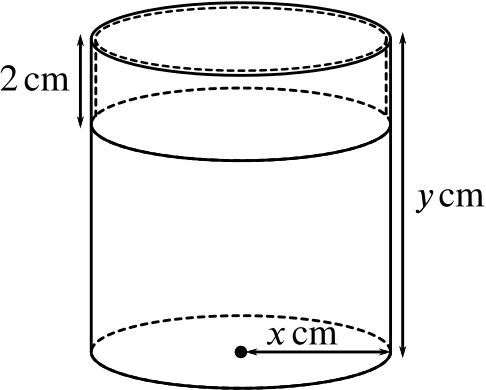
A cylindrical tin and its tight-fitting cylindrical lid (overlapping the tin by 2cm) are to be made from thin sheet metal. When made, the total area of sheet metal used is 350πcm2. The base radius of the tin is xcm and its height is ycm as shown in the diagram. Show that, neglecting the thickness of the metal, x2+xy+2x=175.
Deduce that the volume, Vcm3, of the tin is given by V=π(175x−2x2−x3).
If x may vary, find the values of x and y for which V has its maximum value.
Suggestion
Can you work out the surface area and volume of this tin and lid in terms of x and y? Now can you eliminate y?
Solution
We know that the surface area of the tin is
350πcm2
. In terms of
x
and
y
, the surface area of the tin is:
350π=area of base+area of side+area of side of lid+area of top of lid=πx2+2πxy+2πx×2+πx2=2πx2+2πxy+4πx,
and dividing through by
2π
we get
175=x2+xy+2x.
The volume of the tin is V=πx2y.
We can eliminate y by rearranging equation (1) to find that xy=175−x2−2x, and so V=πx2y=πx(xy)=πx(175−x2−2x)=π(175x−x3−2x2).
We differentiate V with respect to x, giving dxdV=π(175−3x2−4x)=0, so to find stationary points of V, we must solve 3x2+4x−175=0.
We can factorise this equation as (3x+25)(x−7)=0 (or use the quadratic formula).
Since x is the radius of the tin, it must be positive, so x=7.
We have that dx2d2V=π(−6x−4), which is negative when x is positive, so x=7 gives a local maximum for V.
Furthermore, as there are no other stationary points for V with x>0, this must give the maximum possible value for V for x≥0.
We need to find the corresponding y. We saw in the previous part that xy=175−x2−2x, so that 7y=175−49−14=112, and hence y=16.