When is the area of a face of this pyramid a minimum?
Question
A pyramid of given volume stands on a horizontal square base of edge , and its vertex is vertically above the centre of the base. Show that the area of a sloping triangular face is given by and prove that, as varies, is least when the face is equilateral.
Suggestion
What is the formula for the volume of a pyramid?
Sketch a square based pyramid and label its height . Can we now find the area of one of the triangular faces?
Can we create any right-angled triangles where we can use Pythagoras?
…and prove that, as varies, is least when the face is equilateral.
Is minimising the same as minimising ? How could we go about minimising ?
Where is the stationary point of
How do we know the stationary point we’ve found is a minimum?
Can we show that for this value of we have equilateral faces?
Solution
A pyramid of given volume stands on a horizontal square base of edge , and its vertex is vertically above the centre of the base. Show that the area of a sloping triangular face is given by
The volume of a square based pyramid is where is the area of the base and is the height.
Where does this formula come from?
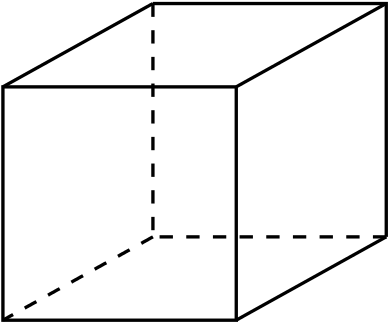
To see where this formula comes from (it holds for pyramids with any base, and cones too) consider a unit cube:
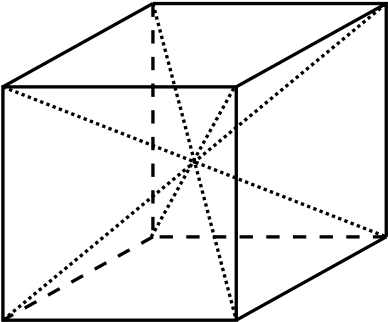
Now draw in the four diagonals from each of the pairs of opposite corners like this:
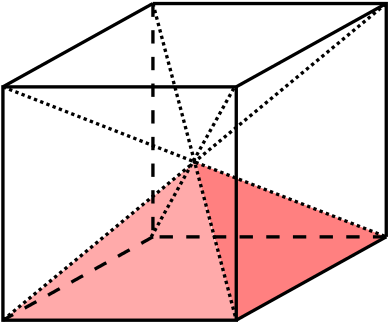
This makes six identical square based pyramids from each of the faces:
Each pyramid has a base of area one and is of height . Each one must also have a volume of , which is .
We can extend this for cubes of a different side length, and cuboids.
Our pyramid looks like this:
So we have
We need to find the area of a sloping triangular face (which will be the same for all four faces, since the vertex is directly above the centre of the base).
For this, we need the height of the face, which is related to and via which we can see from taking a vertical cross-section of the pyramid.
The area of the face is .
Therefore, as required.
…and prove that, as varies, is least when the face is equilateral.
We can say that has a turning point if and only if does, since we know is positive and is an increasing function for .
If you know the Chain Rule for differentiating, you might think about .
So considering we find stationary points when There will be two real roots of this equation, one negative (which doesn’t interest us) and one positive, so there is one stationary point in the region.
We know so if increases slightly from , then increases slightly from , (since is an increasing function for ), which tells us that the gradient of is positive. Similarly if decreases slightly from , the gradient is negative.
So our single stationary point for must be a local minimum, and we know that (and hence ) is minimized when .
Now , and so if , then , and .
So , and each face must be an equilateral triangle.