Character Sets (Cambridge International IGCSE Computer Science)
Spec point —
1.2.1· "1 Understand how and why a computer represents text and the use of character sets, including American standard code for information interchange (ASCII) and Unicode"
Character Sets
What is a character set?
-
A character set is all the characters and symbols that can be represented by a computer system
-
Each character is given a **unique **binary code
-
Character sets are ordered logically, the code for ‘B’ is one more than the code for ‘A’
-
A character set provides a standard for computers to communicate and send/receive information
-
Without a character set, one system might interpret 01000001 differently from another
-
The number of characters that can be represented is determined by the** number of bits used** by the character set
-
Two common character sets are:
- American Standard Code for Information Interchange (ASCII)
- Universal Character Encoding (UNICODE)
ASCII
Spec point —
1.2.1· "1 Understand how and why a computer represents text and the use of character sets, including American standard code for information interchange (ASCII) and Unicode"
ASCII
What is ASCII?
- ASCII is a character set and was an accepted standard for information interchange
- ASCII uses 7 bits, providing 27 unique codes (128) or a maximum of 128 characters it can represent
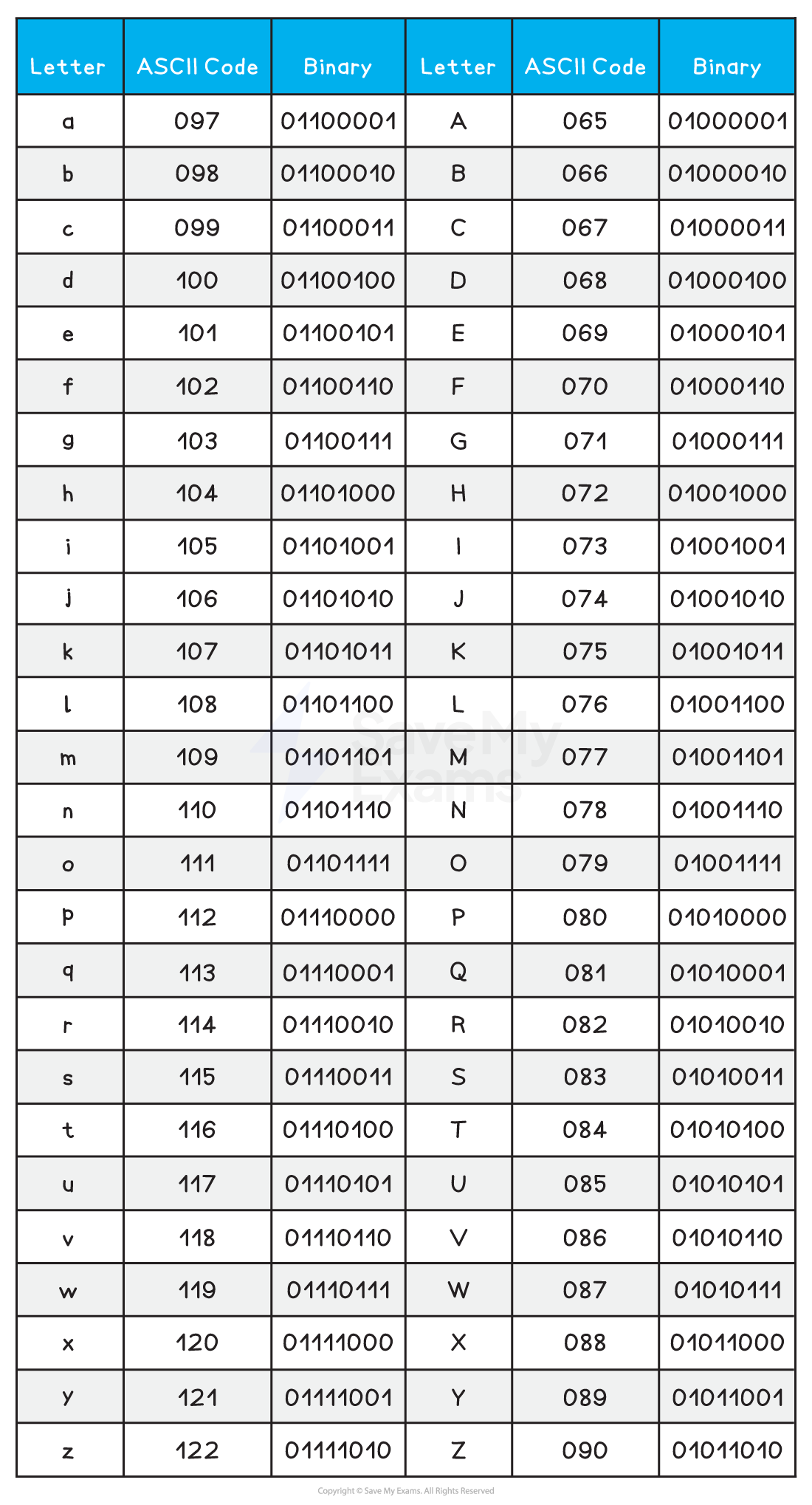
- ASCII only represents basic characters needed for English, limiting its use for other languages
Extended ASCII
- Extended ASCII uses 8 bits, providing 256 unique codes (28 = 256) or a maximum of 256 characters it can represent
- Extended ASCII provides essential characters such as mathematical operators and more recent symbols such as ©
Limitations of ASCII & extended ASCII
-
ASCII has a limited number of characters which means it can only represent the English alphabet, numbers and some special characters
- A, B, C, ………, Z
- a, b, c ,.............,z
- 0, 1, 2,........, 9
- !, @, #, …..
-
ASCII cannot represent characters from languages other than English
-
ASCII does not include modern symbols or emojis common in today's digital communication
UNICODE
Spec point —
1.2.1· "1 Understand how and why a computer represents text and the use of character sets, including American standard code for information interchange (ASCII) and Unicode"
UNICODE
What is UNICODE?
- UNICODE is a character set and was created as a solution to the limitations of ASCII
- UNICODE uses a minimum of 16 bits, providing 216 unique codes (65,536) or a minimum of 65,536 characters it can represent
- UNICODE can represent characters from all the major languages around the world
Exam Hint Exam questions often ask you to compare ASCII & UNICODE, for example the number of bits, number of characters and what they store
ASCII vs UNICODE
| ASCII | UNICODE | |
|---|---|---|
| Number of bits | 7-bits | 16-bits |
| Number of characters | 128 characters | 65,536 characters |
| Uses | Used to represent characters in the English language. | Used to represent characters across the world. |
| Benefits | It uses a lot less storage space than UNICODE. | It can represent more characters than ASCII. It can support all common characters across the world. It can represent special characters such as emoji's. |
| Drawbacks | It can only represent 128 characters. It cannot store special characters such as emoji's. | It uses a lot more storage space than ASCII. |
Worked Example The computer stores text using the ASCII character set.
Part of the ASCII character set is shown:
Character ASCII Denary Code E 69 F 70 G 71 H 72 (a)
Identify the character that will be represented by the ASCII denary code 76 [1]
(b)
Identify a second character set [1]
Answers
Final answer: (a) L (must be a capital)
Final answer: (b) UNICODE
Was this revision note helpful?
Build on this topic