Representing Images (Cambridge International IGCSE Computer Science)
Bitmap Images
Spec point —
1.2.3· "3 Understand how and why a computer represents an image, including the effects of the resolution and colour depth"
Bitmap Images
What is a bitmap?
- A bitmap image is made up of squares called pixels
- A pixel is the smallest element of a bitmap image
- Each pixel is stored as a binary code
- Binary codes are unique to the colour in each pixel
- A typical example of a bitmap image is a photograph
- The more colours and more detail in the image, the higher the quality of the image and the more binary that needs to be stored
Resolution & Colour Depth
Spec point —
1.2.3· "3 Understand how and why a computer represents an image, including the effects of the resolution and colour depth"
Resolution & Colour Depth
Exam Hint *Cambridge IGCSE 0478 expects you to define resolution and colour depth, explain how both affect file size, and use formulas like *
width × height × colour depthto calculate storage needs. This page keeps everything focused on exam-ready phrasing and examples.
What is resolution?
-
Resolution is the total number of pixels that make up a bitmap image
-
It is calculated by multiplying the image's width and height in pixels
-
In general, higher resolution means more detail and better image quality
-
Display resolution is often described by the vertical pixel count, for example:
-
Computer monitors: 1440p has 1440 pixels vertically (2560×1440), while 4K has 2160 pixels vertically (3840×2160)
- The "4K" name comes from its horizontal resolution of roughly 4,000 pixels
-
TVs: HD channels are 1080p (1080 pixels vertically), while UHD/4K channels are 2160p (2160 pixels vertically, or 3840×2160)
-
YouTube: the quality selector lets you choose playback resolution from 144p (144 pixels vertically) up to 4K (2160p)
-
What is colour depth?
- Colour depth is the number of bits stored per pixel in a bitmap image
- The colour depth is dependent on the number of colours needed in the image
- In general, the higher the colour depth the more detail in the image (higher quality)
- In a black & white image the colour depth would be 1, meaning 1 bit is enough to create a unique binary code for each colour in the image (1=white, 0=black)

- In an image with a colour depth of 2, you would have 00, 01, 10 & 11 available binary codes, so 4 colours

- As colour depth increases, so does the amount of colours available in an image
- The amount of colours can be calculated as 2n (n = colour depth)
| Colour Depth | Amount of Colours |
|---|---|
| 1 bit | 2 (B&W) |
| 2 bit | 4 |
| 4 bit | 16 |
| 8 bit | 256 |
| 24 bit | 16,777,216 (True Colour) |
What is the impact of resolution and colour depth?
- As the resolution and/or colour depth increases, the **bigger the size of the file **becomes on secondary storage
- The higher the resolution, the** more pixels** are in the image, the more bits are stored
- The higher the colour depth, the more bits per pixel are stored
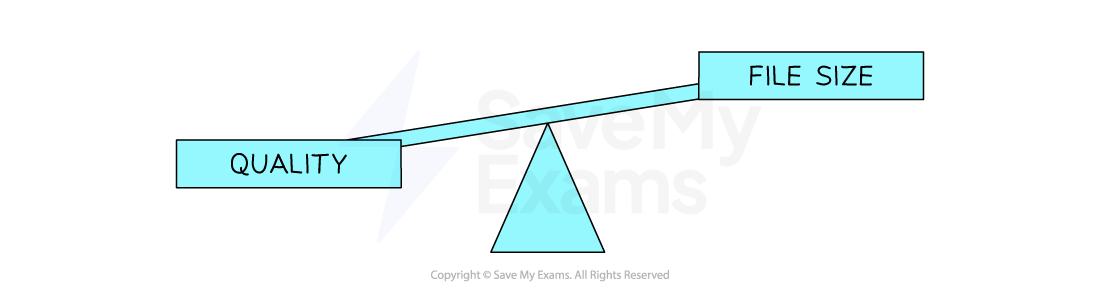
- Striking a balance between quality and file size is always a consideration
Exam Hint In casual use, people say "higher resolution = better quality". But in the exam, focus on what it actually means:
“Resolution is the number of pixels in an image”
Avoid vague terms like “better” and give technical impact: “more bits needed = larger file size.”
Worked Example
Define the term Pixel [1]
If an image has a colour depth of 2 bits, how many colours can the image represent? [1]
Describe the impact of changing an images resolution from 500x500 to 1000x1000 [2]
Answers
- The smallest element of a bitmap image (1 square)
- 4
- The image quality would be higher [1] the file size would be larger [1]
Was this revision note helpful?
Build on this topic