Locating Agents & Rf Values (Cambridge International IGCSE Chemistry)
Locating agents
Spec point —
12.2.2· Describe how paper chromatography is used to separate mixtures of soluble colourless substances, using a suitable solvent and a locating agent Knowledge of specific locating agents is not required
Locating agents
Extended tier only
-
For chromatography to be useful, the chemist needs to be able to see the components move up the paper
- This is not the case for colourless substances such as amino acids or sugars
-
Locating agents can be used to see the spots
- These are substances which react with the sample and produce a visible / coloured spot for the product(s)
-
The chromatogram is treated with the agent after the chromatography run has been carried out, making the sample runs visible to the naked eye
Retention factor (Rf) values
Spec point —
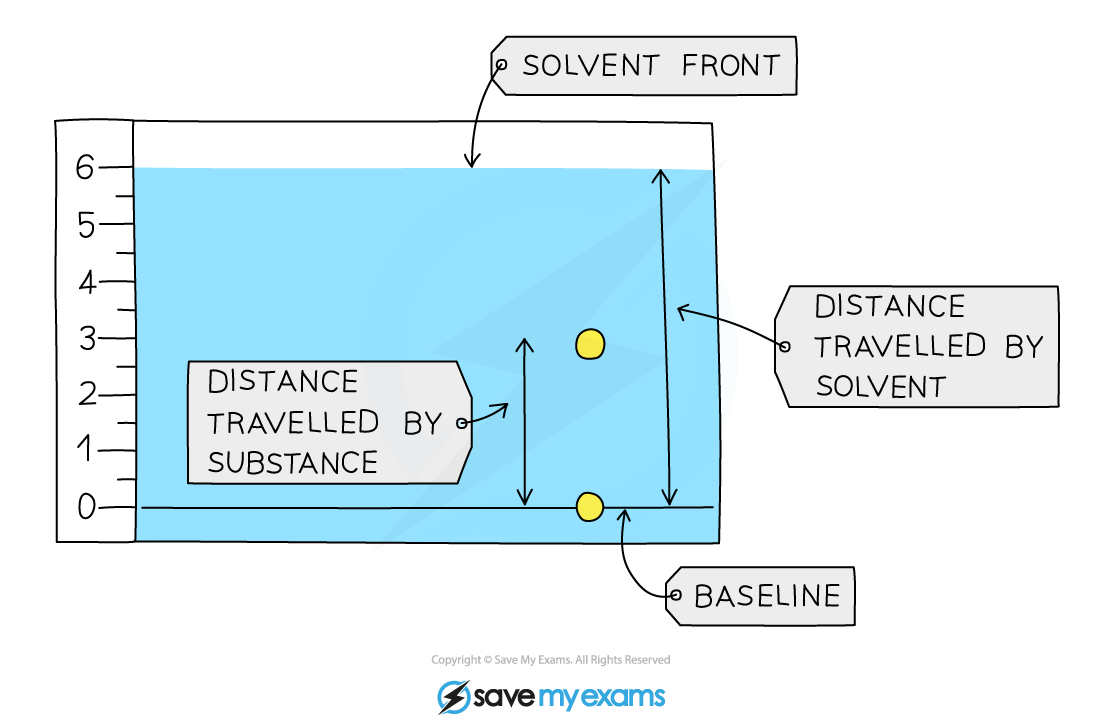
12.2.2· State and use the equation for Rf: Rf = distance travelled by substance/distance travelled by solvent
Extended tier only
-
Rf values are used to identify the components of mixtures
-
The Rf value of a particular compound is always the same
- However, it does depend on the solvent used
- If the solvent is changed then the Rf value changes
-
Calculating the Rf value allows chemists to identify unknown substances because it can be compared with the Rf values of known substances under the same conditions
-
The retention factor, Rf, is calculated by the equation:
Rf=
-
The Rf value:
- Is a ratio
- Has no units
- Will always be less than 1
Worked Example A student obtained the following chromatogram when carrying out chromatography.
Calculate the Rf value of the substance.
Answer:
The Rf value of the substances in the chromatogram above can be calculated by:
- Rf = = = 0.5
Exam Hint When you calculate Rf values in exams, make sure to use your ruler carefully to measure the distance moved by the solvent and the substance, or use any scale provided on the diagram.
Mark schemes can be strict about the values accepted, so it's important to be as accurate as possible when determining these distances.
Was this revision note helpful?
Build on this topic