Transition Elements (Cambridge International IGCSE Chemistry)
Spec point — Describe the transition elements as metals that: have high densities have high melting points form coloured compounds often act as catalysts as elements and in compounds
Transition elements
-
Transition elements are found in the centre of the Periodic Table between Group 2 and Group 3
-
Most metals are transition elements and have properties typical of a metal:
-
They are lustrous
-
They are hard and strong
-
They conduct heat and electricity
-
They have high melting points
- Except mercury: This has a low melting point which is why it is a liquid at room temperature
-
The transition elements in the Periodic Table
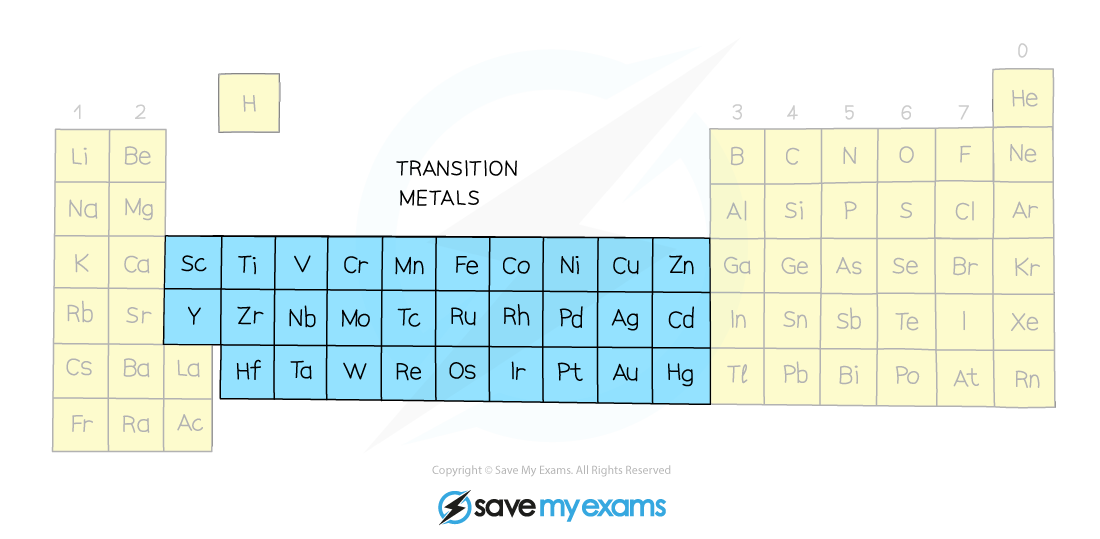
Transition elements are found in the middle of the Periodic Table
-
There are some properties that are only typical of transition elements :
-
They form ions with different charges
- E.g. Iron forms Fe2+ and Fe3+ ions
-
They are useful as catalysts
- E.g. Iron is used as the catalyst in the Haber process
-
-
They form coloured compounds
- E.g. Copper forms blue copper sulfate, black copper oxide and green copper carbonate
Coloured compounds formed by transition metal ions
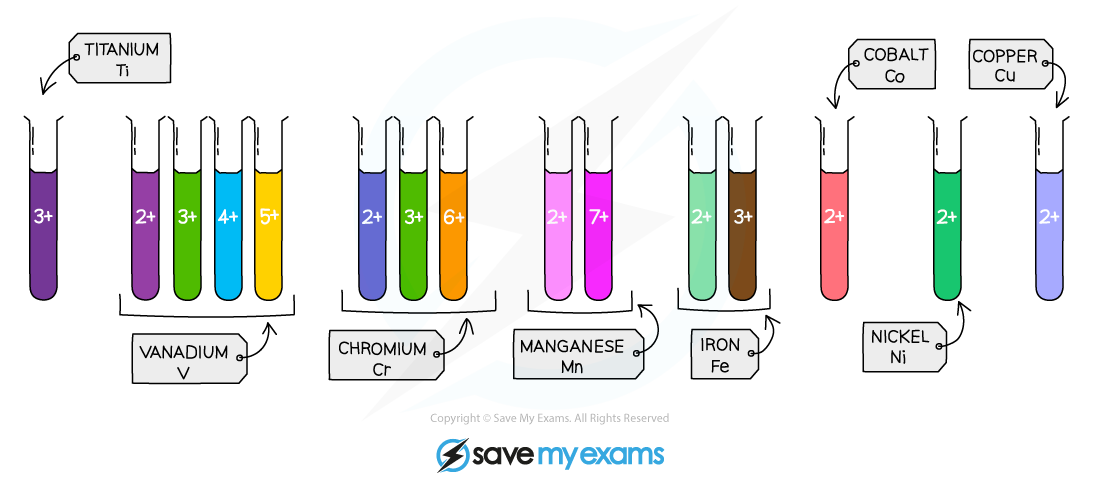
The colours produced by some transition elements ions
Exam Hint Although scandium and zinc are in the transition element area of the Periodic Table, they are not considered transition elements as they do not form coloured compounds and have only one oxidation state.
Transition elements oxidation numbers
Spec point —
8.4.2· Describe transition elements as having ions with variable oxidation numbers, including iron(II) and iron(III)
Extended tier only
-
The transition elements have more than one oxidation number, as they can lose a different number of electrons
-
For example. iron either:
- Lose two electrons to form Fe2+ so has an oxidation number of +2
- Loses three electrons to form Fe3+ so has an oxidation number of +3
-
Compounds containing transition elements in different oxidation states will have different properties and colours
Exam Hint Transition elements also referred to as transition metals.
Was this revision note helpful?
Build on this topic