11 markeasy
The diagram shows a burette and a measuring cylinder, both of which contain a liquid.
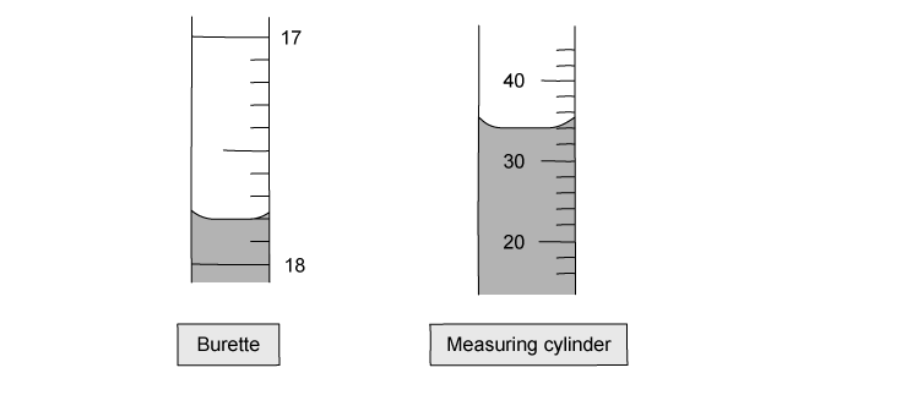
Which row shows the correct reading for both?
| Burette | Measuring cylinder | |
|---|---|---|
| A | 18.4 | 34 |
| B | 18.4 | 56 |
| C | 17.8 | 34 |
| D | 17.8 | 56 |
Choose your answer
17 questions · 17 marks · ≈ 17 min
The diagram shows a burette and a measuring cylinder, both of which contain a liquid.
Which row shows the correct reading for both?
| Burette | Measuring cylinder | |
|---|---|---|
| A | 18.4 | 34 |
| B | 18.4 | 56 |
| C | 17.8 | 34 |
| D | 17.8 | 56 |
Choose your answer
Measuring volumes of liquids is a fundamental aspect of experimental chemistry. The diagram shows three different pieces of apparatus used for this task.
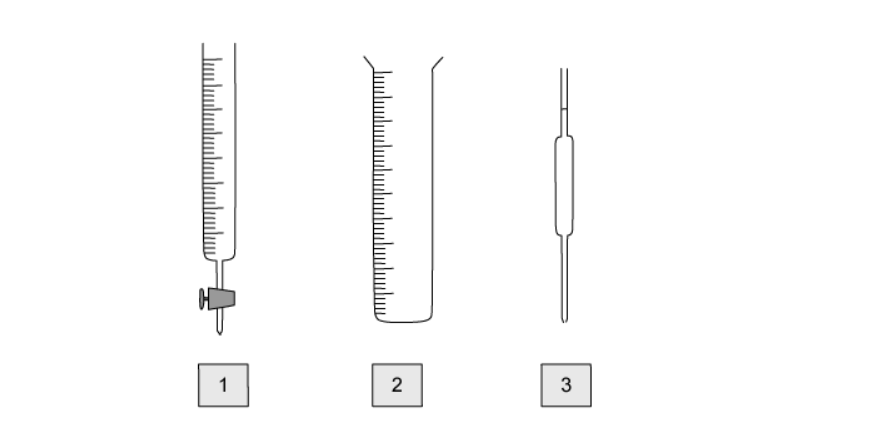
Which row is correct?
| 1 | 2 | 3 | |
|---|---|---|---|
| A | burette | measuring cylinder | pipette |
| B | burette | pipette | measuring cylinder |
| C | pipette | measuring cylinder | burette |
| D | measuring cylinder | burette | pipette |
Choose your answer
A student dissolved ammonium chloride in water when investigating energy changes in reactions.
Which terms best describes each substance?
| ammonium chloride | water | |
|---|---|---|
| A | solute | solvent |
| B | solvent | solution |
| C | solution | solvent |
| D | solute | solution |
Choose your answer
A student prepared crystals of copper sulfate from copper carbonate and sulfuric acid.
The student separated the excess copper carbonate from the solution using filtration.
What word describes the excess copper carbonate?
Choose your answer
Residue
Filtrate
Solvent
Solution
A student carries out a titration to determine the volume of hydrochloric acid needed to neutralise 25 cm3 of sodium hydroxide.
She measured 25 cm3 sodium hydroxide into a conical flask.
Which piece of equipment should she use to do this?
Choose your answer
Burette
Measuring cylinder
Beaker
Pipette
A student investigates the effect of temperature on the rate of reaction between large lumps of calcium carbonate and dilute acid. The student plots a graph of the loss in mass of the reaction mixture against time for different temperatures.
Which combination of apparatus are essential to record the measurements used to plot the graph?
Choose your answer
thermometer, balance and stop-watch
thermometer, gas syringe and stop-watch
balance, gas syringe and stop-watch
thermometer, inverted measuring cylinder and stop-watch
A student carries out a titration to determine the concentration of a dilute acid using a standard alkali.
Five actions in this acid-base titration are shown in the table.
| step | action |
|---|---|
| P | record the final burette reading after the end-point is reached |
| Q | transfer a measured volume of alkali into a conical flask using a volumetric pipette |
| R | add a few drops of a suitable indicator to the flask |
| S | note the initial burette reading before starting the titration |
| T | carefully run the acid from the burette into the flask while swirling until a permanent colour change occurs |
Choose your answer
Q → R → S → T → P
Q → S → T→ P→ R
S → T → P→ Q→ R
Q → R → T → S → P
A student wants to investigate the rate of reaction between marble chips and hydrochloric acid by measuring the volume of carbon dioxide produced with different concentrations of acid.
The equation for the reaction is as follows:
2 HCl + MgCO3 → MgCl2 + CO2 + H2O
Which of the following lists of equipment can she use to measure the volume of the gas produced?
Choose your answer
Gas syringe, cotton wool, bung, delivery tube
Gas syringe, conical flask, bung, delivery tube
Gas syringe, beaker, bung, balance
Balloon, conical flask, stopper, balance
The steps below are for an acid-base titration.
| 1 | Record the final volume of hydrochloric acid in the burette |
|---|---|
| 2 | Add hydrochloric acid from the burette into the conical flask until the indicator changes colour |
| 3 | Record the initial volume of hydrochloric acid in the burette |
| 4 | Add a fixed volume of sodium hydroxide to a conical flask using a pipette |
| 5 | Add indicator |
What is the correct order of these steps?
Choose your answer
3 → 4 → 2 → 5 → 1
4 → 3 → 2 → 1 → 5
4 → 5 → 3 → 2 → 1
5 → 3 → 2 → 1 → 4
A student is following the written procedure for an experiment. The instruction states:
'Quickly add 25 cm3 of sodium hydroxide'
Which piece of apparatus would be most suitable to use?
Choose your answer
Burette
Conical flask
Measuring cylinder
Volumetric pipette
W, X, Y and Z are pieces of laboratory apparatus.
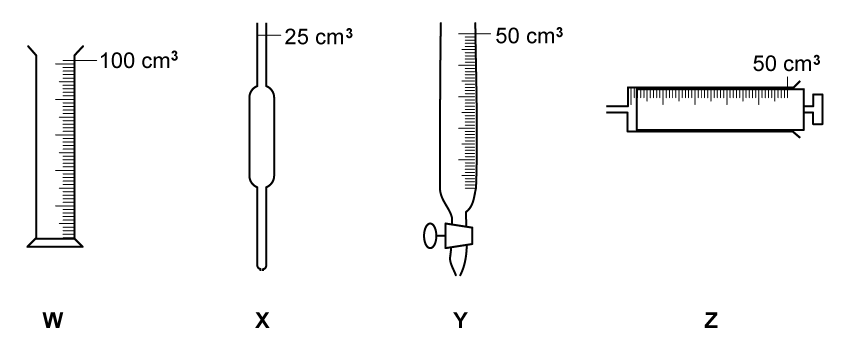
Which row describes the most appropriate use of the apparatus for the measurement taken?
| Apparatus | Measurement taken | |
|---|---|---|
| A | W | 0.5 cm3 of acid to add to marble chips in a rate of reaction investigation |
| B | X | 20 cm3 of sodium hydroxide for use in a titration |
| C | Y | 26.70 cm3 of hydrochloric acid added to sodium hydroxide in a titration |
| D | Z | 85 cm3 of gas given off in a rate of reaction investigation |
Choose your answer
A student decided to investigate the rate of reaction between marble chips and dilute hydrochloric acid at 35 oC.
She had access to the following apparatus:
W a balance
X a thermometer
Y a measuring cylinder
Z a stopwatch
Which pieces of apparatus did she use?
Choose your answer
X, Y and Z only
W, Y and Z only
W,X and Z only
W, X, Y and Z
A student prepared crystals of potassium(II) chloride by the following method.
| 1 | 25.0 cm3 of dilute hydrochloric acid was accurately measured into a conical flask using a measuring cylinder |
|---|---|
| 2 | Aqueous potassium hydroxide was added from a burette until the solution was neutral |
| 3 | The solution was evaporated and the crystals washed with approximately 20 cm3 of water measured using a pipette |
Which steps do not use the most appropriate piece of apparatus for the measurement taken?
Choose your answer
1, 2 and 3
1 and 2 only
1 and 3 only
2 and 3 only
A student prepared a solution of copper(II) sulfate by mixing dilute sulfuric acid with an excess of copper(II) oxide.
They filtered the mixture using the apparatus below.
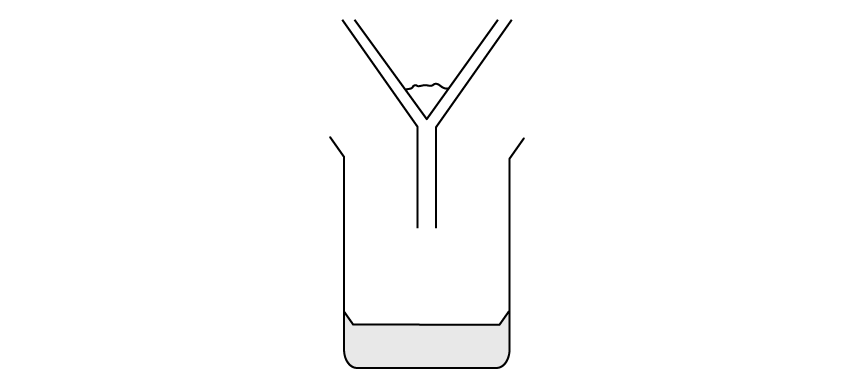
Which terms best describes each substance?
| Solvent | Solute | Filtrate | Residue | |
|---|---|---|---|---|
| A | water | copper(II) sulfate | copper(II) sulfate solution | copper(II) oxide |
| B | dilute hydrochloric acid | copper(II) oxide | water | copper(II) oxide |
| C | water | copper(II) sulfate solution | copper(II) oxide | copper(II) sulfate |
| D | copper(II) sulfate solution | water | dilute hydrochloric acid | water |
Choose your answer
A student performed a titration to find the volume of hydrochloric acid required to neutralise 25.0 cm3 of sodium hydroxide using the following method.
Another student suggested the following changes.
| 1 | Use a pipette to measure the sodium hydroxide |
|---|---|
| 2 | Use universal indicator as the indicator |
| 3 | Repeat the experiment until the results are concordant |
| 4 | Ensure that the initial volume of hydrochloric acid reads 0.00 cm3 on the burette |
Which suggestions would improve the experiment?
Choose your answer
1 and 2
1 and 3
2 and 3
3 and 4
A student titrated sodium carbonate solution against 25 cm3 of hydrochloric acid.
They used methyl orange as an indicator.
What is the colour changed observed at the end point?
Choose your answer
red to yellow
yellow to orange
yellow to red
red to orange
Why is it important to fill the space below the tap in a burette with acid or alkali before beginning a titration?
Choose your answer
To give a more accurate result
The burette's scale does not include this volume
To give concordant results
An incorrect volume would be recorded