16 marksmedium
The diagram shows two bottles of liquid oven cleaner.
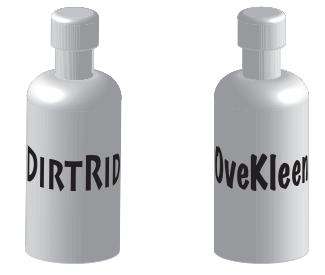
The oven cleaners contain sodium hydroxide solution. Plan an investigation to show which oven cleaner contains the highest concentration of sodium hydroxide.
16 questions · 177 marks · ≈ 3 hours
The diagram shows two bottles of liquid oven cleaner.
The oven cleaners contain sodium hydroxide solution. Plan an investigation to show which oven cleaner contains the highest concentration of sodium hydroxide.
The following paragraph was taken from a student’s notebook.
To make potassium chloride
25.0 cm3 of aqueous potassium hydroxide were placed in a flask and a few drops of indicator were added. Dilute hydrochloric acid was added to the flask until the indicator changed colour. The volume of acid used was 19.0 cm3.
What piece of apparatus should be used to measure the aqueous potassium hydroxide?
Extract:
To make potassium chloride. 25.0 cm^3 of aqueous potassium hydroxide were placed in a flask and a few drops of indicator were added. Dilute hydrochloric acid was added to the flask until the indicator changed colour. The volume of acid used was 19.0 cm^3.
i) Name a suitable indicator that could be used.
(1 mark)
ii) The indicator would change from ........................... to ................................
(2 marks)
Extract:
25.0 cm^3^ of aqueous potassium hydroxide were placed in a flask and a few drops of indicator were added. Dilute hydrochloric acid was added to the flask until the indicator changed colour. The volume of acid used was 19.0 cm^3^.
Which solution was more concentrated? Explain your answer.
Extract:
To make potassium chloride
25.0 cm^3^ of aqueous potassium hydroxide were placed in a flask and a few drops of indicator were added. Dilute hydrochloric acid was added to the flask until the indicator changed colour. The volume of acid used was 19.0 cm^3^.
How could pure crystals of potassium chloride be obtained from this experiment?
Sulfur dioxide gas is denser than air and soluble in water. A sample of sulfur dioxide can be prepared by adding dilute hydrochloric acid to sodium sulfite and warming the mixture. Study the diagram of the apparatus used.
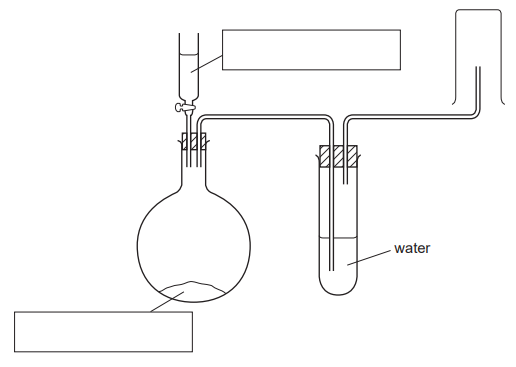
Fill in the boxes to show the chemicals used.
Extract:
Sulfur dioxide gas is denser than air and soluble in water. A sample of sulfur dioxide can be prepared by adding dilute hydrochloric acid to sodium sulfite and warming the mixture. Study the diagram of the apparatus used. Fill in the boxes to show the chemicals used.
Show by using an arrow, on the diagram, where heat is applied.
Extract:
Sulfur dioxide gas is denser than air and soluble in water. A sample of sulfur dioxide can be prepared by adding dilute hydrochloric acid to sodium sulfite and warming the mixture. Study the diagram of the apparatus used. 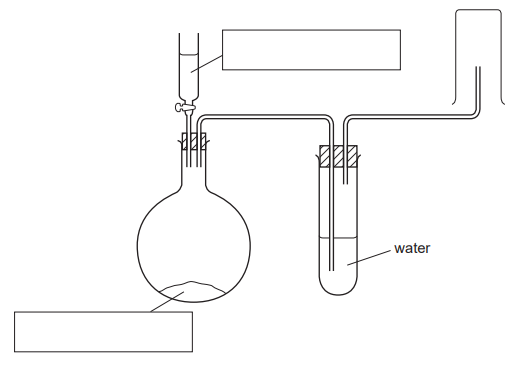 Fill in the boxes to show the chemicals used.
Identify two mistakes in the diagram.
Ammonia is produced when aqueous sodium hydroxide is warmed with ammonium sulfate. Ammonia is less dense than air and very soluble in water. The apparatus below was used to prepare a sample of dry ammonia gas.
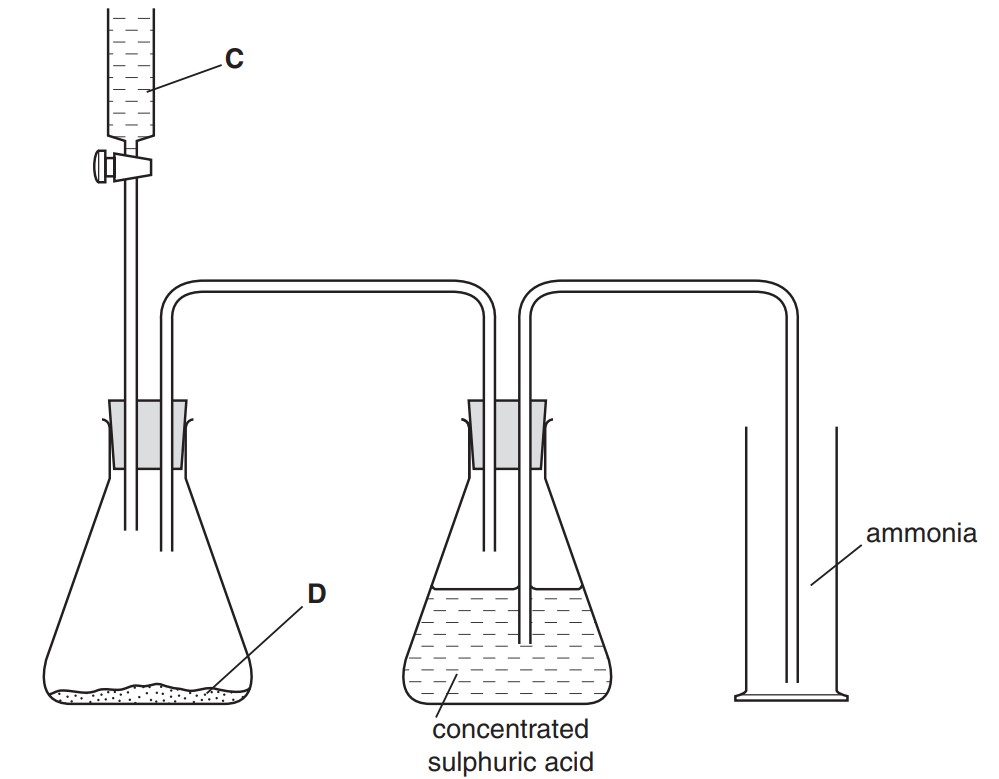
Name substance C.
Extract:
Ammonia is produced when aqueous sodium hydroxide is warmed with ammonium sulfate. Ammonia is less dense than air and very soluble in water. The apparatus below was used to prepare a sample of dry ammonia gas. [Chemistry setup with two Erlenmeyer flasks connected by tubing, one with concentrated sulphuric acid, the other with ammonia and labelled variables C and D.]
Name substance D.
Extract:
Ammonia is produced when aqueous sodium hydroxide is warmed with ammonium sulfate. Ammonia is less dense than air and very soluble in water. The apparatus below was used to prepare a sample of dry ammonia gas. [Chemistry setup with two Erlenmeyer flasks connected by tubing, one with concentrated sulphuric acid, the other with ammonia and labelled variables C and D.]
What necessary piece of equipment is missing in the diagram?
Extract:
Ammonia is produced when aqueous sodium hydroxide is warmed with ammonium sulfate. Ammonia is less dense than air and very soluble in water. The apparatus below was used to prepare a sample of dry ammonia gas. Chemistry setup with two Erlenmeyer flasks connected by tubing, one with concentrated sulphuric acid, the other with ammonia and labelled variables C and D.
Suggest why concentrated sulfuric acid should not be used to dry ammonia.
Extract:
Ammonia is produced when aqueous sodium hydroxide is warmed with ammonium sulfate. Ammonia is less dense than air and very soluble in water. The apparatus below was used to prepare a sample of dry ammonia gas.
![Chemistry setup with two Erlenmeyer flasks connected by tubing, one with concentrated sulphuric acid, the other with ammonia and labelled variables C and D.]
There are two other mistakes in the apparatus shown in the diagram. Identify and explain these mistakes.
mistake 1 .......................................................................................................... explanation ..........................................................................................................
mistake 2 .......................................................................................................... explanation ..........................................................................................................
A student investigated the reaction between aqueous sodium carbonate and two different solutions of dilute hydrochloric acid, A and B.
The reaction is:
Na2CO3 (aq) + 2HCl (aq) → 2NaCl (aq) + H2O (l) + CO2 (g)
Three experiments were carried out.
*Experiment 1 *
Using a measuring cylinder, 25 cm3 of aqueous sodium carbonate were poured into a conical flask.
Thymolphthalein indicator was added to the conical flask. A burette was filled up to the 0.0 cm3 mark with solution A. Dilute hydrochloric acid A was added to the flask, until the solution just changed colour. Use the burette diagram to record the reading in the table.
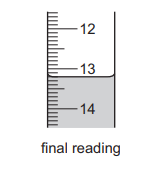
Experiment 2
Experiment 1 was repeated using methyl orange indicator instead of thymolphthalein.
Methyl orange is red-orange in acidic solutions and yellow in alkaline solutions. Use the burette diagrams to record the readings in the table and complete the table.
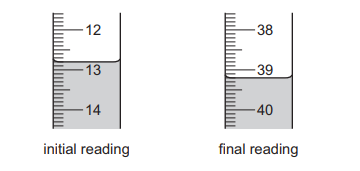
| experiment 1 | experiment 2 | |
|---|---|---|
| final burette reading / cm3 | ||
| initial burette reading / cm3 | ||
| difference / cm3 |
Extract:
A student investigated the reaction between aqueous sodium carbonate and two different solutions of dilute hydrochloric acid, A and B.
Experiment 2: Experiment 1 was repeated using methyl orange indicator instead of thymolphthalein. Methyl orange is red-orange in acidic solutions and yellow in alkaline solutions. Using a measuring cylinder, 25 cm^3 of aqueous sodium carbonate were poured into a conical flask, and the indicator was added.
What colour change was observed in the flask in experiment 2?
from .......................................... to ........................................
Extract:
A student investigated the reaction between aqueous sodium carbonate and two different solutions of dilute hydrochloric acid, A and B.
The reaction is: Na2CO3 (aq) + 2HCl (aq) → 2NaCl (aq) + H2O (l) + CO2 (g)
Experiment 1: Using a measuring cylinder, 25 cm3 of aqueous sodium carbonate were poured into a conical flask. Thymolphthalein indicator was added to the conical flask. A burette was filled up to the 0.0 cm3 mark with solution A. Dilute hydrochloric acid A was added to the flask, until the solution just changed colour.
Experiment 3
Experiment 1 was repeated using solution B of acid instead of solution A. Use the burette diagrams to record the readings in the table and complete the table.
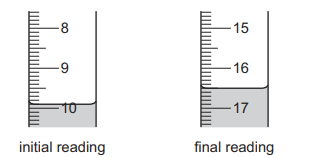
| experiment 3 | |
|---|---|
| final burette reading / cm3 | |
| initial burette reading / cm3 | |
| difference / cm3 |
Extract:
A student investigated the reaction between aqueous sodium carbonate and two different solutions of dilute hydrochloric acid, A and B. The reaction is: Na2CO3 (aq) + 2HCl (aq) → 2NaCl (aq) + H2O (l) + CO2 (g)
Suggest one observation, other than colour change, that is made when hydrochloric acid is added to sodium carbonate.
Extract:
A student investigated the reaction between aqueous sodium carbonate and two different solutions of dilute hydrochloric acid, A and B. Three experiments were carried out. Experiment 1: 25 cm^3 of aqueous sodium carbonate, thymolphthalein indicator, titrated with acid A - difference = 13.2 cm^3. Experiment 2: repeated with methyl orange indicator - difference = 26.4 cm^3. Experiment 3: repeated using solution B of acid instead of solution A - difference = 6.6 cm^3.
Complete the sentence below. Experiment .......... needed the largest volume of hydrochloric acid to change the colour of the indicator.
Extract:
Using a measuring cylinder, 25 cm^3 of aqueous sodium carbonate were poured into a conical flask.
What would be a more accurate method of measuring the volume of the aqueous sodium carbonate?
Extract:
A student investigated the reaction between aqueous sodium carbonate and two different solutions of dilute hydrochloric acid, A and B.
The reaction is:
Na2CO3 (aq) + 2HCl (aq) → 2NaCl (aq) + H2O (l) + CO2 (g)
Using a measuring cylinder, 25 cm3 of aqueous sodium carbonate were poured into a conical flask. Indicator was added to the conical flask. A burette was filled up to the 0.0 cm3 mark with the acid solution. Dilute hydrochloric acid was added to the flask, until the solution just changed colour.
What would be the effect on the results, if any, if the solutions of sodium carbonate were warmed before adding the hydrochloric acid? Give a reason for your answer.
effect on results ............................................................................................... reason ...............................................................................................
Extract:
A student investigated the reaction between aqueous sodium carbonate and two different solutions of dilute hydrochloric acid, A and B. Experiment 1 used 25 cm^3 of aqueous sodium carbonate with solution A; the volume of acid A added (difference) was 13.2 cm^3. Experiment 3 was Experiment 1 repeated using solution B instead of solution A; the volume of acid B added (difference) was 6.6 cm^3.
i) Determine the ratio of volumes of dilute hydrochloric acid used in experiments 1 and 3.
(1 mark)
ii) Use your answer to (h)(i) to deduce how the concentration of solution A differs from that of solution B.
(1 mark)
Extract:
A student investigated the reaction between aqueous sodium carbonate and two different solutions of dilute hydrochloric acid, A and B.
Suggest a different method, using standard laboratory chemicals, to determine which of the solutions of dilute hydrochloric acid, A or B, is more concentrated.
A student investigated the reaction between sodium thiosulfate and potassium iodate.
Two experiments were carried out.
Experiment 1
A burette was filled up to the 0.0 cm3 mark with sodium thiosulfate solution. By using a measuring cylinder, 20 cm3 of solution A of potassium iodate was placed into a conical flask. Dilute sulfuric acid and potassium iodide were also added to the flask. The flask was shaken to mix the contents and produce a red solution of iodine.
The sodium thiosulfate solution was added to the flask. When the contents of the flask were yellow, 1 cm3 of starch solution was added to the flask. Addition of sodium thiosulfate to the flask was continued until the solution turned colourless.
Use the burette diagram to record the final volume in the table and complete the column in the table of results.
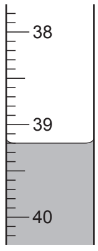
Experiment 2
Experiment 1 was repeated using a different solution of potassium iodate, solution B.
Use the burette diagrams to record the volumes and complete the table.
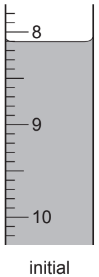 | 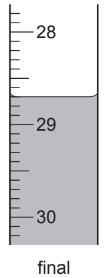 |
|---|
Burette readings / cm3
| Experiment 1 | Experiment 2 | |
|---|---|---|
| final reading | ||
| initial reading | 0.0 | 8.1 |
| difference |
Suggest why the starch was used.
Extract:
A student investigated the reaction between sodium thiosulfate and potassium iodate. Two experiments were carried out. Experiment 1: A burette was filled up to the 0.0 cm3 mark with sodium thiosulfate solution. 20 cm3 of solution A of potassium iodate was placed into a conical flask... Experiment 2 was Experiment 1 repeated using a different solution of potassium iodate, solution B.
Table of results (Burette readings / cm3): Experiment 1: final reading 39.2, initial reading 0.0, difference 39.2 Experiment 2: final reading 28.7, initial reading 8.1, difference 20.6
i) In which experiment was the greatest volume of sodium thiosulfate solution used?
(1 mark)
ii) Compare the volumes of sodium thiosulfate solution used in Experiments 1 and 2.
(1 mark)
iii) Suggest an explanation for the difference in the volumes.
(2 marks)
Extract:
Experiment 1 was repeated using a different solution of potassium iodate, solution B. By using a measuring cylinder, 20 cm^3 of solution of potassium iodate was placed into a conical flask. From the table of results, Experiment 2: initial reading 8.1, final reading 28.7, difference 20.6 cm^3 of sodium thiosulfate solution.
Predict the volume of sodium thiosulfate solution which would be needed to react completely with 10cm3 of solution B.
Extract:
A student investigated the reaction between sodium thiosulfate and potassium iodate. Two experiments were carried out. Experiment 1: A burette was filled up to the 0.0 cm^3 mark with sodium thiosulfate solution. By using a measuring cylinder, 20 cm^3 of solution A of potassium iodate was placed into a conical flask. Dilute sulfuric acid and potassium iodide were also added to the flask. The flask was shaken to mix the contents and produce a red solution of iodine. The sodium thiosulfate solution was added to the flask. When the contents of the flask were yellow, 1 cm^3 of starch solution was added to the flask. Addition of sodium thiosulfate to the flask was continued until the solution turned colourless. Experiment 2: Experiment 1 was repeated using a different solution of potassium iodate, solution B.
Explain one change that could be made to the experimental method to obtain more accurate results, without changing the apparatus.
change ....................................................................................................
explanation ....................................................................................................
A student reacted dry ammonia gas with hot copper(II) oxide.
The apparatus used is shown below.
The equation for the reaction is
2NH3 + 3CuO → 3Cu + N2 + 3H2O

Indicate with an arrow where the heat is applied.
Extract:
A student reacted dry ammonia gas with hot copper(II) oxide.
The equation for the reaction is
2NH3 + 3H+ 3CuO → 3Cu + N22O
The colour of the copper(II) oxide would change from ............................... to ...............................
Extract:
A student reacted dry ammonia gas with hot copper(II) oxide. The equation for the reaction is 2NH3 + 3CuO → 3Cu + N2 + 3H2O
Draw a labelled diagram to show how liquid water could be obtained from the water vapour produced.
Extract:
A student reacted dry ammonia gas with hot copper(II) oxide. The equation for the reaction is 2NH3 + 3H+ 3CuO → 3Cu + N22O
Suggest the effect of nitrogen on a lighted splint.
A student investigated the reaction between two different solutions of dilute hydrochloric acid, A and B, and solution C which is alkaline.
Two experiments were carried out
*Experiment 1 *
A burette was filled with solution A of dilute hydrochloric acid to the 0.0 cm3 mark. Using a measuring cylinder, 20 cm3 of solution C was poured into a conical flask. A few drops of methyl orange were added to the flask.
Solution A was added to the flask, with shaking, until the mixture just changed colour. Use the burette diagram to record the burette reading in the table and complete the table.
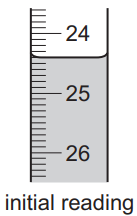
| burette readings | |
|---|---|
| final volume / cm3 | |
| initial volume / cm3 | |
| difference / cm3 |
Extract:
A student investigated the reaction between two different solutions of dilute hydrochloric acid, A and B, and solution C which is alkaline. Two experiments were carried out. Experiment 1: A burette was filled with solution A of dilute hydrochloric acid to the 0.0 cm^3 mark. Using a measuring cylinder, 20 cm^3 of solution C was poured into a conical flask. A few drops of methyl orange were added to the flask. Solution A was added to the flask, with shaking, until the mixture just changed colour.
*Experiment 2 *
The burette was emptied and rinsed, first with distilled water, and then with a little of solution B. The burette was filled with solution B of dilute hydrochloric acid to the 0.0 cm3 mark.
Experiment 1 was repeated using solution B.
Use the burette diagram to record the burette reading in the table and complete the table.
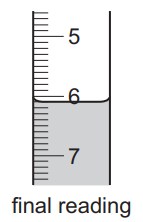
| burette readings | |
|---|---|
| final volume / cm3 | |
| initial volume / cm3 | |
| difference / cm3 |
Extract:
A student investigated the reaction between two different solutions of dilute hydrochloric acid, A and B, and solution C which is alkaline.
Experiment 1
A burette was filled with solution A of dilute hydrochloric acid to the 0.0 cm^3 mark. Using a measuring cylinder, 20 cm^3 of solution C was poured into a conical flask. A few drops of methyl orange were added to the flask.
Solution A was added to the flask, with shaking, until the mixture just changed colour.
i) What type of chemical reaction takes place when hydrochloric acid reacts with alkaline solutions?
(1 mark)
ii) Why is methyl orange added to the flask?
(1 mark)
Extract:
A student investigated the reaction between two different solutions of dilute hydrochloric acid, A and B, and solution C which is alkaline.
Experiment 1: A burette was filled with solution A of dilute hydrochloric acid to the 0.0 cm^3^ mark. Using a measuring cylinder, 20 cm^3^ of solution C was poured into a conical flask. A few drops of methyl orange were added to the flask. Solution A was added to the flask, with shaking, until the mixture just changed colour.
Experiment 2: The burette was emptied and rinsed, first with distilled water, and then with a little of solution B. The burette was filled with solution B of dilute hydrochloric acid to the 0.0 cm^3^ mark. Experiment 1 was repeated using solution B.
Why was the burette rinsed, first with distilled water and then with solution B, before starting Experiment 2?
Extract:
A student investigated the reaction between two different solutions of dilute hydrochloric acid, A and B, and solution C which is alkaline. Two experiments were carried out. Experiment 1: A burette was filled with solution A of dilute hydrochloric acid to the 0.0 cm^3 mark. Using a measuring cylinder, 20 cm^3 of solution C was poured into a conical flask. A few drops of methyl orange were added to the flask. Solution A was added to the flask, with shaking, until the mixture just changed colour. The difference (volume used) was 24.4 cm^3. Experiment 2: The burette was filled with solution B of dilute hydrochloric acid to the 0.0 cm^3 mark. Experiment 1 was repeated using solution B. The difference (volume used) was 6.1 cm^3.
i) In which experiment was the greater volume of dilute hydrochloric acid used?
(1 mark)
ii) Compare the volumes of dilute hydrochloric acid used in Experiments 1 and 2.
(1 mark)
iii) Suggest, in terms of the concentration of solutions A and B, an explanation for the difference in volumes used.
(2 marks)
Extract:
Experiment 1: Using a measuring cylinder, 20 cm^3 of solution C was poured into a conical flask. A few drops of methyl orange were added to the flask. Solution A was added to the flask, with shaking, until the mixture just changed colour.
Experiment 2: The burette was filled with solution B of dilute hydrochloric acid to the 0.0 cm^3 mark. Experiment 1 was repeated using solution B. The burette result (difference) was 6.1 / 6.10 cm^3.
If Experiment 2 was repeated using 10 cm3 of solution C, what volume of dilute hydrochloric acid would be used? Explain your answer.
Extract:
A student investigated the reaction between two different solutions of dilute hydrochloric acid, A and B, and solution C which is alkaline.
Experiment 1
A burette was filled with solution A of dilute hydrochloric acid to the 0.0 cm^3 mark. Using a measuring cylinder, 20 cm^3 of solution C was poured into a conical flask. A few drops of methyl orange were added to the flask.
Give one advantage and one disadvantage of using a measuring cylinder for solution C.
Extract:
A student investigated the reaction between two different solutions of dilute hydrochloric acid, A and B, and solution C which is alkaline.
Describe a method other than titration, using a different reactant, that could be used to compare the concentrations of the two solutions of dilute hydrochloric acid, A and B.
A student investigated the redox reaction between potassium iodate(V) and iodide ions.
Two experiments were carried out.
*Experiment 1 *
A burette was filled up to the 0.0 cm3 mark with the solution A of sodium thiosulphate. By using a measuring cylinder, a 10 cm3 sample of the solution B of potassium iodate(V) was added into a conical flask. A 10 cm3 sample of dilute sulfuric acid was added to the flask followed by 20 cm3 of aqueous potassium iodide.
Solution A was added slowly to the flask until there was a pale yellow colour in the contents of the flask. Starch solution was then added into the flask and the colour changed to blue black. Solution A was added to the flask until the colour just disappeared.
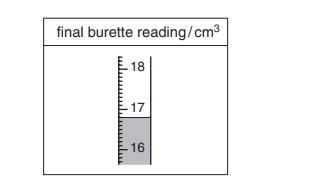
Experiment 2
Experiment 1 was repeated using solution C of potassium iodate(V) instead of solution B.
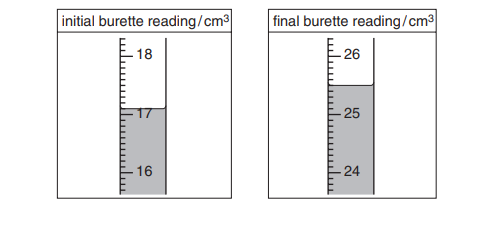
Use the burette diagrams for experiment 1 and 2 to record the volumes in the table and complete the table.
| Burette readings / cm3 | Experiment 1 | Experiment 2 |
|---|---|---|
| Final reading | ||
| Initial reading | 0.0 | |
| Difference |
Extract:
A student investigated the redox reaction between potassium iodate(V) and iodide ions. Two experiments were carried out. Experiment 1: A burette was filled up to the 0.0 cm^3 mark with the solution A of sodium thiosulphate... Solution A was added slowly to the flask until there was a pale yellow colour... Experiment 2: Experiment 1 was repeated using solution C of potassium iodate(V) instead of solution B.
The completed table is: | Burette readings / cm^3 | Experiment 1 | Experiment 2 | | Final reading | 16.8 | 25.5 | | Initial reading | 0.0 | 17.1 | | Difference | 16.8 | 8.4 |
The reaction of the mixture of potassium iodate(V), sulfuric acid and potassium iodide in the flask produces iodine. Sodium thiosulfate then reacts with the iodine.
i) In which Experiment was the greatest volume of aqueous sodium thiosulfate used?
(1 mark)
ii) Compare the volumes of sodium thiosulfate used in Experiments 1 and 2.
(1 mark)
A student investigated the reaction between aqueous sodium hydroxide and acid K.
Two experiments were carried out.
Experiment 1
Using a measuring cylinder, 25 cm3 of acid K was poured into a conical flask. Phenolphthalein indicator was added to the flask. A burette was filled with aqueous sodium hydroxide to the 0.0 cm3 mark. Aqueous sodium hydroxide was added from the burette to the flask and the mixture shaken until the solution showed a permanent colour change.
The final volume was measured. Use the burette diagram to record the final volume in the table and complete the table.
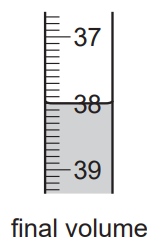
| burette readings | |
|---|---|
| final volume / cm3 | |
| initial volume / cm3 | |
| difference / cm3 |
Extract:
A student investigated the reaction between aqueous sodium hydroxide and acid K. Two experiments were carried out. Experiment 1: Using a measuring cylinder, 25 cm^3 of acid K was poured into a conical flask. Phenolphthalein indicator was added to the flask. A burette was filled with aqueous sodium hydroxide to the 0.0 cm^3 mark. Aqueous sodium hydroxide was added from the burette to the flask and the mixture shaken until the solution showed a permanent colour change.
Experiment 2
The solution was poured away and the conical flask rinsed.
Using a measuring cylinder, 50 cm3 of acid K was poured into the conical flask. 0.3 g of powdered calcium carbonate was added to the flask and the flask shaken until no further reaction was observed.
Phenolphthalein was added to the mixture in the flask.
A burette was filled with the same aqueous sodium hydroxide and the initial volume measured. Aqueous sodium hydroxide was added from the burette to the flask and the mixture shaken until the solution showed a permanent colour change.
Use the burette diagrams to record the initial and final volumes in the table and complete the table.
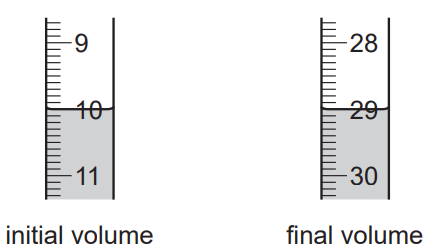
| burette readings | |
|---|---|
| final volume / cm3 | |
| initial volume / cm3 | |
| difference / cm3 |
Extract:
A student investigated the reaction between aqueous sodium hydroxide and acid K.
What type of chemical reaction occurred when acid K reacted with sodium hydroxide?
Extract:
Experiment 1: Using a measuring cylinder, 25 cm^3 of acid K was poured into a conical flask. Phenolphthalein indicator was added to the flask. A burette was filled with aqueous sodium hydroxide to the 0.0 cm^3 mark. Aqueous sodium hydroxide was added from the burette to the flask and the mixture shaken until the solution showed a permanent colour change. The final volume (difference) was 38.0 cm^3.
If Experiment 1 were repeated using 50 cm3 of acid K, what volume of sodium hydroxide would be required to change the colour of the indicator?
Extract:
Experiment 2: Using a measuring cylinder, 50 cm^3 of acid K was poured into the conical flask. 0.3 g of powdered calcium carbonate was added to the flask and the flask shaken until no further reaction was observed. Phenolphthalein was added to the mixture in the flask. A burette was filled with the same aqueous sodium hydroxide and the initial volume measured. Aqueous sodium hydroxide was added from the burette to the flask until the solution showed a permanent colour change. The burette readings: final volume 29.0 cm^3, initial volume 10.0 cm^3, difference 19.0 cm^3.
If Experiment 1 were repeated using 50 cm^3 of acid K, the volume of sodium hydroxide that would be required to change the colour of the indicator is 2 × volume for Experiment 1 from table / 76 cm^3.
i) What were the effects of adding 0.3 g of powdered calcium carbonate to acid K?
(2 marks)
ii) Use your answer in (d) to work out the difference between the volume of sodium hydroxide needed to completely react with 50 cm3 of acid K and the volume of sodium hydroxide used in Experiment 2.
(2 marks)
iii) Estimate the mass of calcium carbonate that would be needed to be added to 50 cm3 of acid K to require 0.0 cm3 of sodium hydroxide.
(1 mark)
Extract:
A student investigated the reaction between aqueous sodium hydroxide and acid K.
Experiment 1
Using a measuring cylinder, 25 cm^3^ of acid K was poured into a conical flask. Phenolphthalein indicator was added to the flask. A burette was filled with aqueous sodium hydroxide to the 0.0 cm^3^ mark. Aqueous sodium hydroxide was added from the burette to the flask and the mixture shaken until the solution showed a permanent colour change.
What would be the effect on the results if the solutions of acid K were warmed before adding the sodium hydroxide? Give a reason for your answer.
Extract:
Using a measuring cylinder, 25 cm^3^ of acid K was poured into a conical flask. Phenolphthalein indicator was added to the flask. A burette was filled with aqueous sodium hydroxide to the 0.0 cm^3^ mark. Aqueous sodium hydroxide was added from the burette to the flask and the mixture shaken until the solution showed a permanent colour change.
Suggest the advantage, if any, of
i) using a pipette to measure the volume of acid K.
(2 marks)
ii) using a polystyrene cup instead of a flask.
(2 marks)
A student investigated the reaction between two different solutions of deep purple potassium manganate(VII), A and B, and an acidic solution of hydrogen peroxide.
Three experiments were carried out.
Experiment 1
A burette was filled with the solution A of potassium manganate(VII) up to the 0.0 cm3 mark. Using a measuring cylinder, 25 cm3 of colourless hydrogen peroxide solution was poured into the conical flask.
The potassium manganate(VII) solution A was added slowly to the flask, and shaken to mix thoroughly. Addition of potassium manganate(VII) solution was continued until there was a permanent pink colour in the contents of the flask.
Use the burette diagram to record the volume in the table of results and complete the column.
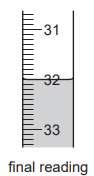
| experiment 1 | |
|---|---|
| final reading / cm3 | |
| initial reading / cm3 | |
| difference cm3 |
Extract:
A student investigated the reaction between two different solutions of deep purple potassium manganate(VII), A and B, and an acidic solution of hydrogen peroxide. Three experiments were carried out. Experiment 1: A burette was filled with the solution A of potassium manganate(VII) up to the 0.0 cm^3 mark. Using a measuring cylinder, 25 cm^3 of colourless hydrogen peroxide solution was poured into the conical flask. The potassium manganate(VII) solution A was added slowly to the flask, and shaken to mix thoroughly. Addition of potassium manganate(VII) solution was continued until there was a permanent pink colour in the contents of the flask.
*Experiment 2 *
Experiment 1 was repeated using the solution B of potassium manganate(VII) instead of solution A.
Use the burette diagrams to record the volumes in the table of results and complete the table.
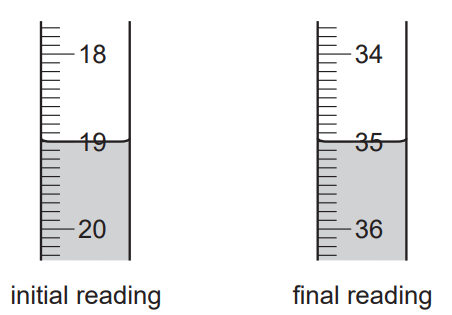
| experiment 2 | |
|---|---|
| final reading / cm3 | |
| initial reading / cm3 | |
| difference / cm3 |
Experiment 3 To a little of the hydrogen peroxide solution in a test-tube, manganese(IV) oxide was added. Rapid effervescence was observed and a glowing splint relit.
Identify the gas given off in Experiment 3.
Extract:
A student investigated the reaction between two different solutions of deep purple potassium manganate(VII), A and B, and an acidic solution of hydrogen peroxide.
A burette was filled with the solution A of potassium manganate(VII) up to the 0.0 cm^3 mark. Using a measuring cylinder, 25 cm^3 of colourless hydrogen peroxide solution was poured into the conical flask.
The potassium manganate(VII) solution A was added slowly to the flask, and shaken to mix thoroughly. Addition of potassium manganate(VII) solution was continued until there was a permanent pink colour in the contents of the flask.
i) What colour change was observed when potassium manganate(VII) solution was added to the flask?
from ..................................................... to .....................................................
(1 mark)
ii) Why was an indicator not added to the flask?
(1 mark)
Extract:
A student investigated the reaction between two different solutions of deep purple potassium manganate(VII), A and B, and an acidic solution of hydrogen peroxide. Experiment 1: A burette was filled with solution A of potassium manganate(VII) up to the 0.0 cm³ mark. 25 cm³ of colourless hydrogen peroxide solution was poured into the conical flask. Potassium manganate(VII) solution A was added until there was a permanent pink colour. Experiment 1 result: final reading 32.0, initial reading 0.0, difference 32.0 cm³. Experiment 2 was Experiment 1 repeated using solution B instead of solution A. Experiment 2 result: final reading 35.0, initial reading 19.0, difference 16.0 cm³.
i) In which experiment was the greatest volume of potassium manganate(VII) solution used?
(1 mark)
ii) Compare the volumes of potassium manganate(VII) used in Experiments 1 and 2.
(1 mark)
iii) Suggest an explanation for the difference in volumes.
(2 marks)
Extract:
Experiment 1: Using a measuring cylinder, 25 cm^3 of colourless hydrogen peroxide solution was poured into the conical flask. Experiment 2: Experiment 1 was repeated using the solution B of potassium manganate(VII) instead of solution A. difference / cm^3 = 16.0
If Experiment 2 was repeated using 12.5 cm3 of the hydrogen peroxide solution, what volume of potassium manganate(VII) solution would be needed to react completely? Explain your answer.
Extract:
A burette was filled with the solution A of potassium manganate(VII) up to the 0.0 cm^3^ mark. Using a measuring cylinder, 25 cm^3^ of colourless hydrogen peroxide solution was poured into the conical flask.
Give one advantage and one disadvantage of using a measuring cylinder for the hydrogen peroxide solution.
Look at the diagrams of common laboratory apparatus.
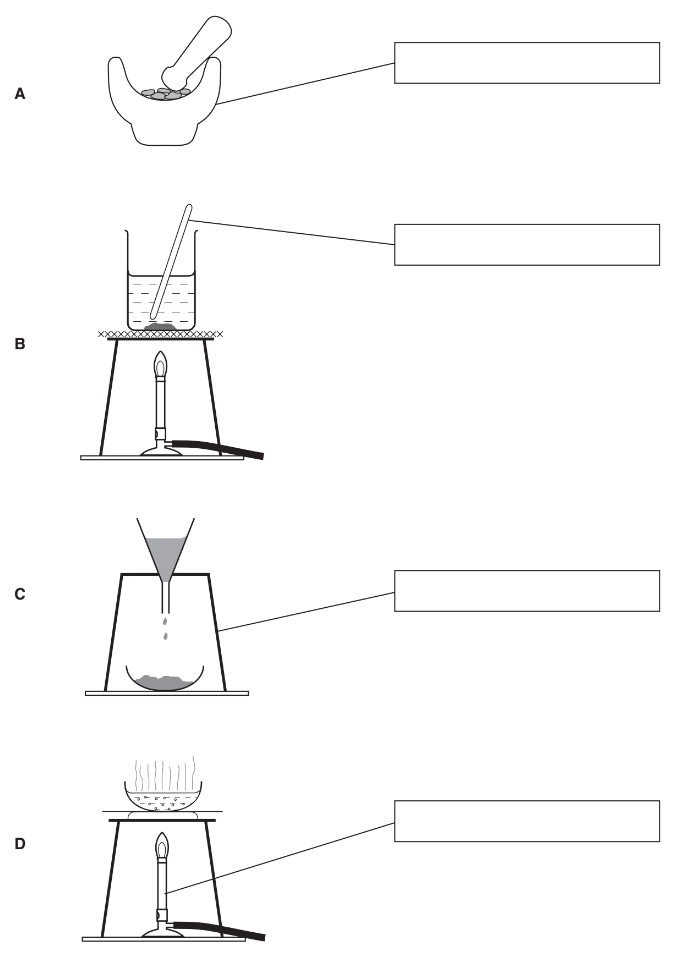
Complete the empty boxes to identify the pieces of apparatus labelled.
Extract:
Look at the diagrams of common laboratory apparatus. Complete the empty boxes to identify the pieces of apparatus labelled.
What name is given to the separation method in C?
Extract:
Look at the diagrams of common laboratory apparatus. Complete the empty boxes to identify the pieces of apparatus labelled. A = mortar; B = stirrer / stirring rod; C = tripod; D = Bunsen burner
Which apparatus would be most suitable to obtain crystals from an aqueous solution of copper(II) sulphate?
Hydrogen chloride gas is strong-smelling, denser than air and soluble in water. A sample of hydrogen chloride gas can be prepared by adding concentrated sulfuric acid to sodium chloride. Study the diagram of the apparatus used.
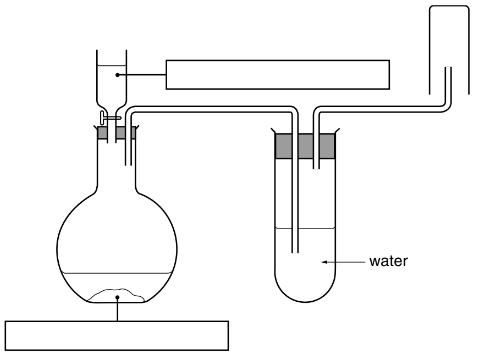
Fill in the boxes to show the chemicals used.
Extract:
Hydrogen chloride gas is strong-smelling, denser than air and soluble in water. A sample of hydrogen chloride gas can be prepared by adding concentrated sulfuric acid to sodium chloride. Study the diagram of the apparatus used.
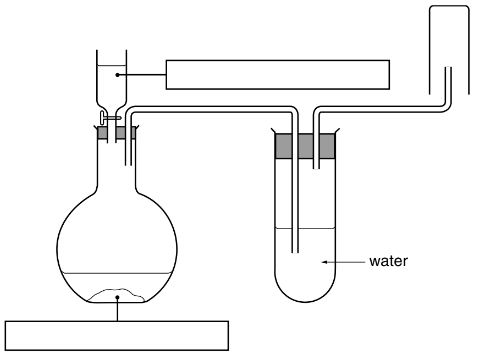
Identify and explain two mistakes in the diagram.
Mistake 1 ....................................................................................................
(2 marks)
Mistake 2 ....................................................................................................
(2 marks)
Extract:
Hydrogen chloride gas is strong-smelling, denser than air and soluble in water. A sample of hydrogen chloride gas can be prepared by adding concentrated sulfuric acid to sodium chloride.
State one precaution that should be taken when carrying out this experiment.
A student investigated an aqueous solution of calcium hydroxide and water.
Two experiments were carried out.
Experiment 1
By using a measuring cylinder 25 cm3 of the aqueous solution of calcium hydroxide was placed in a flask. Phenolphthalein indicator was added to the flask. A burette was filled to the 0.0cm3 mark with solution M of hydrochloric acid.
Solution M was added slowly to the flask until the colour just disappeared.
Use the burette diagram to record the volume in the table and complete the column.
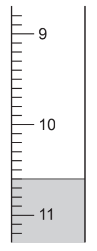
Experiment 2
Experiment 1 was repeated using a different solution, N, of hydrochloric acid.
Use the burette diagrams to record the volumes in the table and complete the table.
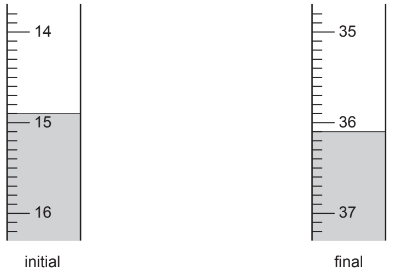
Table of results
| burette readings / cm3 | Experiment 1 | Experiment 2 |
|---|---|---|
| final reading | ||
| initial reading | 0.0 | |
| difference |
What type of chemical reaction occurs when hydrochloric acid reacts with calcium hydroxide?
Extract:
A student investigated an aqueous solution of calcium hydroxide and water. Two experiments were carried out. Experiment 1: By using a measuring cylinder 25 cm^3 of the aqueous solution of calcium hydroxide was placed in a flask. Phenolphthalein indicator was added to the flask. A burette was filled to the 0.0cm^3 mark with solution M of hydrochloric acid. Solution M was added slowly to the flask until the colour just disappeared. Experiment 2: Experiment 1 was repeated using a different solution, N, of hydrochloric acid.
The completed results table is: | burette readings / cm^3 | Experiment 1 | Experiment 2 | | final reading | 10.6 | 36.1 | | initial reading | 0.0 | 14.9 | | difference | 10.6 | 21.2 |
i) In which experiment was the greater volume of hydrochloric acid used?
(1 mark)
ii) Compare the volumes of acid used in Experiments 1 and 2.
(2 marks)
iii) Suggest an explanation for the difference in volumes.
(2 marks)
Extract:
Experiment 1: By using a measuring cylinder 25 cm^3^ of the aqueous solution of calcium hydroxide was placed in a flask. Phenolphthalein indicator was added to the flask. A burette was filled to the 0.0cm^3^ mark with solution M of hydrochloric acid. Solution M was added slowly to the flask until the colour just disappeared.
Completed results: Experiment 1 final reading 10.6, initial reading 0.0, difference 10.6 cm^3^.
Predict the volume of hydrochloric acid M that would be needed to react completely if Experiment 1 was repeated with 50cm3 of calcium hydroxide solution?
volume of solution ..................................................
explanation ....................................................................................................
Extract:
A student investigated an aqueous solution of calcium hydroxide and water. Two experiments were carried out. Experiment 1: By using a measuring cylinder 25 cm^3 of the aqueous solution of calcium hydroxide was placed in a flask. Phenolphthalein indicator was added to the flask. A burette was filled to the 0.0cm^3 mark with solution M of hydrochloric acid. Solution M was added slowly to the flask until the colour just disappeared.
Suggest one change you could make to the apparatus used in the experiments to obtain more accurate results.
A student tests two substances, solution C and solid D.
Tests on solution C
Solution C is aqueous potassium carbonate.
The student divides solution C into two approximately equal portions in two test-tubes. Record the expected observation.
To the first portion of solution C, about 10 cm3 of dilute hydrochloric acid is added.
Observation:
Extract:
A student tests two substances, solution C and solid D. Tests on solution C: Solution C is aqueous potassium carbonate. The student divides solution C into two approximately equal portions in two test-tubes.
The student does a flame test on the second portion of solution C.
i) State the expected colour of the flame.
(1 mark)
ii) Describe how to do a flame test.
(2 marks)
Tests on solid D
Table 3.1 shows the tests and the student's observations for solid D.
Table 3.1
| tests | observations |
|---|---|
| test 1 Do a flame test on solid D. | orange-red colour |
| test 2 The remaining solid D is dissolved in distilled water to form solution D. Solution D is divided into two portions. To the first portion of solution D, aqueous ammonia is added dropwise and then in excess. | very slight white precipitate |
| test 3 To the second portion of solution D, add about 1 cm3 of dilute nitric acid followed by a few drops of aqueous silver nitrate. | yellow precipitate |
Identify the two ions present in the solid
A student investigates the energy of reaction when different alcohols are burned. The alcohols belong to a homologous series.
The student uses the apparatus shown in Fig. 2.1
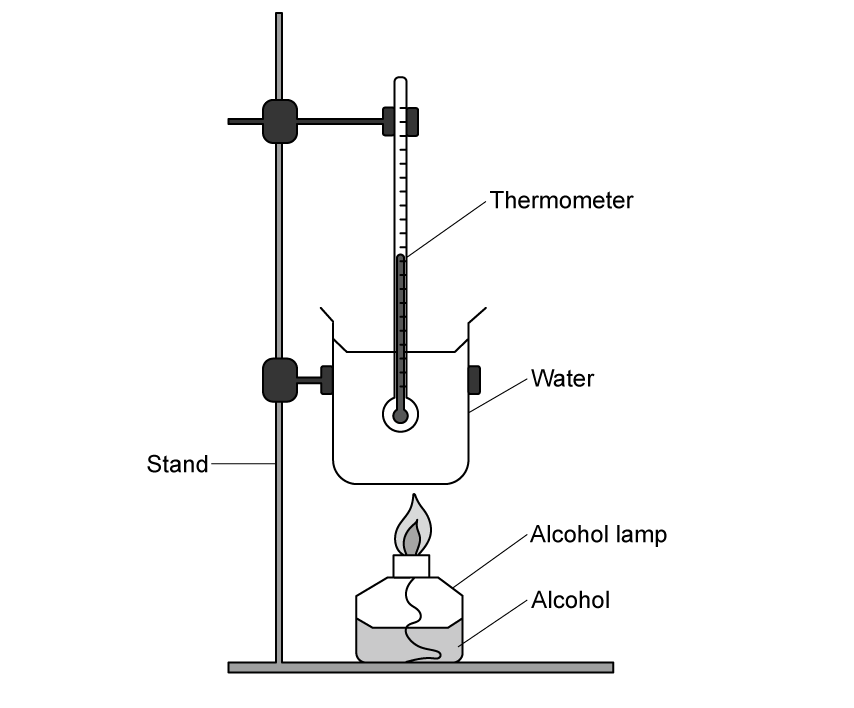
Fig 2.1
The student does five experiments.
Experiment 1
Experiment 2
Experiments 3, 4 and 5
Use the thermometer diagrams to complete Table 2.1.
| experiment | alcohol | number of Carbon Atoms | initial temperature / °C | final temperature / °C | temperature increase / °C |
|---|---|---|---|---|---|
| 1 | Methanol | 1 | 21.0 | 27.0 | 6.0 |
| 2 | Ethanol | 2 | |||
| 3 | Propanol | 3 | |||
| 4 | Butanol | 4 | |||
| 5 | Pentanol | 5 |
Experiment 1
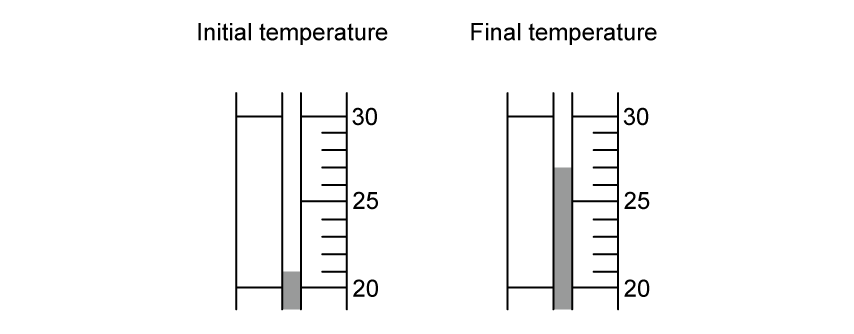
Experiment 2
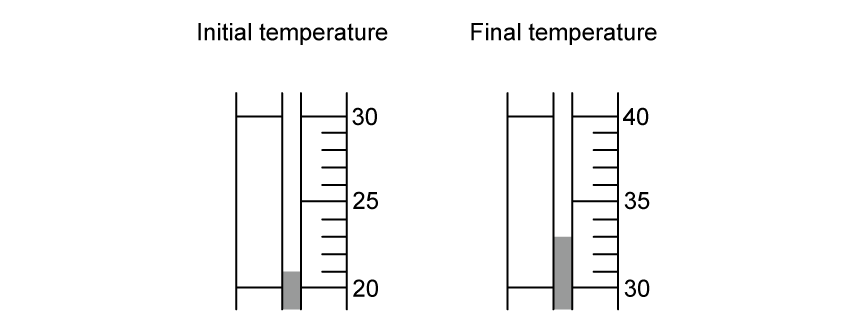
Experiment 3
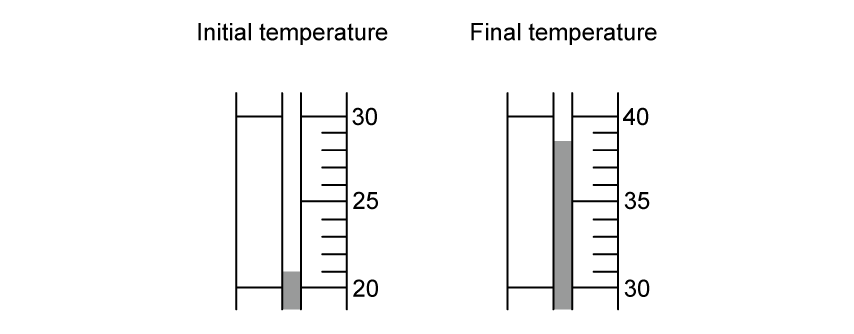
Experiment 4
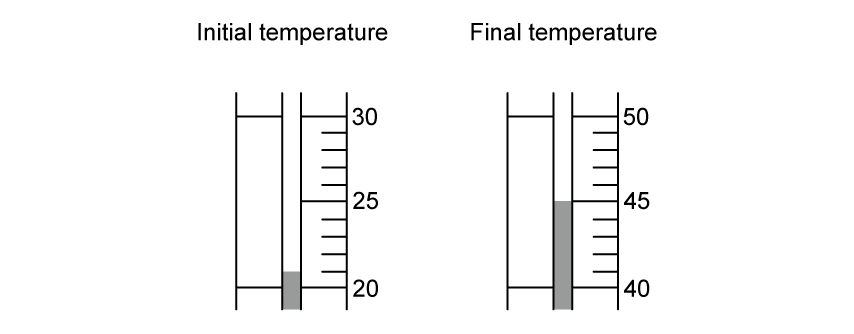
Experiment 5
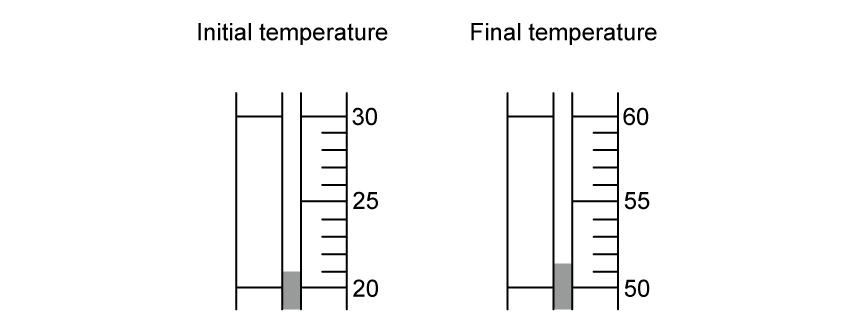
Extract:
| experiment | alcohol | number of Carbon Atoms | initial temperature / °C | final temperature / °C | temperature increase / °C | | 1 | Methanol | 1 | 21.0 | 27.0 | 6.0 | | 2 | Ethanol | 2 | 21.0 | 33.0 | 12.0 | | 3 | Propanol | 3 | 21.0 | 38.5 | 17.5 | | 4 | Butanol | 4 | 21.0 | 45.0 | 24.0 | | 5 | Pentanol | 5 | 21.0 | 51.5 | 30.5 |
The student wants to study the relationship between the number of carbon atoms in the alcohol molecule and the energy released.
Plot the results from Experiments 1 to 5 on the grid in Fig 2.2. The x-axis is provided. Add a suitable scale for the y-axis. Draw a line of best fit that extends through all the grid.
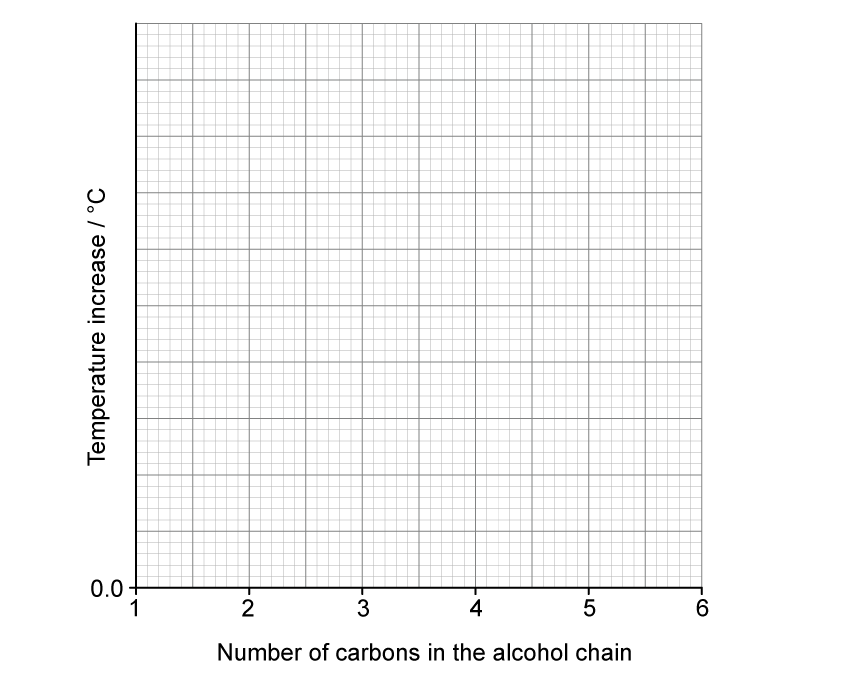
Fig 2.2
Extract:
The student investigates the energy of reaction when different alcohols are burned. Temperature increase data: Methanol (1 carbon): 6.0 °C Ethanol (2 carbons): 12.0 °C Propanol (3 carbons): 17.5 °C Butanol (4 carbons): 24.0 °C Pentanol (5 carbons): 30.5 °C
Plot the results from Experiments 1 to 5 on the grid in Fig 2.2. The x-axis is number of carbons in the alcohol chain (1 to 6), y-axis is temperature increase / °C. Draw a line of best fit that extends through all the grid.
Use your graph to deduce the temperature increase expected if hexanol (6 carbon atoms) is used. Show clearly on the graph how you worked out your answer.
............. °C
Extract:
Use your graph to deduce the temperature increase expected if hexanol (6 carbon atoms) is used. The expected temperature change for 6 carbon atoms would be 35.5 °C
Calculate the thermal energy, Q, absorbed by the water during the combustion of hexanol. Use your predicted temperature increase for hexanol from the graph in Fig 2.2.
where:
Include the unit for Q in your answer.
Extract:
A student investigates the energy of reaction when different alcohols are burned. The alcohols belong to a homologous series. Experiments 1-5 use methanol (1 carbon), ethanol (2), propanol (3), butanol (4), pentanol (5). Results table: | experiment | alcohol | number of Carbon Atoms | temperature increase / °C | | 1 | Methanol | 1 | 6.0 | | 2 | Ethanol | 2 | 12.0 | | 3 | Propanol | 3 | 17.5 | | 4 | Butanol | 4 | 24.0 | | 5 | Pentanol | 5 | 30.5 |
Describe the relationship between the number of carbon atoms in the alcohol molecule and the temperature change of the water.
Extract:
A student investigates the energy of reaction when different alcohols are burned. The alcohols belong to a homologous series. The student does five experiments. Experiment 1: Using a measuring cylinder, 10 cm^3 of methanol, CH3OH, is placed into the spirit burner. 100 cm^3 of water is poured into a 250 cm^3 beaker. The initial temperature of the water is recorded. The wick is lit and the alcohol is allowed to burn until it is all used up. The final temperature of the water is recorded. Experiment 1 is repeated using ethanol, propanol, butanol and pentanol.
Explain why the volume of alcohol used must be kept constant in all five experiments.
Extract:
A student investigates the energy of reaction when different alcohols are burned. Experiment 1: Using a measuring cylinder, 10 cm^3 of methanol, CH3OH, is placed into the spirit burner. 100 cm^3 of water is poured into a 250 cm^3 beaker. The initial temperature of the water is recorded. The wick is lit and the alcohol is allowed to burn until it is all used up. The final temperature of the water is recorded.
The student repeats the experiment but uses a pipette rather than a measuring cylinder to measure the volume of alcohol. Suggest how this change affects the accuracy of the results. Explain your answer.
Extract:
A student investigates the energy of reaction when different alcohols are burned. The alcohols belong to a homologous series. The student uses the apparatus shown in Fig. 2.1 (Clamp stand holding a thermometer vertically. The thermometer bulb is immersed in water inside a beaker. An alcohol lamp containing alcohol is placed beneath the beaker to heat the water.) Using a measuring cylinder, 10 cm^3 of methanol, CH3OH, is placed into the spirit burner. 100 cm^3 of water is poured into a 250 cm^3 beaker. The initial temperature of the water is recorded. The wick is lit and the alcohol is allowed to burn until it is all used up. The final temperature of the water is recorded.
The student’s calculated value for the energy released was much lower than the theoretical value found in a data book.
Suggest two reasons for this difference, other than student error in reading the thermometer.