How Vaccines Work (Cambridge International AS Biology)
Spec point —
11.2.5· explain that vaccines contain antigens that stimulate immune responses to provide long-term immunity
How vaccines work
-
A vaccine is a suspension of antigens that are intentionally put into the body to induce artificial active immunity
- A specific immune response where antibodies are released by plasma cells
-
There are two main types of vaccines:
- Live attenuated*
- Inactivated
-
Vaccines are administered either by injection or orally (by mouth)
- When a person is given a vaccine they have been given a vaccination(they are said to have been vaccinated)
-
Vaccinations given by injection are usually into a muscle or under the skin
-
Vaccinations produce long-term immunity as they cause memory cells to be created
- The immune system remembers the antigen when reencountered and produces antibodies to it, in what is a faster, stronger secondary response
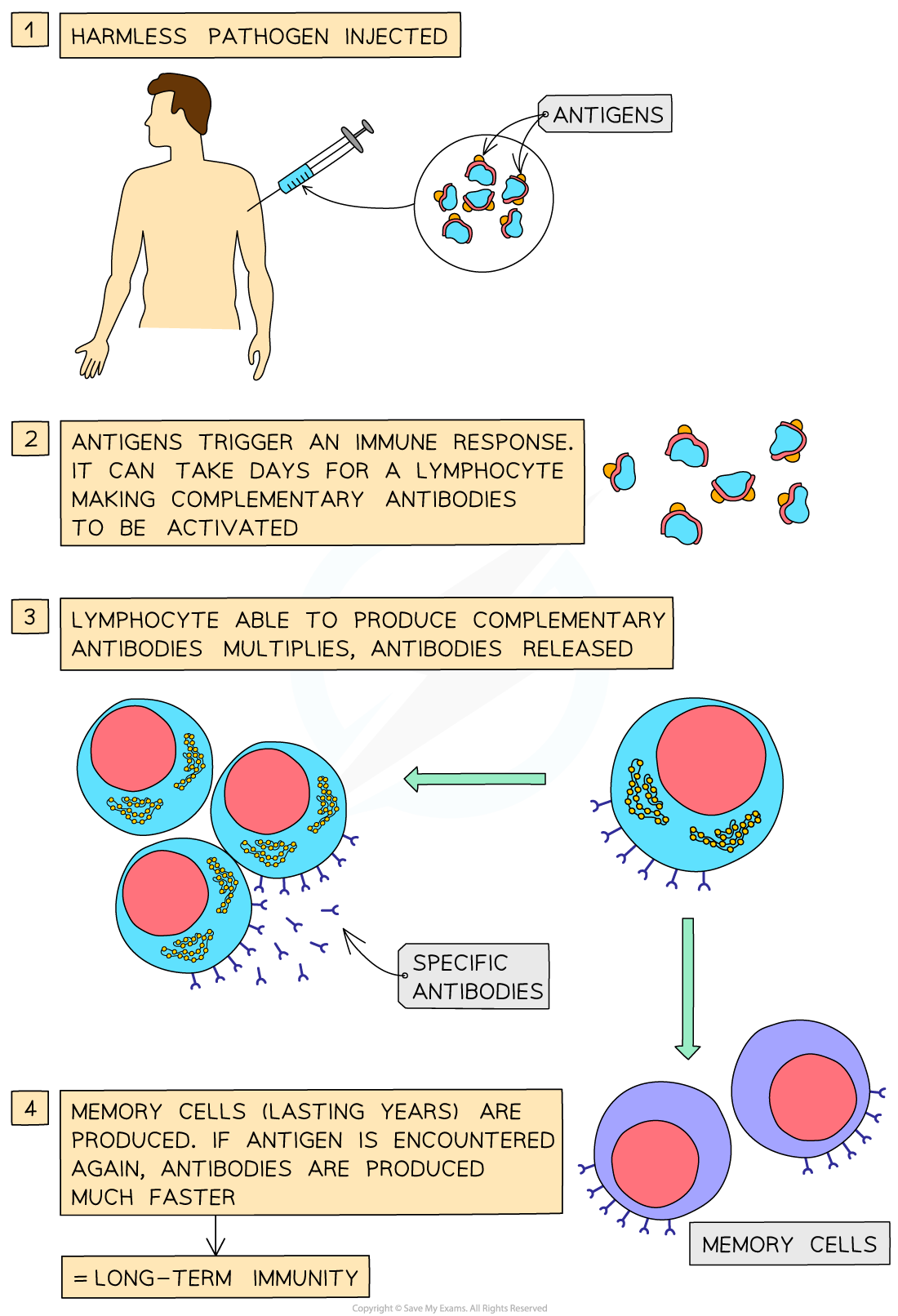
The process of vaccination and development of long term immunity
Live attenuated vaccines
-
Live attenuated vaccines contain whole pathogens(e.g. bacteria and viruses) that have been ‘weakened’
- These weakened pathogens multiply slowly allowing for the body to recognise the antigens
- They trigger the primary immune response (plasma cells to produce antibodies)
- These vaccines tend to produce a stronger and longer-lasting immune response
Inactivated vaccines
-
Inactivated vaccines contain whole pathogens that have been killed (‘whole killed’) or small parts (‘subunit’) of the pathogens (e.g. proteins or sugars or harmless forms of the toxins – toxoids)
-
As inactivated vaccines do not contain living pathogens they cannot cause disease, even for those with weak immune systems
-
However these vaccines do not trigger a strong or long-lasting immune response like the live attenuated vaccines
- Repeated doses and / or booster doses are often required
-
Exam Hint Remember vaccines trigger the primary immune response (T-helper cells trigger plasma cells to secrete specific antibodies), which leads to the production of memory cells. This will give a faster and greater response (a higher concentration of antibodies in a shorter period of time) during the secondary response.
Was this revision note helpful?
Build on this topic