Biological Molecules: Key Terms (Cambridge International AS Biology)
The Two Forms of Glucose
Spec point —
2.2.1· describe and draw the ring forms of α-glucose and β-glucose
-
The most well-known carbohydrate monomer is glucose
-
Glucose has the molecular formula C6H12O6
-
Glucose is the most common monosaccharide and is of central importance to most forms of life
-
There are different types of monosaccharide formed from molecules with varying numbers of carbon atom, for example:
- Trioses (3C) e.g. glyceraldehyde
- Pentoses (5C) e.g. ribose
- Hexoses (6C) e.g. glucose
-
Glucose exists in two structurally different forms – alpha (α) glucose and beta (β) glucose and is therefore known as an isomer
- This structural variety results in different functions between carbohydrates
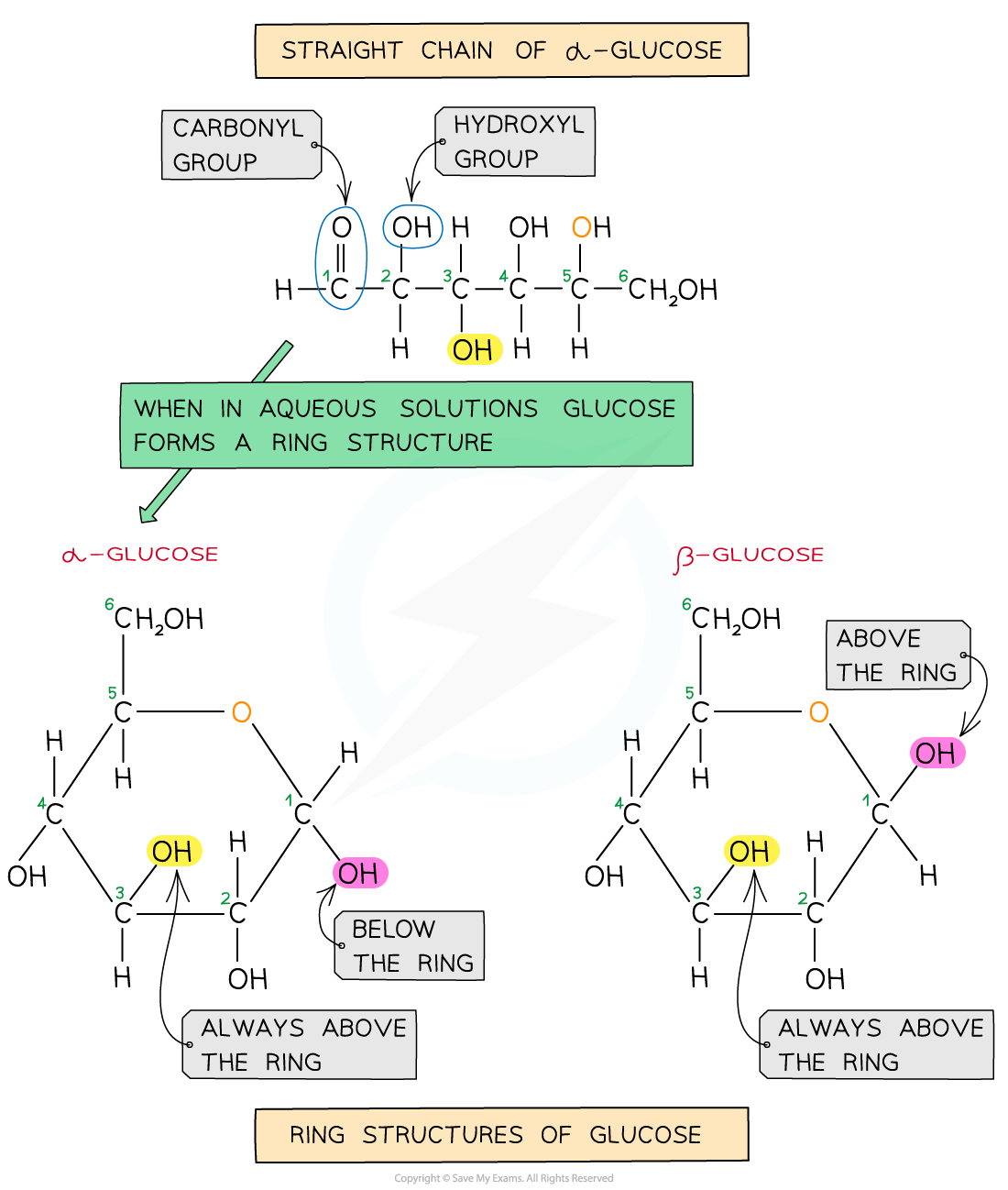
Straight chain and ring structural formula of alpha & beta glucose
- Different polysaccharides are formed from the two isomers of glucose
| Polysaccharide | Alpha Glucose | Beta Glucose |
|---|---|---|
| Starch | ✓ | X |
| Glycogen | ✓ | X |
| Cellulose | X | ✓ |
Exam Hint You must be able to recognise and draw the isomer rings of α and β glucose.
Biological Molecules: Key Terms
Spec point —
2.2.2· define the terms monomer, polymer, macromolecule, monosaccharide, disaccharide and polysaccharide
-
The key molecules that are required to build structures that enable organisms to function are:
- Carbohydrates
- Proteins
- Lipids
- Nucleic Acids
- Water
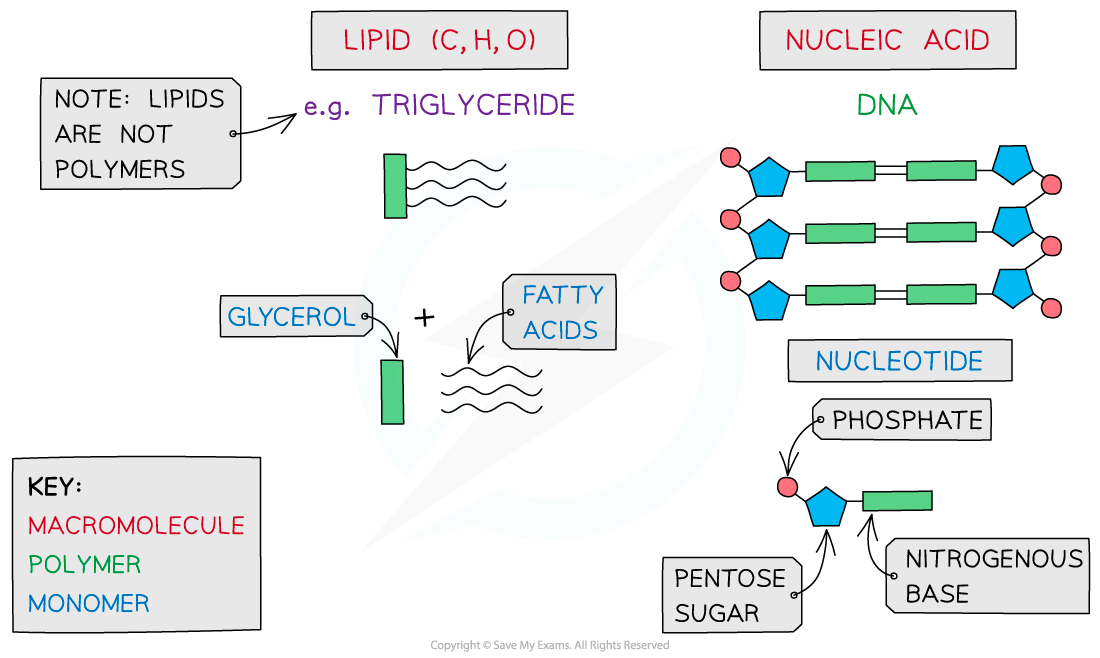
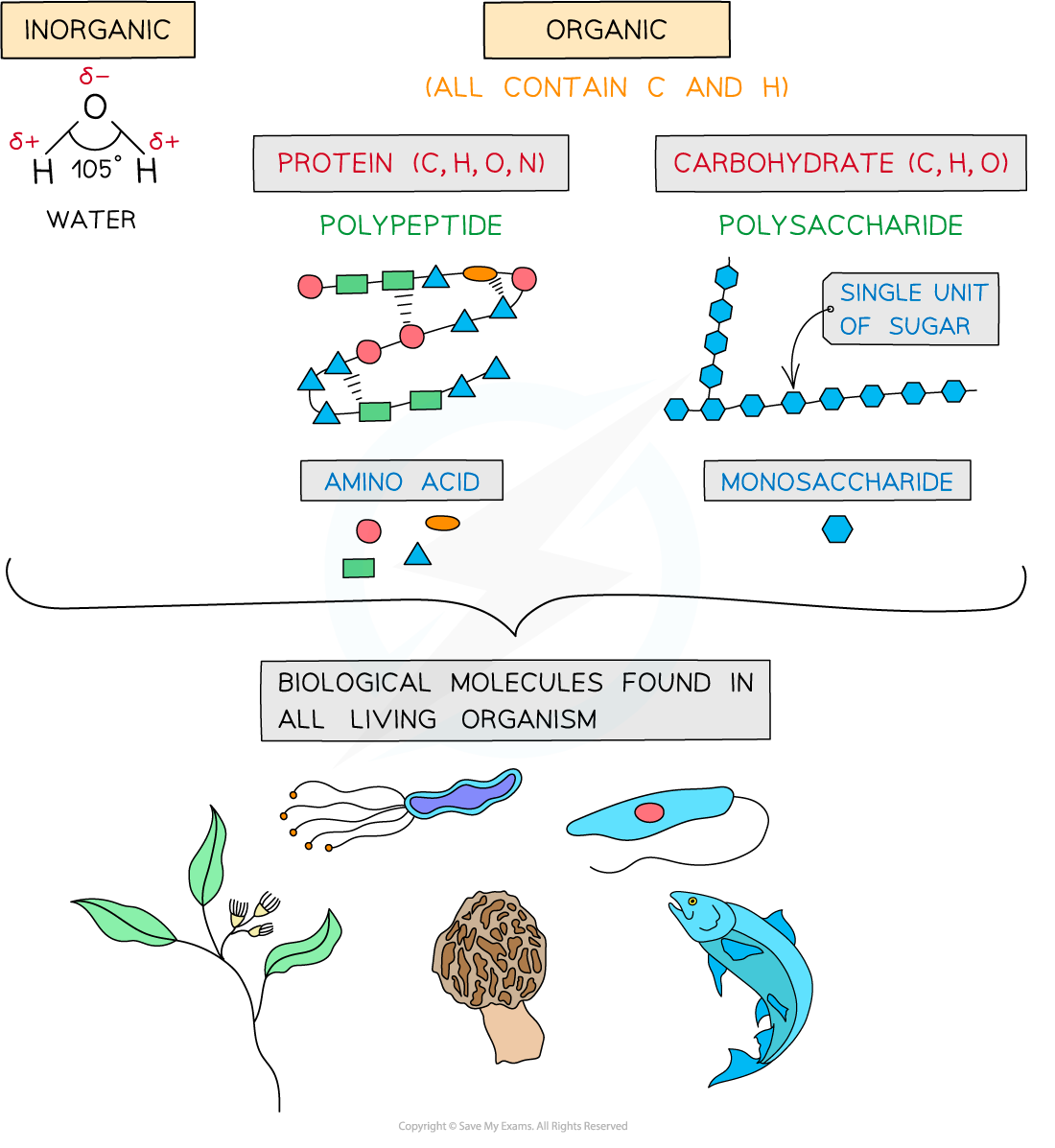
The key biological molecules for living organisms
-
Carbohydrates, proteins, lipids and nucleic acids contain the elements carbon (C) and hydrogen (H) making them organic compounds
-
Carbon atoms are key to the organic compounds because:
- Each carbon atom can form four covalent bonds – this makes the compounds very stable (as covalent bonds are so strong they require a large input of energy to break them)
- Carbon atoms can form covalent bonds with oxygen, nitrogen and sulfur
- Carbon atoms can bond to form straight chains, branched chains or rings
-
Carbon compounds can form small single subunits called monomers, that bond with many repeating subunits to form large molecules called polymers, by a process called polymerisation
-
Macromolecules are very large molecules
- That contain 1000 or more atoms therefore having a high molecular mass
- Polymers can be macromolecules, however not all macromolecules are polymers as the subunits of polymers have to be the same repeating units
Carbohydrates
- Carbohydrates are one of the main carbon-based compounds in living organisms
- All molecules in this group contain C, H and O
- As H and O atoms are always present in the ratio of 2:1(e.g. water H2O, which is where ‘hydrate’ comes from) they can be represented by the formula Cx (H2O)y
- The three types of carbohydrates are monosaccharides, disaccharides and polysaccharides
Types of carbohydrate table
| Monosaccharide | Disaccharide | Polysaccharide | |
|---|---|---|---|
| Definition | A single sugar monomer, all of which are reducing sugars | A sugar formed from two monosaccharides joined by a glycosidic bond in a condensation reaction | A polymer formed by many monosaccharides joined by a glycosidic bond in a condensation reaction |
| Examples | Glyceraldehyde (3C) Ribose (5C) Glucose (6C) | Maltose (α glucose + α glucose) Sucrose (α glucose + fructose) Lactose (α glucose + β galactose) | Cellulose (monomer is *β *glucose) Starch (monomer is *α *glucose) Glycogen (monomer is *α *glucose) |
| Function | Energy in respiration Building blocks of polymers | Sugar in germinating seeds (maltose) Mammal milk sugar (lactose) Sugar stored in cane sugar (sucrose) | Energy storage (plants - starch; animals - glycogen) Structural cell wall (cellulose) |
Exam Hint When discussing monomers and polymers, give the definition but also name specific examples e.g. nucleic acids – the monomer is a nucleotide.
You need to be able to define the terms monomer, polymer, macromolecule, monosaccharide, disaccharide and polysaccharide.
Was this revision note helpful?
Build on this topic