Viruses (Cambridge International AS Biology)
Key Features of Viruses
Spec point —
1.2.7· state that all viruses are non-cellular structures with a nucleic acid core (either DNA or RNA) and a capsid made of protein, and that some viruses have an outer envelope made of phospholipids
-
Viruses are non-cellular particles that infect living cells
- Note that viruses are not cells, and they are not considered to be living organisms, so are referred to as 'particles'
-
They are much smaller than prokaryotic cells, with a diameter of 20-300 nm
-
Structurally they have
- A nucleic acid core made of either DNA or RNA
- A protein coat called a capsid
-
Some viruses have an outer layer called an envelope; this forms from the membrane phospholipids of the host cell in which they were produced
-
Viruses can only reproduce by infecting living cells and using their protein-building machinery to produce new viral particles
- Viruses use attachment proteins on their surface to bind to and infect their host cells
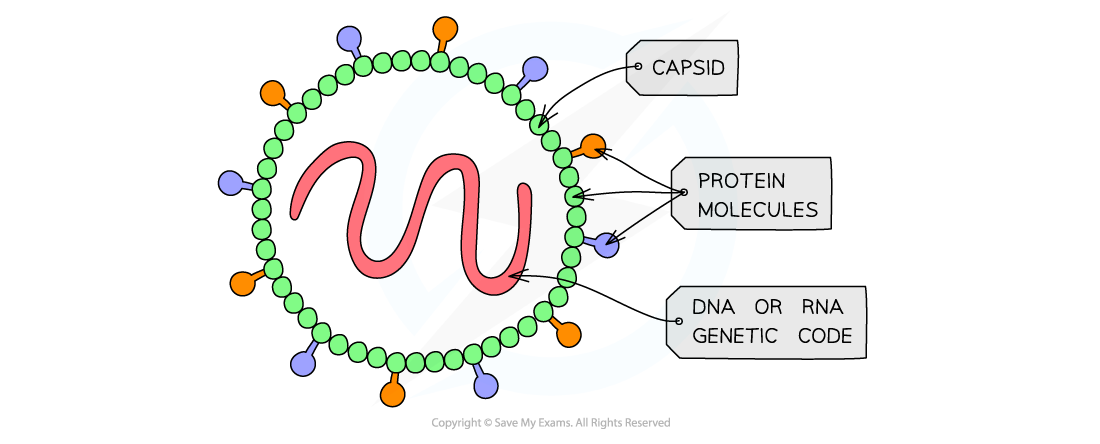
Basic virus structure includes a protein capsid and a nucleic acid core
Exam Hint Never describe viruses as cells or living organisms in exam answers.
Examiners often include this as a trap — viruses are non-cellular particles that rely on host cells to reproduce. Make sure to refer to them as “virus particles”, not “cells”, and state that they cannot carry out life processes independently.
Was this revision note helpful?