Reconciliation between Profit Statements (Cambridge International AS Accounting)
Profit statements using marginal costing
Spec point — how to prepare costing and profit statements using marginal costing
What are profit statements?
- Profit statements show the profit or loss made from selling a product/service
How do I prepare a profit statement using marginal costing?
-
STEP 1 Calculate the sales revenue
- Selling price per unit × number of units sold
-
STEP 2 Calculate the cost of sales
-
Start with opening inventory
-
Add production cost
- **Excluding **the fixed costs
-
Subtract closing inventory
-
-
STEP 3 Calculate the** contribution**
- Revenue - variables
-
STEP 4 Subtract the fixed costs
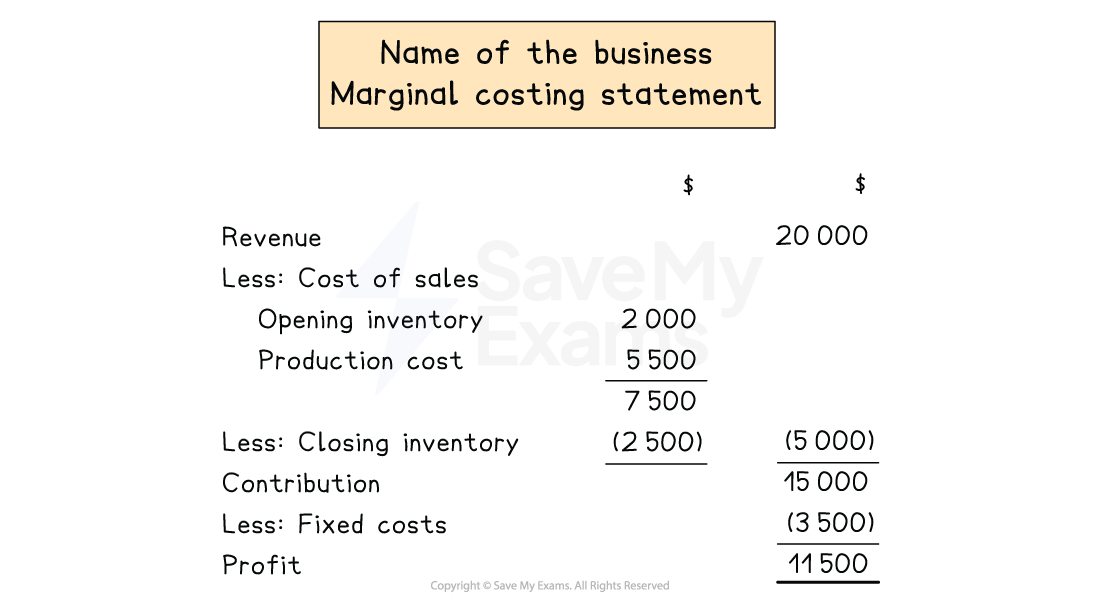
Layout of a profit statement using marginal costing
Worked Example Jane manufactures a single product. She uses a system of marginal costing.
The following budgeted data is available for one unit of the product.
$ Selling price 14 Direct materials 4 Direct labour 3 On 1 August, Jane held 2 000 units.
The following actual results are available.
Sales: 12 000 units
Production: 18 000 units
Fixed overheads: $25 000
Prepare the profit statement for the month of August to calculate the profit or loss.
Answer:
Sales revenue $14 × 12 000 = $168 000
Production cost
- Direct materials *$4 × 18 000 = $72 000 *
- Direct labour $3 × 18 000 = $54 000
- Total
$72 000 + $54 000 = $126 000
- Opening inventory ($4 + $3) × 2 000 = $14 000
- Closing inventory *Opening inventory + Production - Sales * *= 2 000 + 18 000 - 12 000 * = 8 000 units ($4 + $3) × 8 000 = $56 000
Profit statement for the month of August
$ Revenue 168 000 Cost of sales: Opening inventory 14 000 Production costs 126 000 Less: Closing inventory (56 000) (84 000) Contribution 84 000 Less: Fixed overheads (25 000) Profit for the month 59 000 Final answer: Profit for August is $57 000
Reconciliation between absorption and marginal costing
Spec point — how to prepare a statement reconciling the reported profits using marginal costing and absorption costing
How is reconciliation between absorption and marginal costing done?
-
A statement reconciling the reported profits using absorption and marginal costing is prepared
-
A difference arises because of fixed manufacturing overheads being treated differently
- In marginal costing, fixed manufacturing overheads are charged fully to the period
- In absorption costing, fixed manufacturing overheads are absorbed into product cost and can be carried forward in closing inventory or released from opening inventory
-
When opening inventory is greater than the closing inventory
- Marginal profit is higher than absorption profit
-
When closing inventory is greater than opening inventory
- Absorption profit is higher than marginal profit
How is inventory valued using absorption and marginal costing?
-
In absorption costing, fixed costs are absorbed into inventory
- Fixed manufacturing overheads are included when calculating the value of inventory
- When calculating value of opening inventory:
Opening スペース units スペース かける 開き括弧 Total スペース direct スペース costs スペース たす スペース Variable スペース manufacturing スペース overheads スペース たす スペース Fixed スペース manufacturing スペース overheads 閉じ括弧 - When calculating value of closing inventory:
Closing スペース units スペース かける スペース 開き括弧 Total スペース direct スペース costs スペース たす スペース Variable スペース manufacturing スペース overheads スペース たす スペース Fixed スペース manufacturing スペース overheads 閉じ括弧
-
In marginal costing, fixed costs are excluded from inventory
- Only variable costs are included when calculating the value of inventory
- When calculating value of opening inventory:
Opening スペース units スペース かける スペース 開き括弧 Total スペース direct スペース costs スペース たす スペース Variable スペース manufacturing スペース overheads 閉じ括弧 - When calculating value of closing inventory:
Closing スペース units スペース かける 開き括弧 Total スペース direct スペース costs スペース たす 狭い空白文字 Variable スペース manufacturing スペース overheads 閉じ括弧
How is a reconciliation statement prepared?
-
STEP 1 Calculate profit as per absorption costing
-
Start with sales revenue
-
Subtract production cost which includes:
- Direct materials
- Direct labour
- Other direct costs
- Variable manufacturing overheads
- Fixed manufacturing overheads
-
Subtract operating expenses
- Administration costs
- Selling & distribution costs
-
-
STEP 2 Add the difference in opening inventory
- Calculate opening inventory for absorption costing
- Calculate opening inventory for marginal costing
- Calculate the difference in opening inventory value
-
STEP 3 Subtract the difference in closing inventory
- Calculate closing inventory for absorption costing
- Calculate closing inventory for marginal costing
- Calculate the difference in closing inventory value
-
STEP 4 Check that the value equals the profit as per marginal costing
-
Start with sales revenue
-
Subtract production costs which includes:
- Direct materials
- Direct labour
- Other direct costs
- Variable manufacturing overheads
-
Subtract operating expenses
- Administration costs
- Selling & distribution costs
-
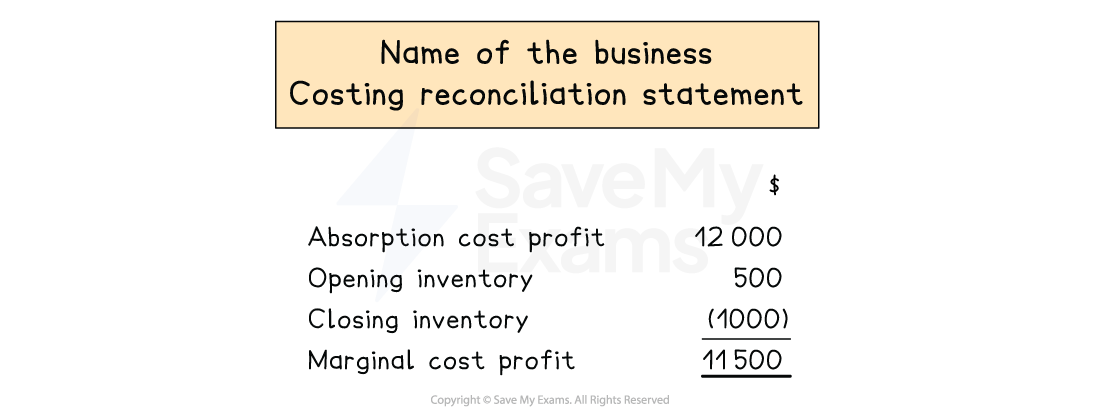
*Example of a cost reconciliation statement *
Worked Example With absorption costing:
- Profit: $9 200
- Opening inventory: $1 600
- Closing inventory: $2 000
With marginal costing:
- Profit: $9 100
- Opening inventory: $1 500
- Closing inventory: $1 800
Prepare a statement reconciling the profit from absorption costing and marginal costing.
Answer:
Calculate the difference in the inventory values
*Difference in opening inventory: 1 600 - 1 500 = 100 *
*Difference in closing inventory: 2 000 - 1 800 = 200 *
$ Profit from absorption costing 9 200 Difference in opening inventory 100 Less: Difference in closing inventory (200) Profit from marginal costing 9 100
Was this revision note helpful?