Resonance (Cambridge International A-Level Physics)
Exam board Cambridge International · A-LevelUpdated 2026-07-02
Spec point —
17.3.3
Resonance
-
Resonance involves a maximum amplitude of oscillation that occurs when an oscillating system is forced to oscillate at its natural frequency
- All oscillating systems have a natural frequency (f0), the frequency at which the system is allowed to oscillate freely
- The driving frequency (f) is the frequency of the forced oscillations
-
When the driving frequency approaches the natural frequency of an oscillator, the system gains more energy from the driving force
- Eventually, when they are equal, the oscillator vibrates with its maximum amplitude, this is resonance
-
For example, when a child is pushed on a swing:
- The swing and child have a fixed natural frequency
- A small push after each cycle creates the driving frequency increasing the amplitude of the oscillations so the child swings higher
- Resonance occurs when the driving frequency is equal to the natural frequency
- When the driving frequency does not quite match the natural frequency, the amplitude will increase but not to the same extent as when resonance is achieved
-
At resonance, energy is transferred from the driver to the oscillating system in the most efficient way
- Therefore, at resonance, the system transfers the maximum kinetic energy possible
A child pushed on a swing
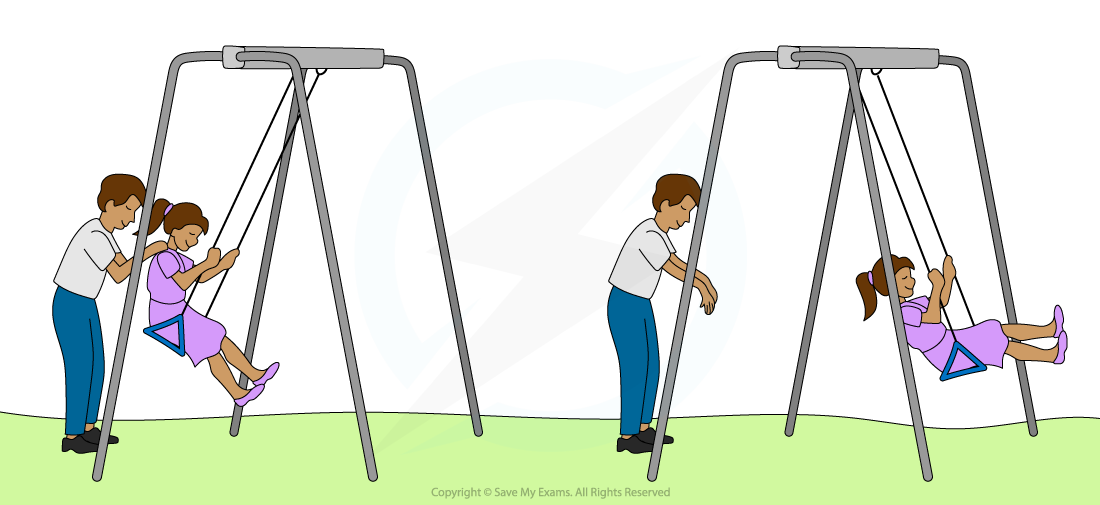
The person pushing the swing supplies an applied force to the system at the driving frequency until the child oscillates at the maximum frequency, the natural frequency
Was this revision note helpful?