Electric Field Lines (Cambridge International A-Level Physics)
Representing Electric Fields
-
Field lines are used to represent the direction and magnitude of an electric field
- In an electric field, field lines are always directed from the positive charge to the negative charge
-
In a uniform electric field:
- the field lines are equally spaced at all points
- electric field strength is constant at all points in the field
- the force acting on a test charge has the same magnitude and direction at all points in the field
-
In a radial electric field:
- the field lines are equally spaced as they exit the surface of the charge, but they become further apart with distance
- the electric field strength decreases with distance from the charge producing the field
- the magnitude of the force acting on a test charge decreases with distance
Electric field around a point charge
-
Around a point charge, the electric field is radial and the lines are directly radially inwards or outwards
- If the charge is positive(+), the field lines are radially outwards
- If the charge is negative(-), the field lines are radially inwards
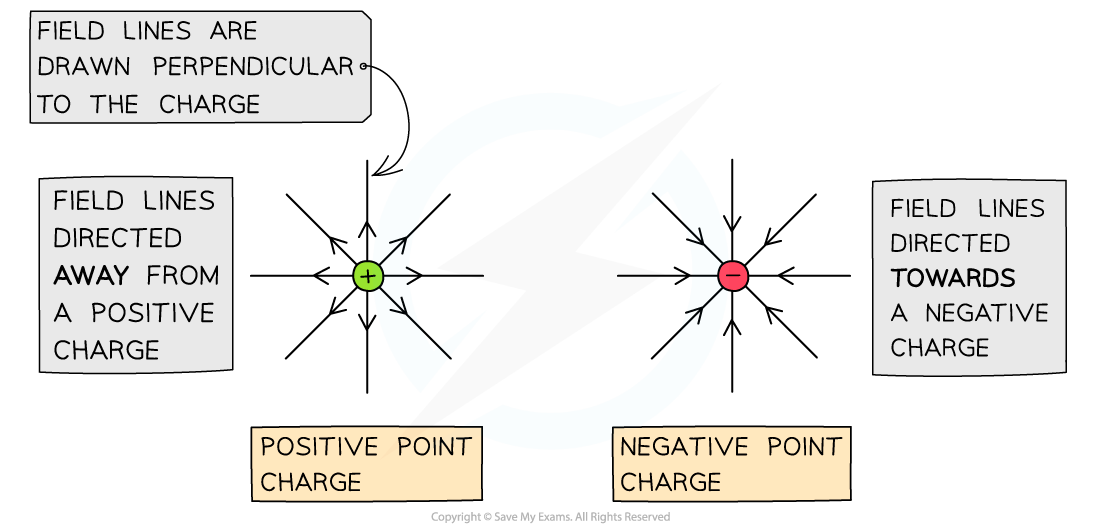
Electric field lines around a point charge are directed away from a positive charge and towards a negative charge
-
A radial field spreads uniformly to (or from) the charge in all directions, and the strength of the field is indicated by the spacing of the field lines
- The electric field is stronger where the lines are closer together
- The electric field is weaker where the lines are further apart
-
This shares many similarities to radial gravitational field lines around a point mass
- Since gravity is only an attractive force, the field lines will look similar to the negative point charge, whilst electric field lines can be in either direction
Electric field around a conducting sphere
-
When a conducting sphere becomes charged, the electric field around it is the same as it would be if all the charge was concentrated at the centre
- This means that a charged sphere can be treated in the same way as a point charge in calculations
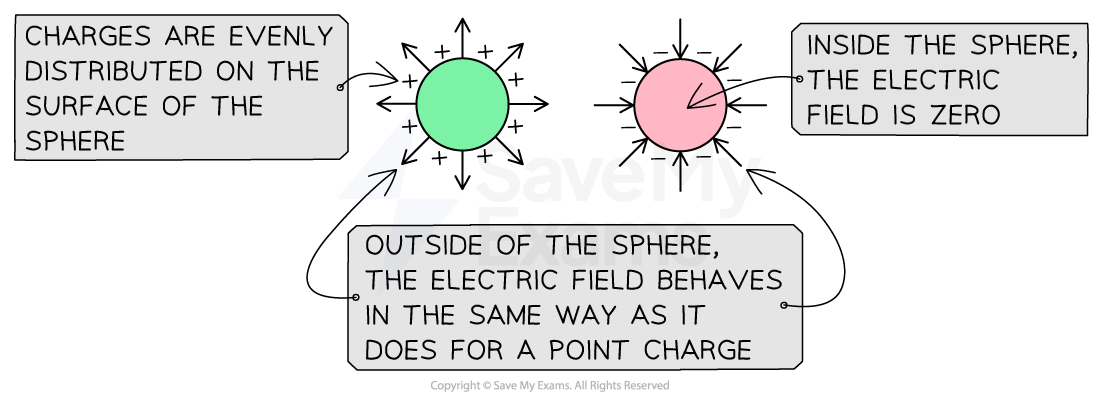
Electric field lines around a charged conducting sphere are similar to the field lines around a point charge
- Note: field lines are always perpendicular to the surface of a conducting sphere
Electric field between two point charges
-
For two opposite charges:
- the field lines are directed from the positive charge to the negative charge
- the closer the charges are brought together, the stronger the attractive electric force between them becomes
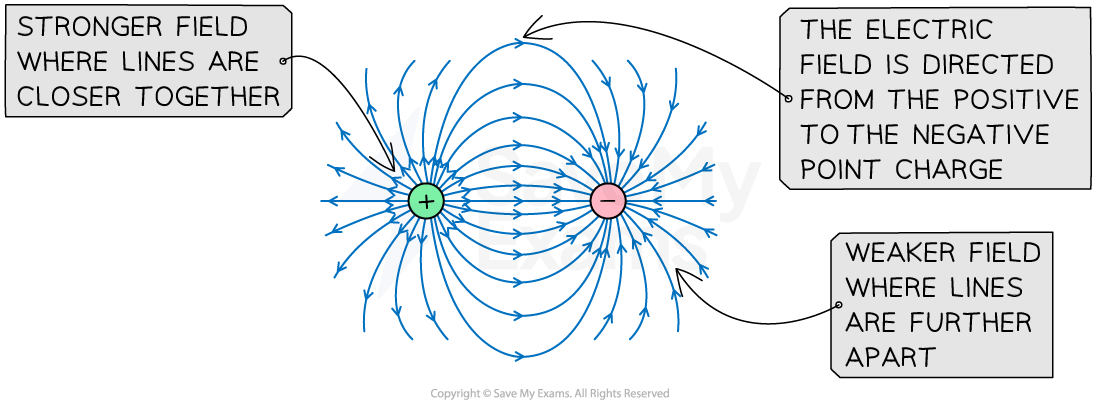
The electric field lines between two opposite charges are directed from the positive to the negative charge. The field lines connect the surfaces of the charges to represent attraction
-
For two charges of the same type:
- the field lines are directed away from two positive charges or towards two negative charges
- the closer the charges are brought together, the stronger the repulsive electric force between them becomes
- there is a neutral point at the midpoint between the charges where the resultant electric force is zero
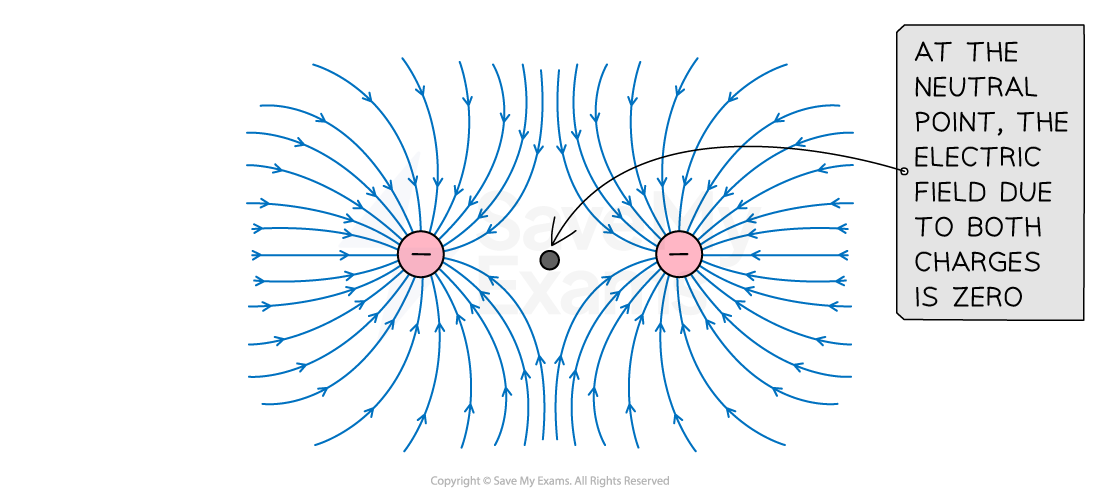
The electric field lines between two like charges are directed away from positive charges or towards negative charges. The field lines do not connect the surfaces of the charges to represent repulsion
Electric field between two parallel plates
-
When a potential difference is applied between two parallel plates, they become charged
- The electric field between the plates is uniform
- The electric field beyond the edges of the plates is non-uniform
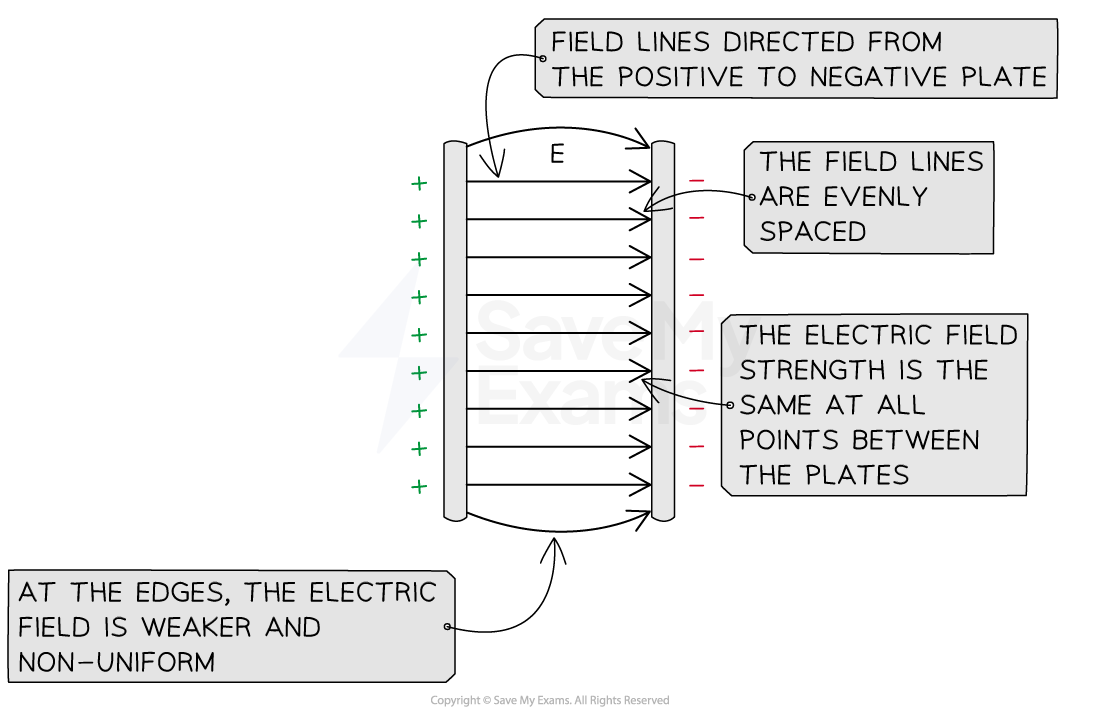
Electric field lines between two parallel plates are directed from the positive to the negative plate. A uniform electric field has equally spaced field lines
Electric field between a point charge and parallel plate
-
The field around a point charge travelling between two parallel plates combines
- the field around a point charge
- the field between two parallel plates
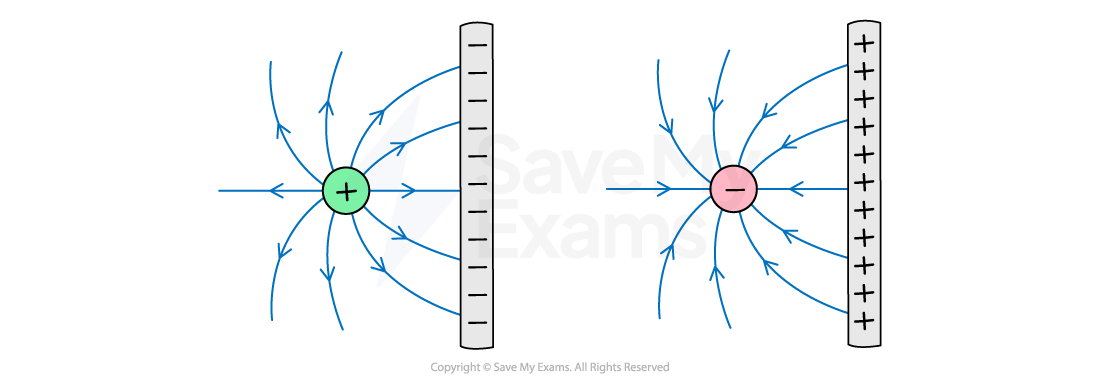
The electric field lines between a point charge and a parallel plate are similar to the field between two opposite charges. The field lines become parallel when they touch the plate
Worked Example Sketch the electric field lines between the two point charges in the diagram below.
Answer:
- Electric field lines around point charges have arrows which point radially outwards for positive charges and radially inwards for negative charges
- Arrows (representing force on a positive test charge) point from the positive charge to the negative charge

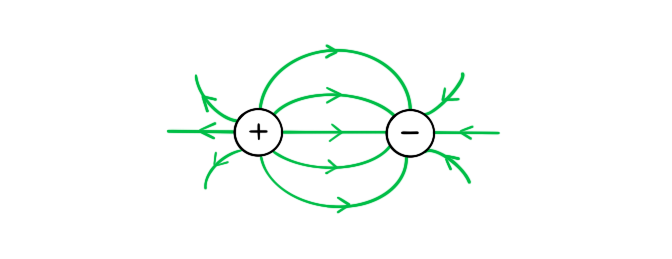
Exam Hint Always label the arrows on the field lines! The lines must also touch the surface of the source charge or plates and they must never cross.
Was this revision note helpful?
Build on this topic