Principles of Electromagnetic Induction (Cambridge International A-Level Physics)
Principles of electromagnetic induction
-
Electromagnetic induction is a phenomenon which occurs when an e.m.f. is induced due to relative movement between a conductor and a magnetic field
-
This could occur when:
- a conductor moves relative to a magnetic field
- a magnetic field varies relative to a conductor
-
When a conductor cuts through magnetic field lines:
- the free electrons in the conductor experience a magnetic force
- this causes work to be done as charges in the conductor become separated
- mechanical work is transferred to the charges as electric potential energy
- a potential difference is created between the ends of the conductor, or in other words, an e.m.f. is induced
-
The phenomenon of EM induction can be demonstrated using a magnet and a coil, or a wire and two magnets
Experiment 1: Moving a magnet through a coil
- When a coil is connected to a sensitive voltmeter, a bar magnet can be moved in and out of the coil to induce an e.m.f
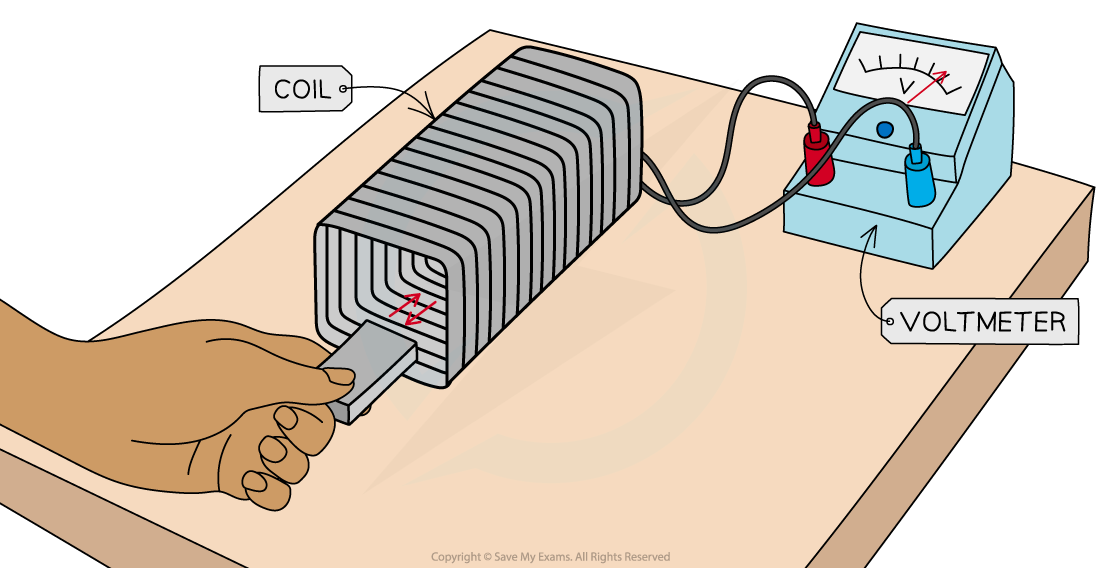
A bar magnet is moved through a coil connected to a voltmeter to induce an e.m.f
The expected results are...
- When the bar magnet is not moving, the voltmeter shows a zero reading
- When the bar magnet is stationary inside or outside the coil, the rate of change of flux is zero, so no e.m.f. is induced
- When the bar magnet begins to move inside the coil, there is a reading on the voltmeter
- As the bar magnet moves, its magnetic field lines ‘cut through’ the coil, generating a change in magnetic flux(ΔΦ)
- This induces an e.m.f. within the coil, shown momentarily by the reading on the voltmeter
- When the bar magnet is taken back out of the coil, an e.m.f. is induced in the opposite direction
- As the magnet changes direction, the direction of the current changes
- The voltmeter will momentarily show a reading with the opposite sign
- Increasing the speed of the magnet induces an e.m.f. with a higher magnitude
- As the speed of the magnet increases, the rate of change of flux increases
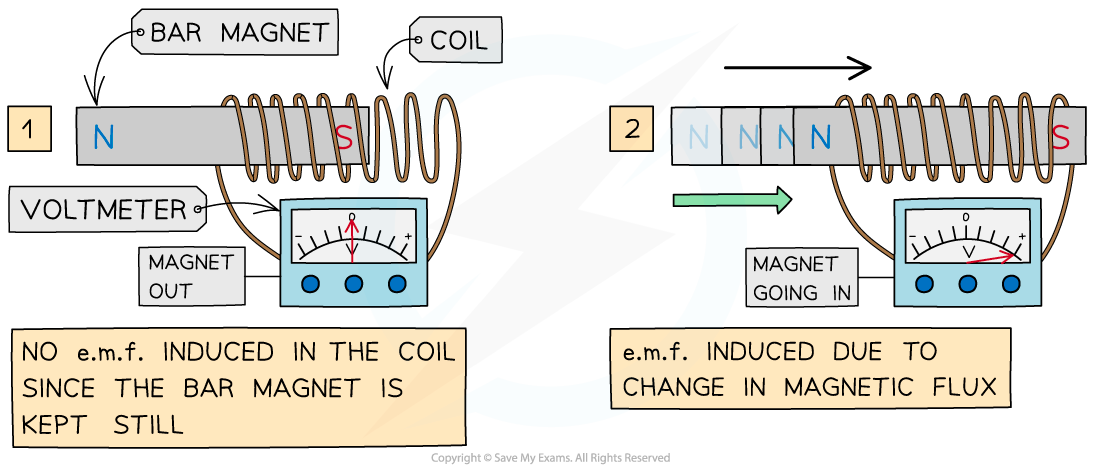
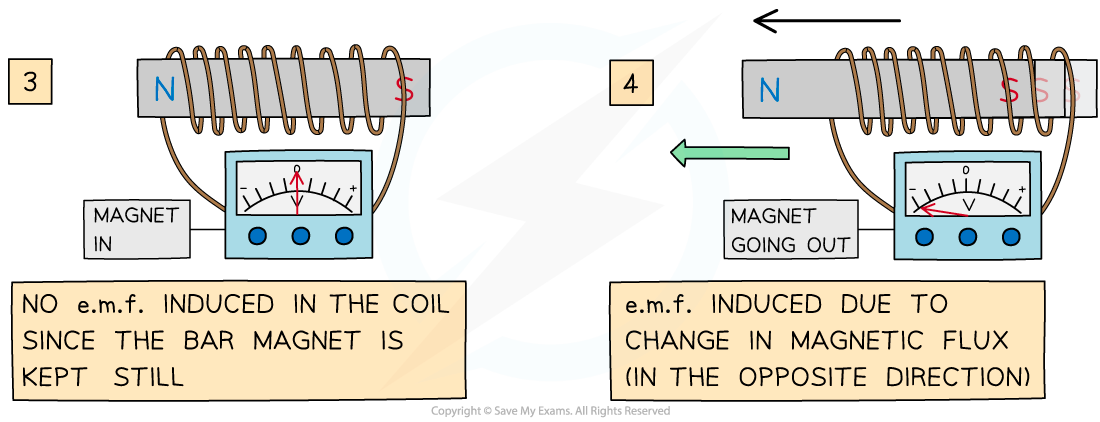
An e.m.f is induced only when the bar magnet is moving through the coil
-
Factors that will increase the magnitude of the induced e.m.f. are:
- Moving the magnet faster through the coil
- Adding more turns to the coil
- Increasing the strength of the bar magnet
Experiment 2: Moving a wire through a magnetic field
-
When a long wire is connected to a voltmeter and moved between two magnets, an e.m.f. is induced
- Note: there is no current flowing through the wire to start with
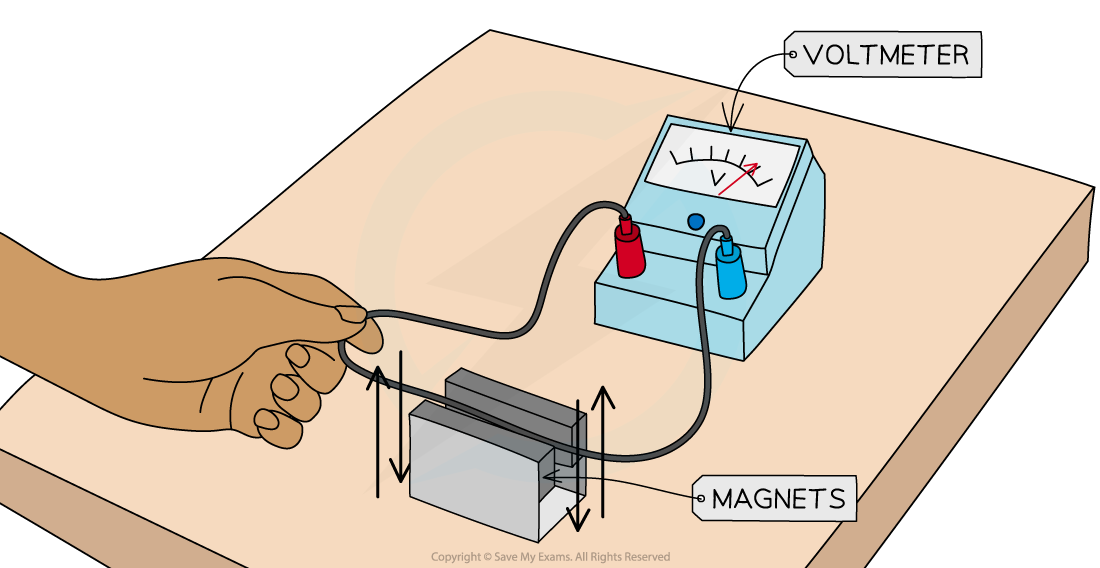
A wire is moved between two magnets connected to a voltmeter to induce an e.m.f.
The expected results are...
- When the wire is not moving, the voltmeter shows a zero reading
- When the wire is stationary inside or outside the magnet, the rate of change of flux is zero, so no e.m.f. is induced
- As the wire moves between the magnets, an e.m.f. is induced
- This is shown momentarily by the reading on the voltmeter
- As the wire moves through the magnetic field, it ‘cuts through’ the magnetic field lines, generating a change in magnetic flux
- When the wire is moved back out of the field, an e.m.f. is induced in the opposite direction
-
As the wire changes direction, the direction of the current changes
-
The voltmeter will momentarily show a reading with the opposite sign
-
Factors that will increase the magnitude of the induced e.m.f. are:
- Increasing the length of the wire in the field
- Moving the wire between the magnets faster
- Increasing the strength of the magnets
Was this revision note helpful?
Build on this topic