Alternating Current & Voltage (Cambridge International A-Level Physics)
Properties of Alternating Current & Voltage
-
An alternating current (a.c) is defined as: A current which periodically varies from positive to negative and changes its magnitude continuously with time
-
This means the direction of an alternating current varies every half-cycle
-
The variation of current, or p.d., with time can be described as a sine curve ie. sinusoidal
- Therefore, the electrons in a wire carrying a.c. move back and forth with simple harmonic motion
-
As with SHM, the time period of an alternating current is defined as:
-
Where:
- T = time period (s)
- f = frequency (Hz)
-
Peak current (I0), or peak voltage (V0), is defined as: The maximum value of the alternating current or voltage
-
Peak current, or voltage, can be determined from the amplitude of the graph
Time period and peak current on a current-time graph
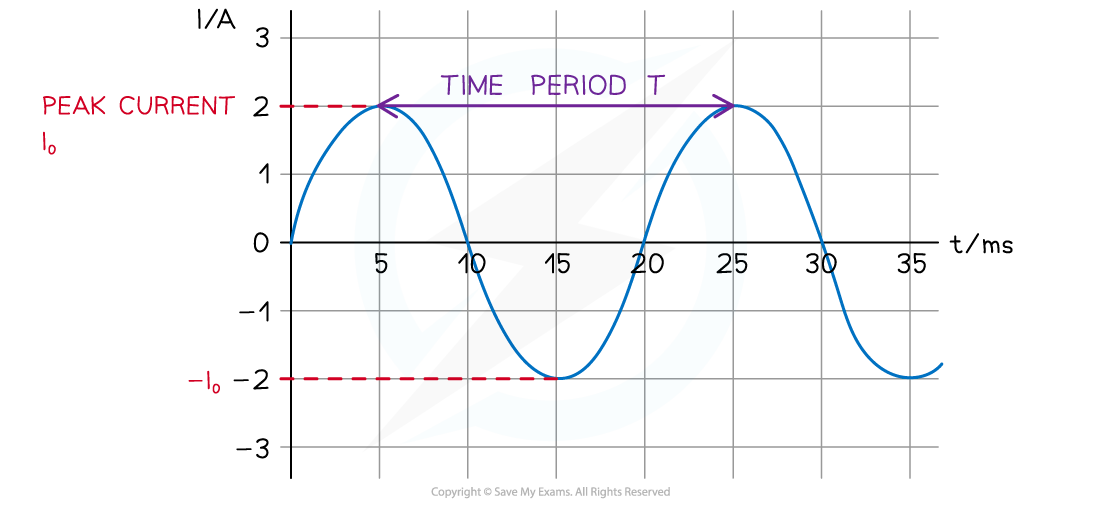
Graph of alternating current against time with a time period of 20 ms and peak current of 2 A
-
Mains electricity is supplied as alternating current
- Power stations produce alternating current
- This is the type of current supplied when devices are plugged into sockets
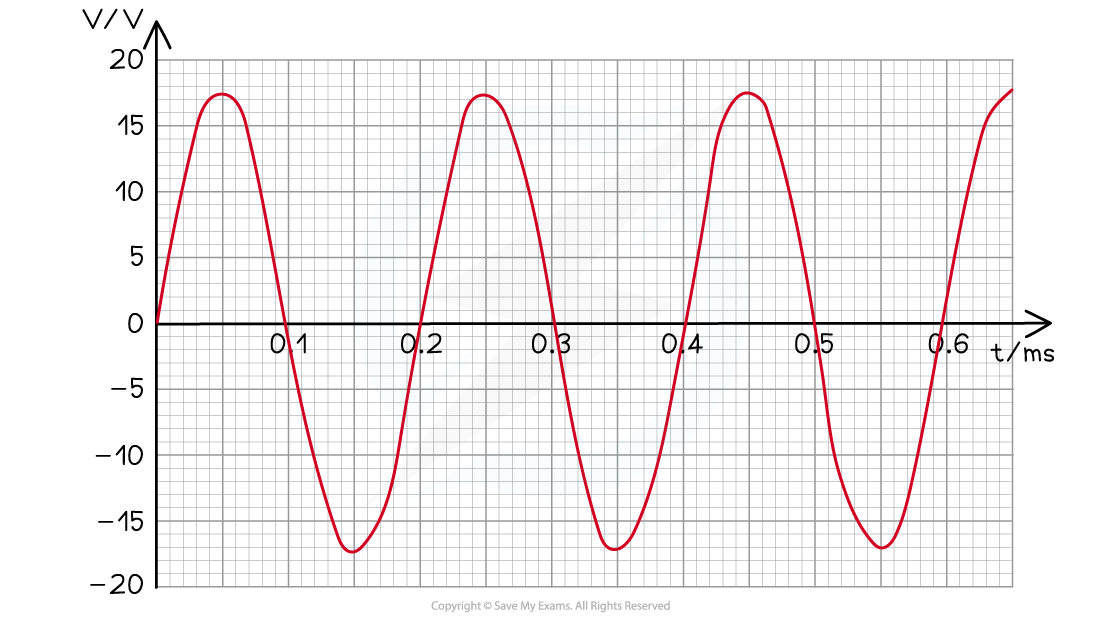
Worked Example The variation with time t of the output voltage V of an alternating voltage supply is shown in the graph below.
Use the graph to calculate the frequency of the supply.
Answer:
Step 1: Write down the period-frequency relation
Step 2: Calculate the time period from the graph
- The time period is the time taken for one complete cycle
- From the graph, this is equal to 0.2 ms
- Therefore, the time period is
T = 0.2 ms = 0.2 × 10⁻³ s
Step 3: Substitute into frequency equation
Exam Hint Remember to double check the units on the alternating current and voltage graphs. These are often shown in the range of milli-seconds (ms) instead of seconds (s) on the x axis.
Using Sinusoidal Representations
- The equation representing alternating current which gives the value of the current I at any time t is:
-
Where:
- I = current (A)
- I0 = peak current (A)
- ω = angular frequency of the supply (rad s-1)
- t = time (s)
-
Note: this a sine function since the alternative current graph is sinusoidal
-
A similar equation can be used for representing alternating voltage:
-
Where:
- V = voltage (V)
- V0 = peak voltage (V)
-
Recall the relation between the equation for angular frequency ω:
-
Where:
- f = frequency of the supply (Hz)
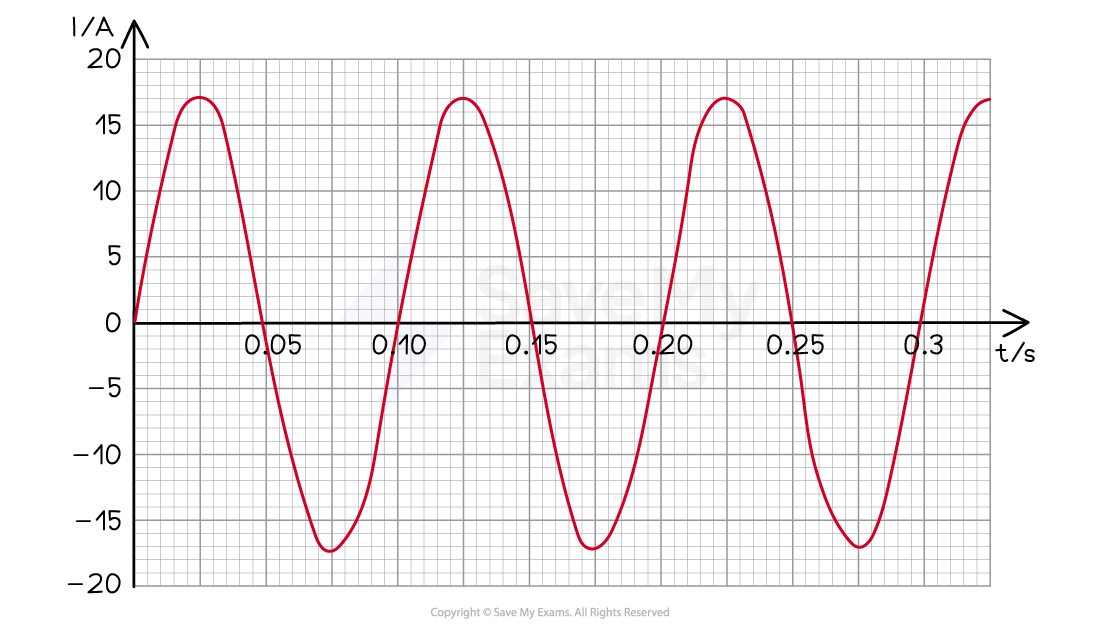
Worked Example An alternating current I varies with time t as shown in the graph below.
Using the graph and the equation for alternating current, calculate the value of the current at a time 0.48 s.
Answer:
Step 1: Write out the equation for alternating current
Step 2: Write out the equation for angular frequency
Step 3: Measure the time period T and peak current I 0 from the graph **
- The time period is the time taken for one full cycle, T = 0.10 s
- Peak current (amplitude),I0 = 17 A
Step 4: Substitute values into alternating current equation at time t**
- Using the time given in the question, t = 0.48 s
Exam Hint These equations are written as , the x is replaced with I or V, depending on the question.
Remember to check that your calculator is in radians mode when using any of these equations. This is because the angular frequency ω is measured in rad s-1.
Current can also be positive or negative, depending on its direction. This is why the answer in the worked example is negative. At t = 0.48 s the current will be in the negative direction. The mark schemes in the exams are normally not too picky about this, but the size of the current (16 A in the worked example) is what will get the mark.
Was this revision note helpful?
Build on this topic