Root-Mean-Square Current & Voltage (Cambridge International A-Level Physics)
Root-mean-square current & voltage
- Root-mean-square (r.m.s) values of current, or voltage, are a useful way of comparing a.c current, or voltage, to its equivalent direct current, or voltage
- The r.m.s values represent the d.c current, or voltage, values that will produce the same heating effect, or power dissipation, as the alternating current, or voltage
- The r.m.s value of an alternating current is defined as: The value of a constant current that produces the same power in a resistor as the alternating current
- The r.m.s current Ir.m.s is defined by the equation:
- The r.m.s value of an alternating voltage is defined as: The value of a constant voltage that produces the same power in a resistor as the alternating voltage
- The r.m.s voltage Vr.m.s is defined by the equation:
-
Where:
- I0 = peak current (A)
- V0 = peak voltage (V)
-
So, r.m.s current is equal to 0.707 × I0, which is about 70% of the peak current I0
-
The r.m.s value is therefore defined as: The steady direct current, or voltage that delivers the same average power in a resistor as the alternating current, or voltage
-
A resistive load is an electrical component with resistance e.g. a lamp
Peak voltage and RMS voltage
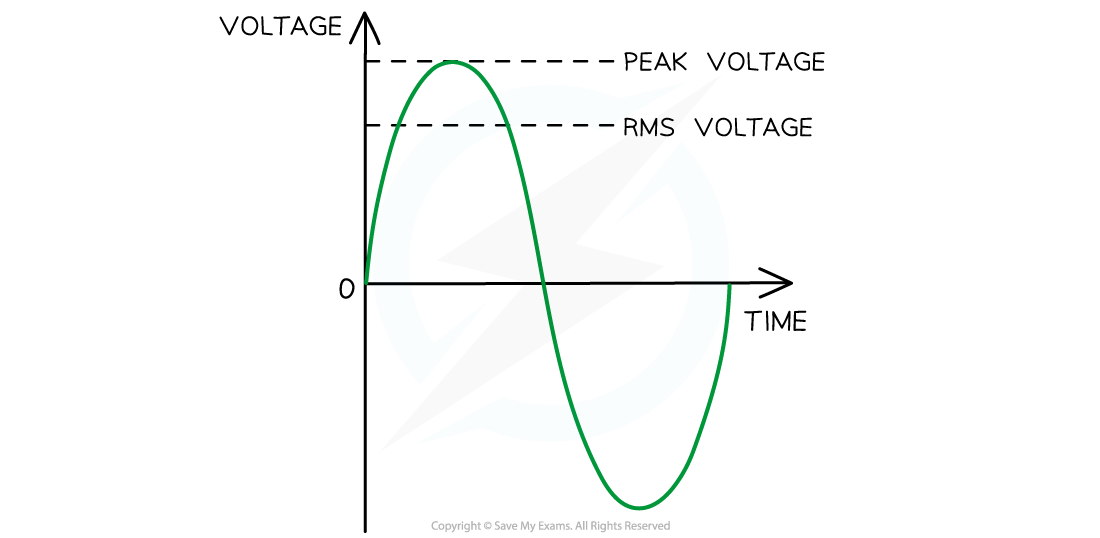
Vr.m.sand peak voltage. The r.m.s voltage is about 70% of the peak voltage
Worked Example An alternating current is I is represented by the equation
I=410 sin (100 straight π t)where I is measured in amps and t is in seconds.
For this alternating current, determine
(a) the r.m.s current
(b) the frequency.
Answer:
(a)
Step 1: Write out the equation for r.m.s current
Step 2: Determine the peak voltage I0
- The alternating current equation is in the form:
I=I_ 0 sin (ω t)- Comparing this to
I=bold 410 sin (100 straight π t)means the peak current is I0= 410 AStep 3: Substitute into the I r.m.s equation
(b)
Step 1: Write out the equation for angular frequency
Step 2: Determine the angular frequency
- The alternating current equation is in the form:
I=I_ 0 sin (ω t)- Comparing this to
I=410 sin (bold 100 bold π t)means the angular frequency is ω = 100π rad s−1Step 3: Rearrange and substitute into the equation to calculate frequency
Exam Hint These equations are not given on your data sheet, so make sure you learn them!
Was this revision note helpful?
Build on this topic