Square Roots of a Complex Number (Cambridge International A-Level Mathematics)
Exam board Cambridge International · A-LevelUpdated 2026-07-02
Square roots of a complex number
How do I find the square root of a complex number?
-
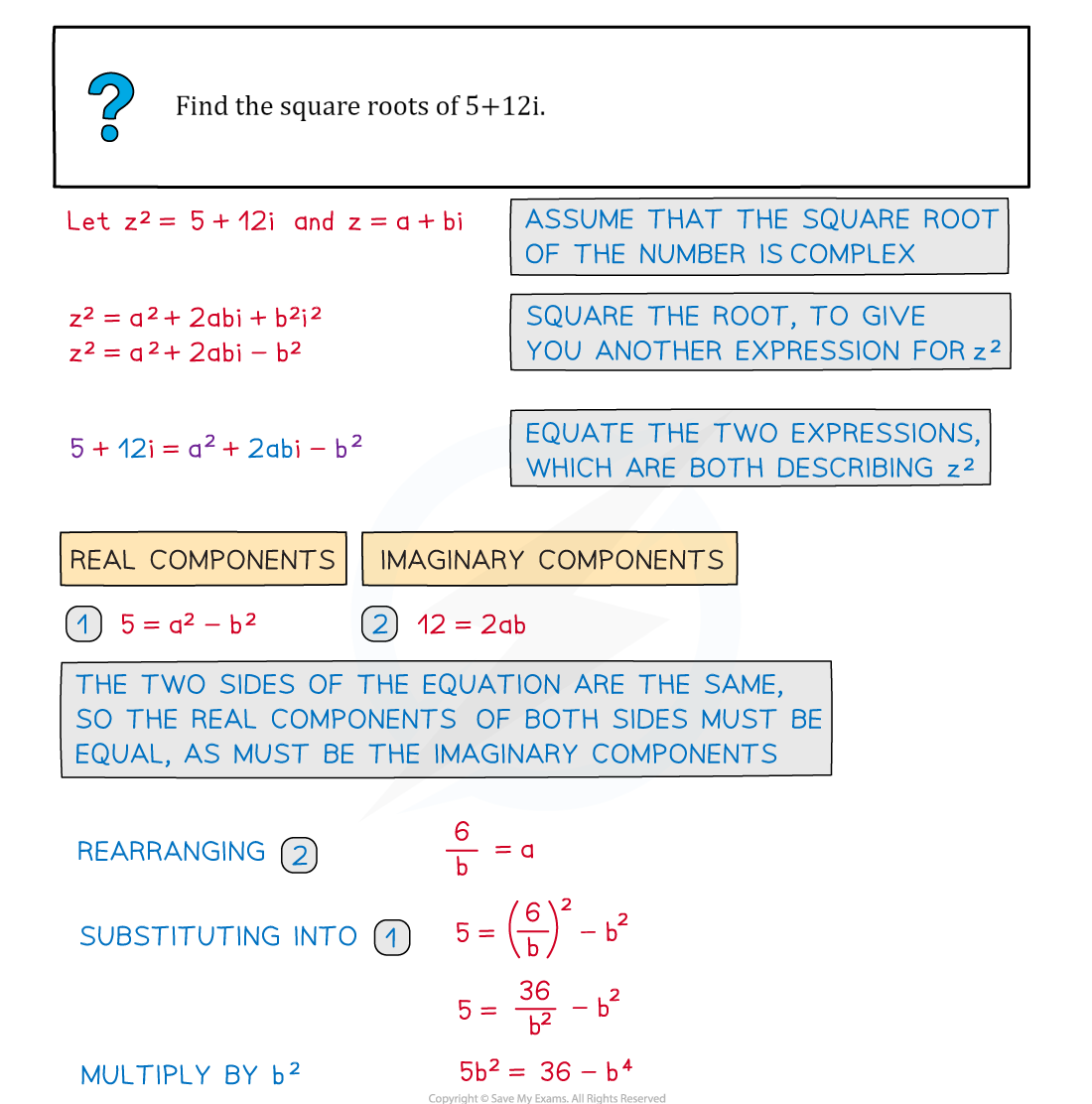
The square roots of a complex number will themselves be complex:
- i.e. if then
-
We can then square () and equate it to the original complex number (), as they both describe :
-
Then expand and simplify:
-
As both sides are equal we are able to equate real and imaginary parts:
- Equating the real components: (1)
- Equating the imaginary components: (2)
-
These equations can then be solved simultaneously to find the real and imaginary components of the square root
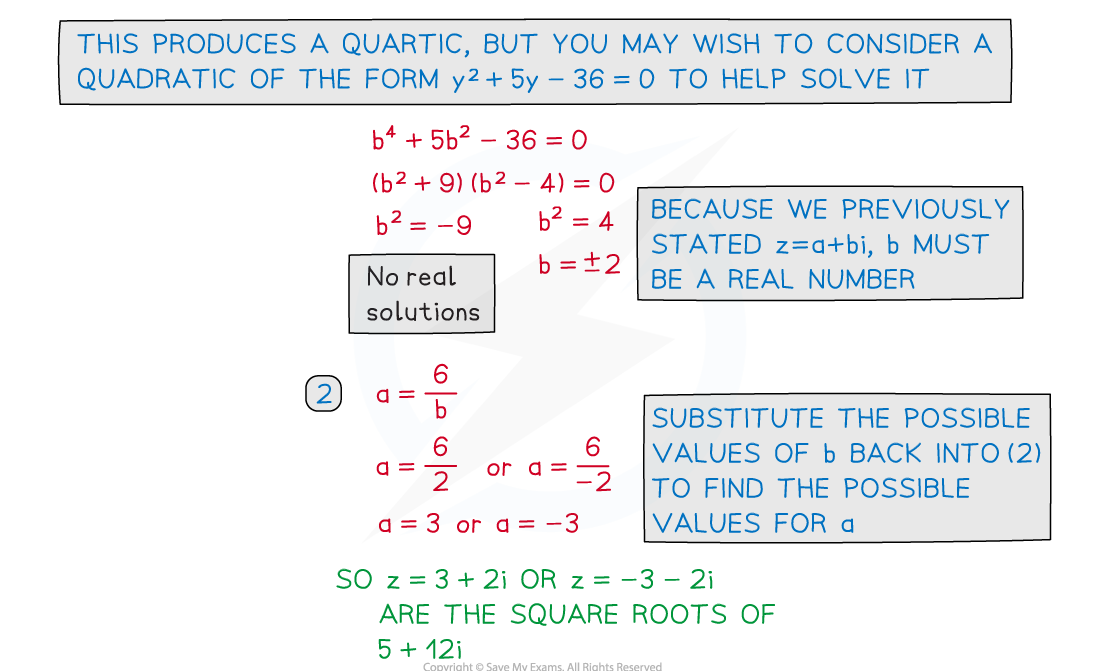
- In general, we can rearrange (2) to make and then substitute into (1)
- This will lead to a quartic equation in terms of d; which can be solved by making a substitution to turn it into a quadratic (see 1.1.5 Further Solving Quadratic Equations (Hidden Quadratics))
-
The values of can then be used to find the corresponding values of , so we now have both components of both square roots ()
-
Note that one root will be the negative of the other root
- i.e. and
Worked Example
Exam Hint
- Most calculators used at A-Level can handle complex numbers.
- Once you have found the square roots algebraically; use your calculator to square them and make sure you get the number you were originally trying to square-root!
Was this revision note helpful?
Build on this topic