Operations with Complex Numbers (Cambridge International A-Level Mathematics)
Complex Numbers – Basics
Introduction to complex numbers
Complex numbers are a set of numbers which contain both a real part and an imaginary part. The set of complex numbers is denoted as .
What is an imaginary number?
-
Up until now, when we have encountered an equation such as we would have stated that there are “no real solutions” as the solutions are which are not real numbers
-
To solve this issue, mathematicians have defined one of the square roots of negative one as ; an imaginary number
-
We can use the rules for manipulating surds to manipulate imaginary numbers.
-
We can do this by rewriting surds to be a multiple of using the fact that
What is a complex number?
-
Complex numbers have both a real part and an imaginary part
-
For example:
-
The real part is 3 and the imaginary part is 4
- Note that the imaginary part does not include the ''
-
-
Complex numbers are often denoted by and we can refer to the real and imaginary parts respectively using and
-
In general:
- This is the Cartesian form of z
Re (z)=aIm (z)=b
-
It is important to note that two complex numbers are equal if, and only if, both the real and imaginary parts are identical.
- For example, and are not equal
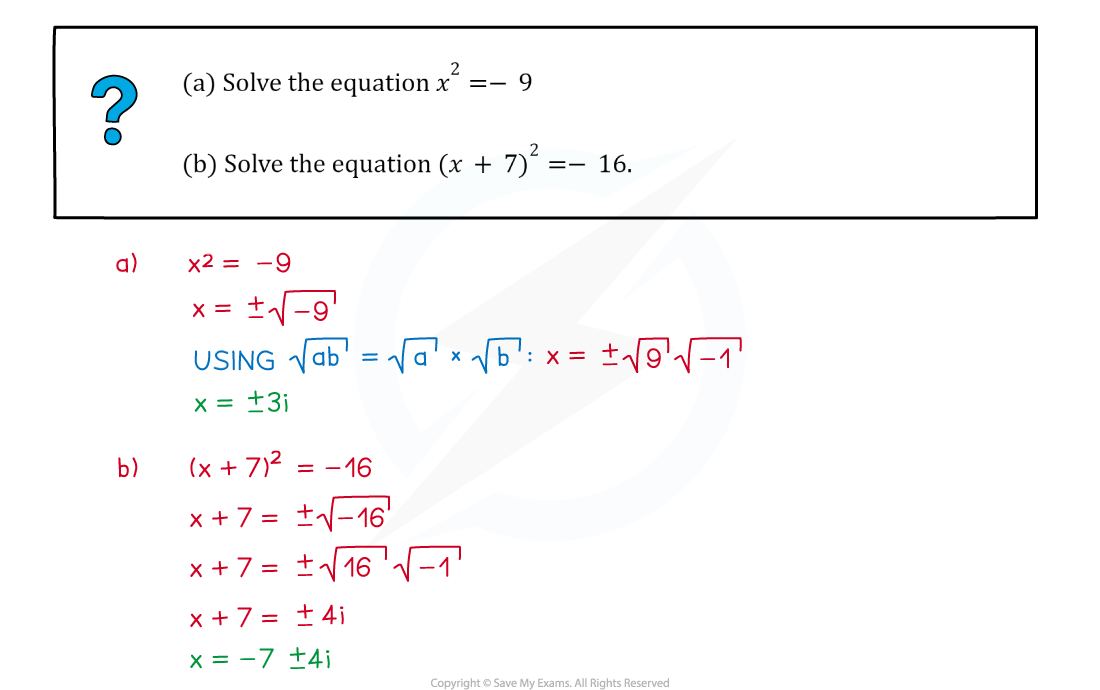
Worked Example
Exam Hint
- Be careful in your notation of complex and imaginary numbers.
- For example:
(3 √(5) icould also be written as , but if you wrote this could easily be confused with .
Complex Numbers – Basic Operations
Operations with complex numbers
How do I add and subtract complex numbers?
-
When adding and subtracting complex numbers, simplify the real and imaginary parts separately
- Just like you would when collecting like terms in algebra and surds, or dealing with different components in vectors
-
Complex numbers can also be multiplied by a constant in the same way as algebraic expressions:
How do I multiply complex numbers?
-
The most important thing to bear in mind when multiplying complex numbers is that
-
We can still apply our usual rules for multiplying algebraic terms:
(a+b)(c+d)=a c+a d+b c+b d
-
Sometimes when a question describes multiple complex numbers, the notation is used to represent each complex number
What are the powers of i?
-
Because this can lead to some interesting results for higher powers of i
-
We can use this same approach of using i2 to deal with much higher powers
- Just remember that -1 raised to an even power is 1 and raised to an odd power is -1
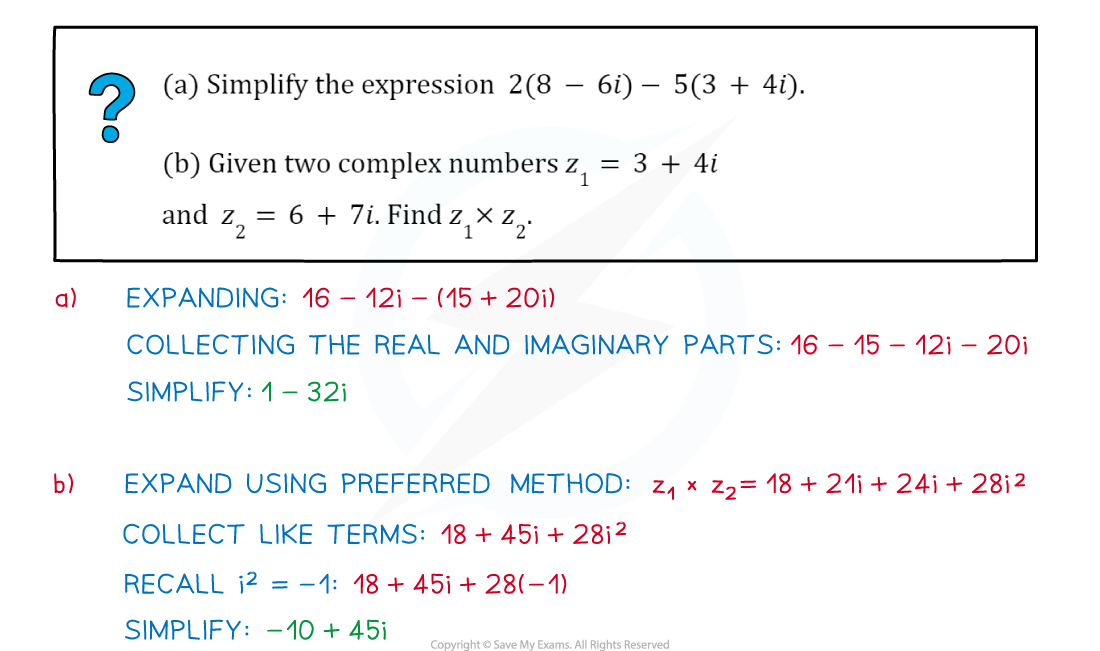
Worked Example
Exam Hint
- Most calculators used at A-Level can work with complex numbers and you can use these to check your working.
- You should still show your full working though to ensure you get all marks though.
Was this revision note helpful?
Build on this topic