Complex Roots of Polynomials (Cambridge International A-Level Mathematics)
Complex Roots of Quadratics
What are complex roots?
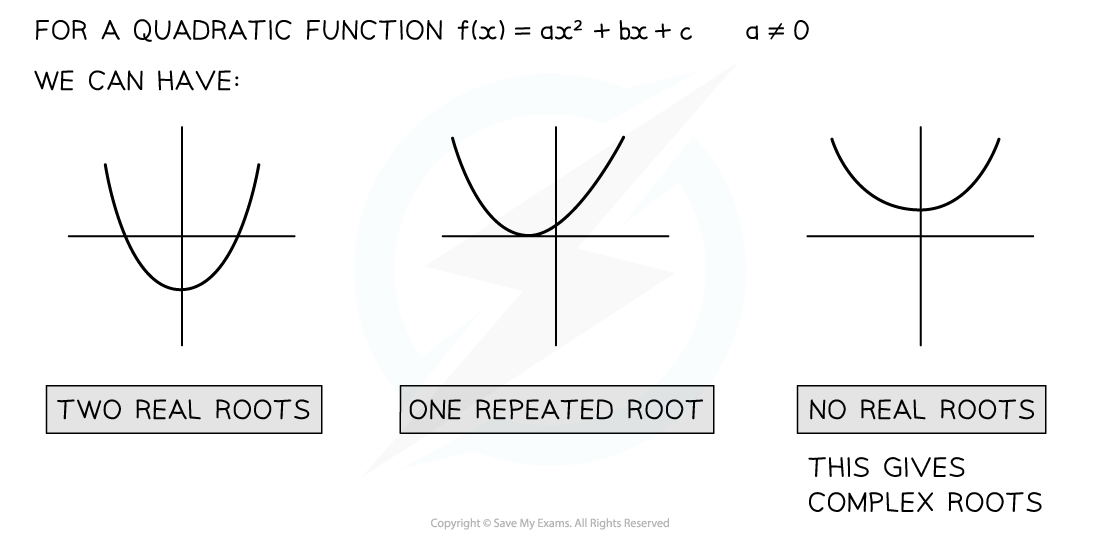
- Complex numbers provide solutions for quadratic equations which have no real roots
-
Complex roots occur when solving a quadratic with a negative discriminant
- This leads to square rooting a negative number
How do I solve a quadratic equation with complex roots?
-
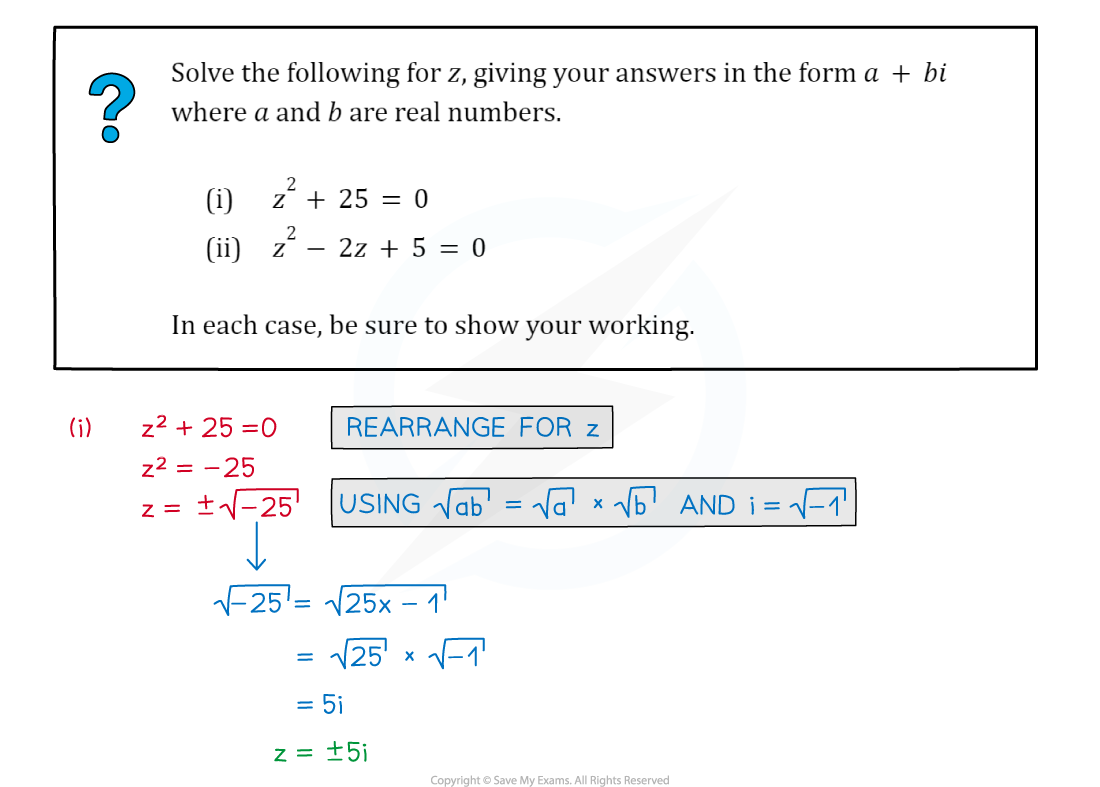
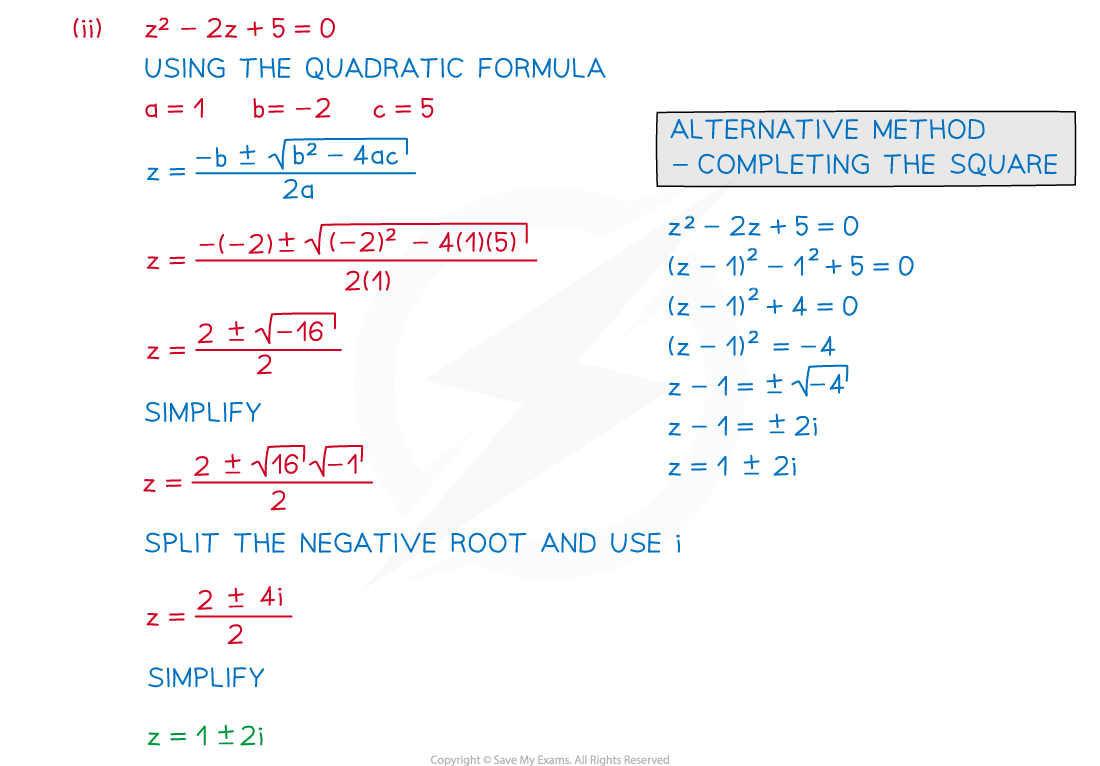
We solve an equation with complex roots in the same way we solve any other quadratic equations
- If in the form
a z²+b=0 blank (a≠0)we can rearrange to solve - If in the form we can complete the square or use the quadratic formula
- If in the form
-
We use the property along with a manipulation of surds
-
-
When the coefficients of the quadratic equation are real, complex roots occur in complex conjugate pairs
- If is a root of a quadratic with real coefficients then is also a root
-
When the coefficients of the quadratic equation are non-real, the solutions will not be complex conjugates
- To solve these use the quadratic formula
How do I find a quadratic equation given one complex root?
-
We can find the equation of the form if you are given a complex root in the form
-
We know that the complex conjugate is another root,
-
This means that and are factors of the quadratic equation
-
Therefore
z²+b z+c=left square bracket z−(m+n straight i) right square bracket left square bracket z−(m−n straight i) right square bracket- Writing this as the difference of two squares - - will speed up expanding
-
Expanding and simplifying gives us a quadratic equation where and are real numbers
-
Worked Example
Exam Hint
- Once you have your final answers you can check your roots are correct by substituting your solutions back into the original equation.
- You should get 0 if correct! [Note: 0 is equivalent to ]
Complex Roots of Cubics & Quartics
How many roots should a polynomial have?
-
We know from previous sections that every quadratic equation has two roots(not necessarily distinct)
-
This is a particular case of a more general rule:
- Every polynomial equation, with real coefficients, of degree n has n roots
- The n roots are not necessarily all distinct and therefore we need to count any repeated roots that may occur individually
-
From the above rule we can state the following:
-
A cubic equation of the form can have either:
- 3 real roots
- Or 1 real root and a complex conjugate pair
-
-
A quartic equation of the form will have the following cases for roots:
- 4 real roots
- 2 real and 2 non-real roots(a complex conjugate pair)
- 4 non-real roots (two complex conjugate pairs)
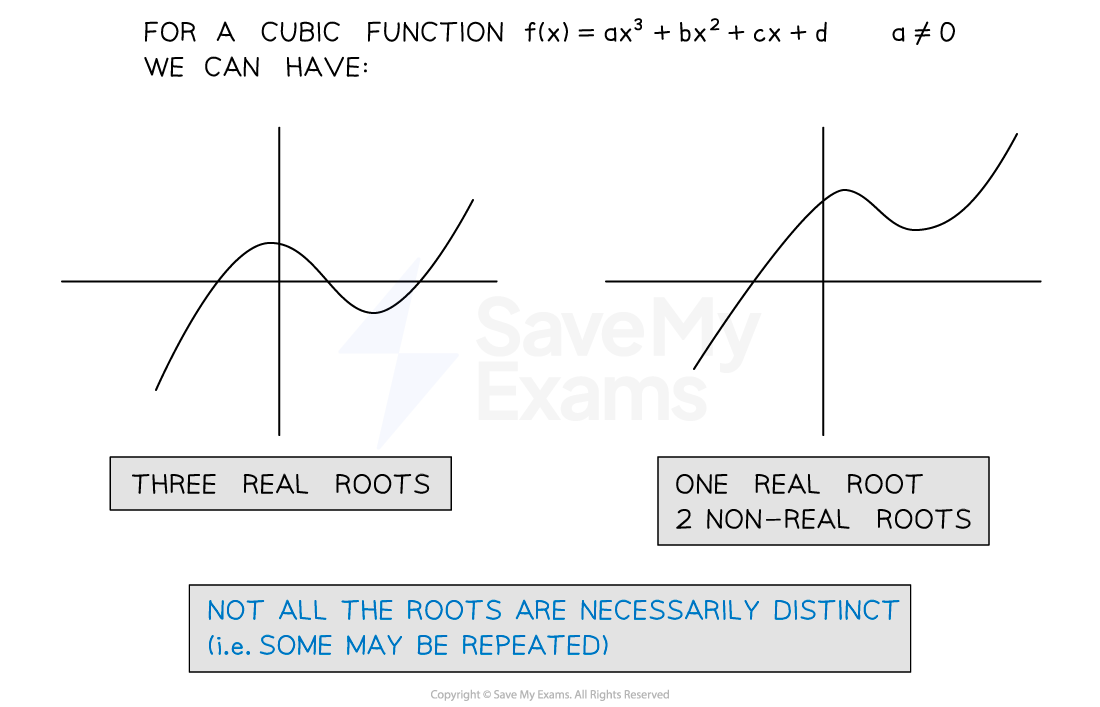
Number of roots of a cubic function
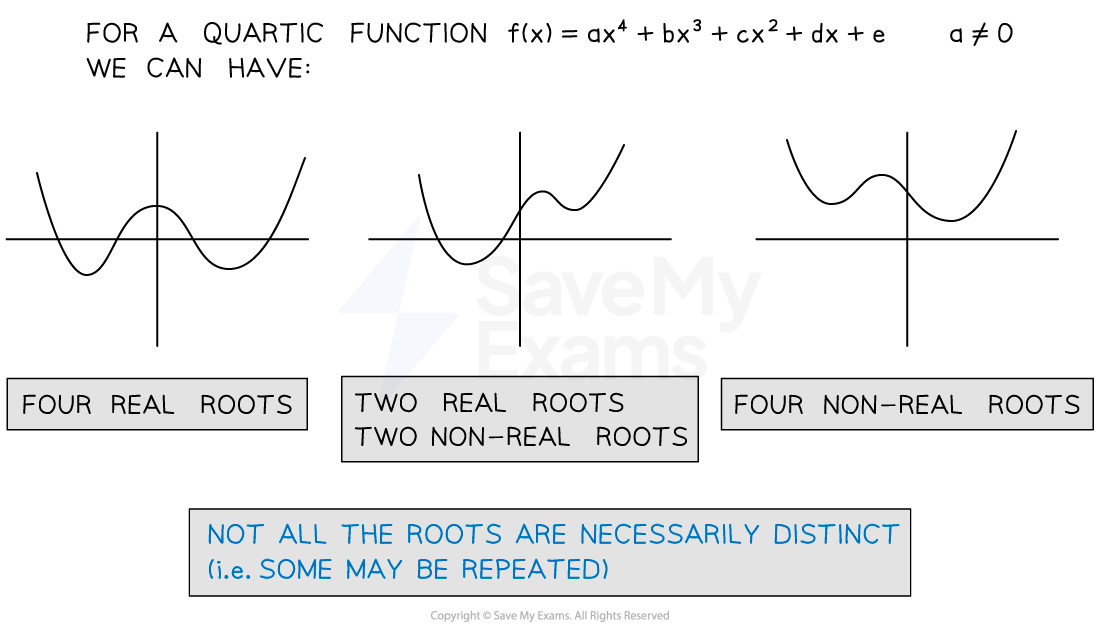
Number of roots of a quartic function
How do I solve a cubic equation given one complex root?
-
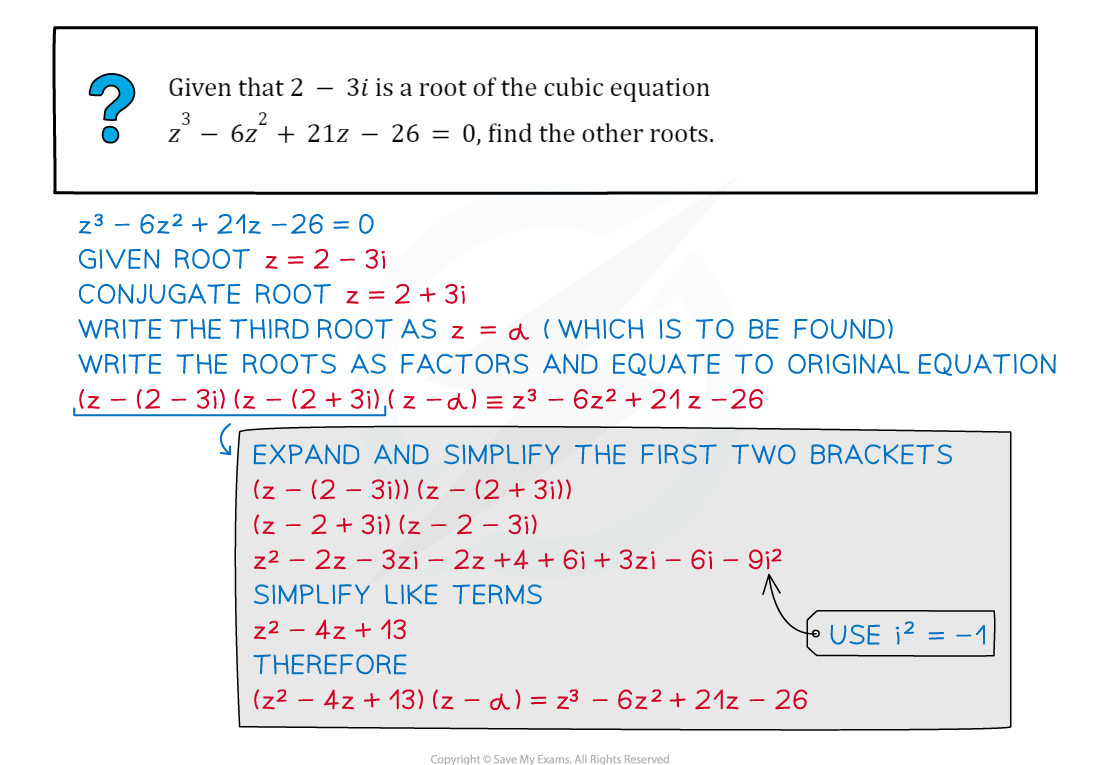
Steps to solve a cubic equation with complex roots
- If we are told that is a root, then we know is also a root
- This means that and are factors of the cubic equation
- Multiply the above factors together gives us a quadratic factor of the form
- We need to find the third factor
- Multiply the factors and equate to our original equation to get
(A z²+B z+C)(z−α)=a x³+b x²+c x+d
-
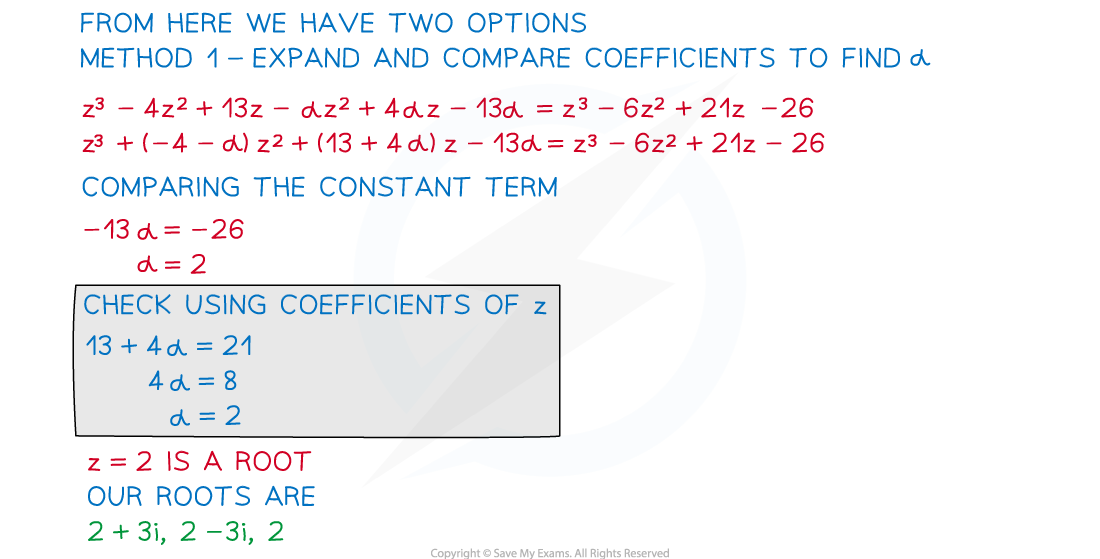
From there either
- Expand and compare coefficients to find
- Or use polynomial division to find the factor
(z−α)
-
Finally, write your three roots clearly
How do I solve a quartic equation given one complex root?
-
When asked to find the roots of a quartic equation when we are given one, we use almost the same method as we did for a cubic equation
-
State the initial root and its conjugate and write their factors as a quadratic factor (as above) we will have two unknown roots to find, write these as factors and
-
The unknown factors also form a quadratic factor
-
Then continue with the steps from above, either comparing coefficients or using polynomial division
- If using polynomial division, then solve the quadratic factor you get to find the roots and
-
How do I find unknown coefficients of cubics and quartics?
-
Steps to find unknown variables in a given equation when given a root:
- Substitute the given root into the equation
- Expand and group together the real and imaginary parts (these expressions will contain our unknown values)
- Solve as simultaneous equations to find the unknowns
- Substitute the values into the original equation
- From here continue using the previously described methods for finding other roots for either cubic/quartic equations
Worked Example
Exam Hint
- As with solving quadratic equations, we can substitute our solutions back into the original equation to check we get 0.
Was this revision note helpful?
Build on this topic