Complex Conjugation & Division (Cambridge International A-Level Mathematics)
Complex conjugation & division
When dividing complex numbers, we can use the complex conjugate to make the denominator a real number, which makes carrying out the division much easier.
What is a complex conjugate?
-
For a given complex number , the complex conjugate of is denoted as, where
-
If then
-
You will find that:
-
is always real because
- For example:
-
is always imaginary because
- For example:
-
is always real because (as )
- For example:
-
How do I divide complex numbers?
-
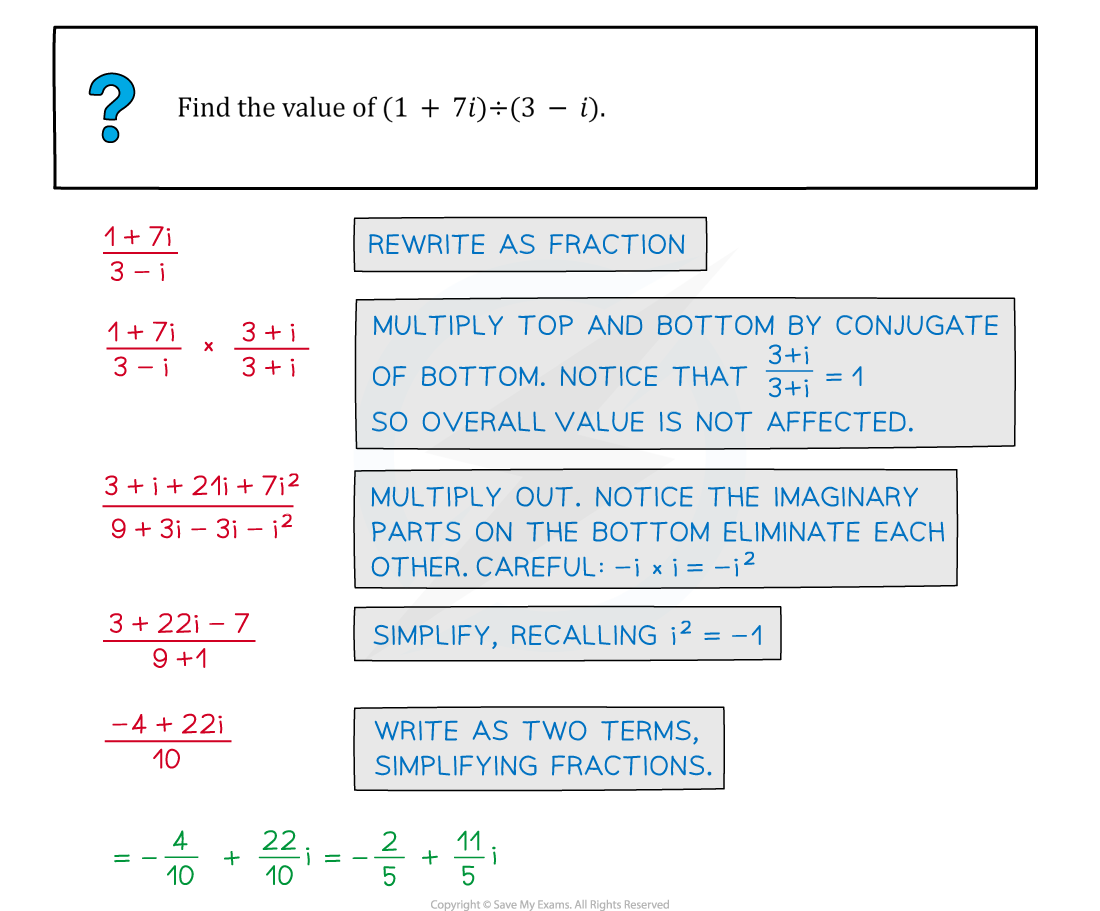
When we divide complex numbers, we can express the calculation in the form of a fraction, and then start by multiplying the top and bottom by the conjugate of the denominator:
-
This ensures we are multiplying by 1; so not affecting the overall value
-
This gives us a real number as the denominator because we have a complex number multiplied by its conjugate ()
-
This process is very similar to “rationalising the denominator” with surds
Worked Example
Exam Hint
- We can speed up the process for finding by using the basic pattern of
(x+a)(x−a)=x²−a²- We can apply this to complex numbers: (using the fact that )
- So multiplied by its conjugate would be
Was this revision note helpful?
Build on this topic