Exponential Form of Complex Numbers (Cambridge International A-Level Mathematics)
Exponential form of complex numbers
You now know how to do lots of operations with complex numbers: add, subtract, multiply, divide, raise to a power and even square root. The last operation to learn is raising the number e to the power of an imaginary number.
What is e to the power of an imaginary number?
-
Given an imaginary number (iθ) we can define exponentiation as
- is the complex number with modulus 1 and argument θ
-
This works with our current rules of exponents
-
- This shows e to the power 0 would still give the answer of 1
-
- This is because when you multiply complex numbers you can add the arguments
- This shows that when you multiply two powers you can still add the indices
-
- This is because when you divide complex numbers you can subtract the arguments
- This shows that when you divide two powers you can still subtract the indices
-
What is the exponential form of a complex number?
-
Any complex number can be written in polar form
- r is the modulus
- θ* *is the argument
-
Using the definition of we can now also write in exponential form
Why do I need to use the exponential form of a complex number?
-
It's just a shorter and quicker way of expressing complex numbers
-
It makes a link between the exponential function and trigonometric functions
-
It makes it easier to remember what happens with the moduli and arguments when multiplying and dividing
-
If and then
-
- You can clearly see that the moduli have been multiplied and the arguments have been added
-
z _ 1 / z _ 2 = r _ 1 / r _ 2 e ^ i ( theta _ 1 - theta _ 2 )- You can clearly see that the moduli have been divided and the arguments have been subtracted
-
What are some common numbers in exponential form?
-
As and you can write:
-
Using the same idea you can write:
- where k is any integer
-
As and you can write:
- Or more commonly written as
-
As and you can write:
Worked Example
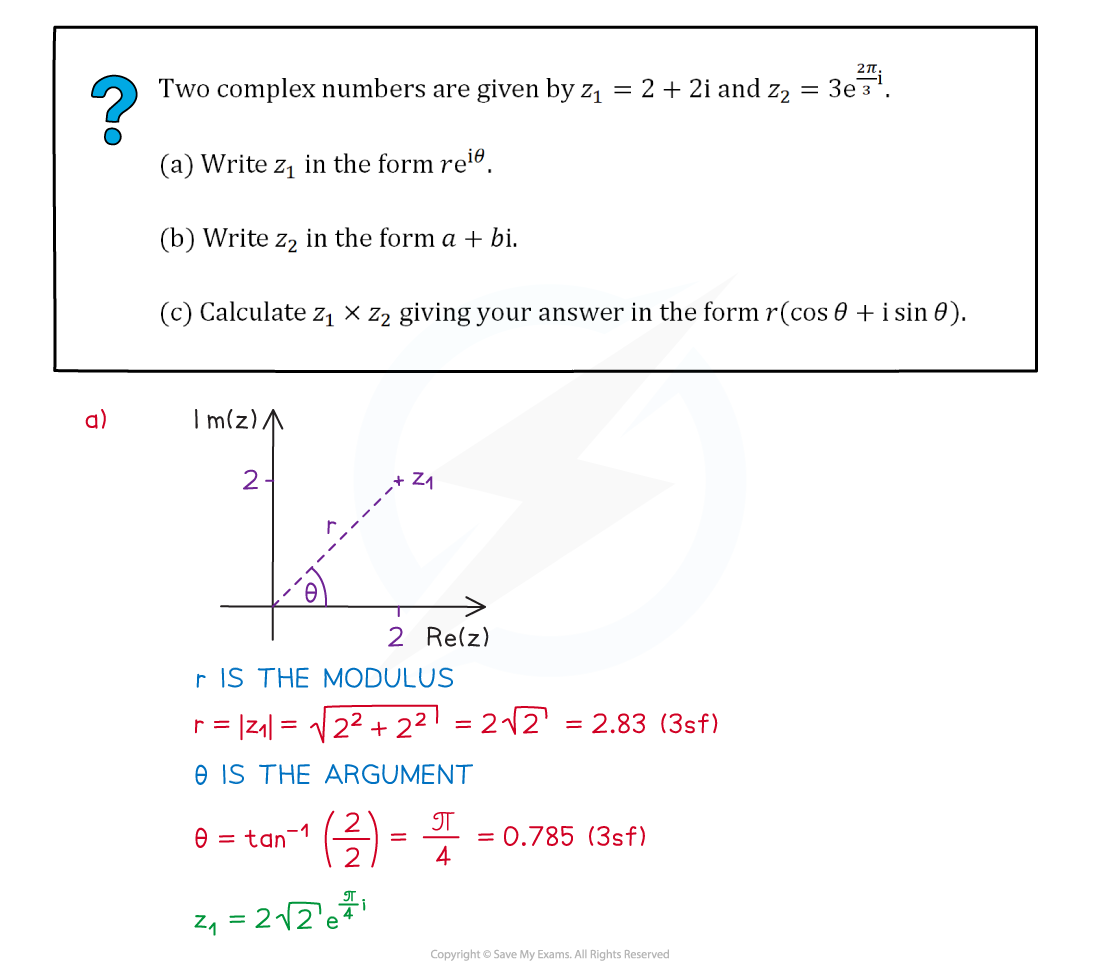
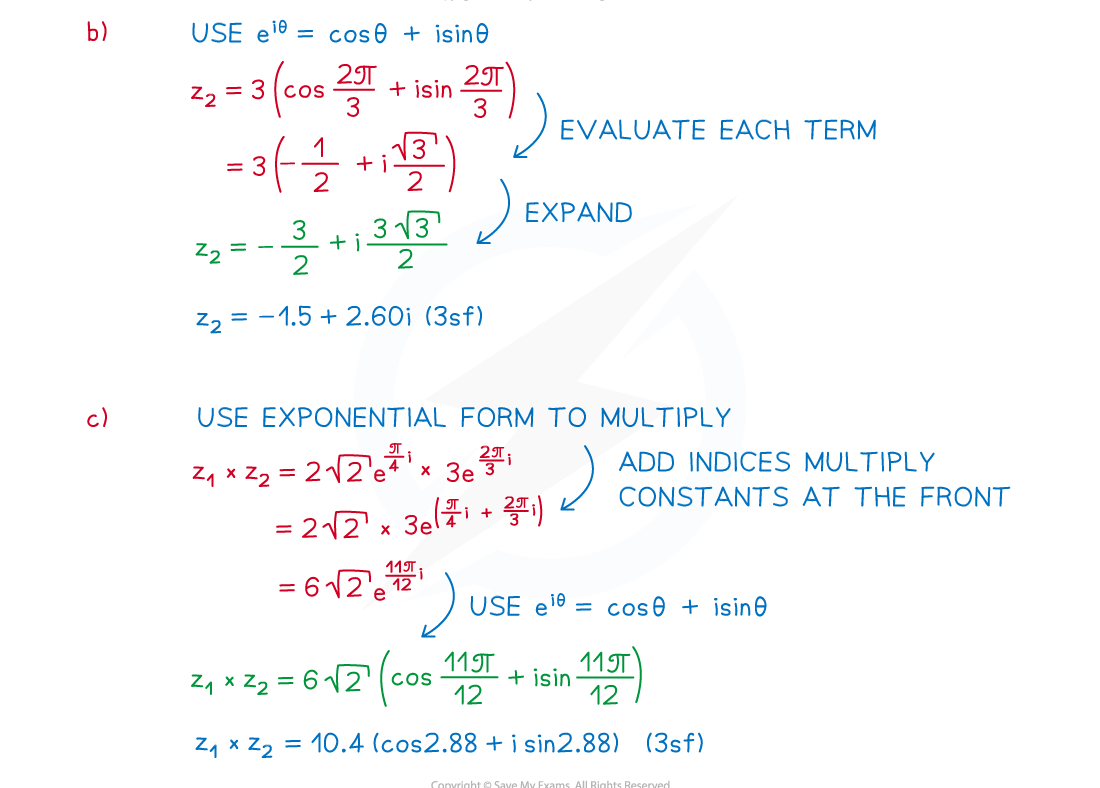
Exam Hint
- The powers can be long and contain fractions so make sure you write the expression clearly.
- You don’t want to lose marks because the examiner can’t read your answer
Was this revision note helpful?
Build on this topic