Geometry of Complex Multiplication & Division (Cambridge International A-Level Mathematics)
Geometry of complex multiplication & division
You now know how conjugation, addition and subtraction affect the geometry of complex numbers on an Argand diagram. Now we can look at the effects of multiplication and division.
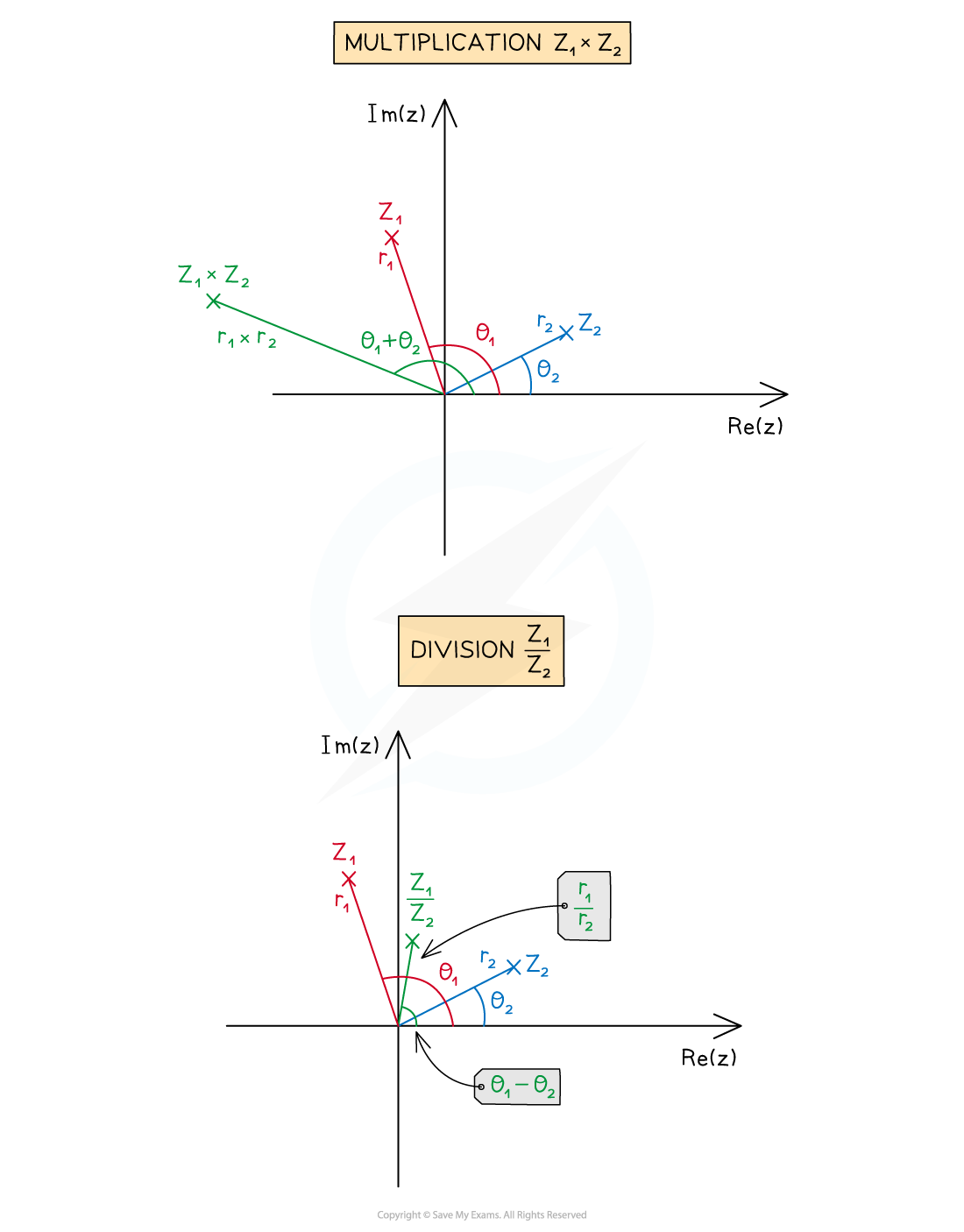
How do I sketch complex multiplication and division on an Argand diagram?
-
Let z1 and z2 be two complex numbers
- With moduli r1 and r2 respectively
- And arguments θ1 and θ2 respectively
-
To plot on an Argand diagram
-
The modulus will be
-
The argument will be
- Subtract 2π from the argument if it is not in the range
-
To plot on an Argand diagram
-
The modulus will be
-
The argument will be
- Add 2π to the argument if it is not in the range
-
-
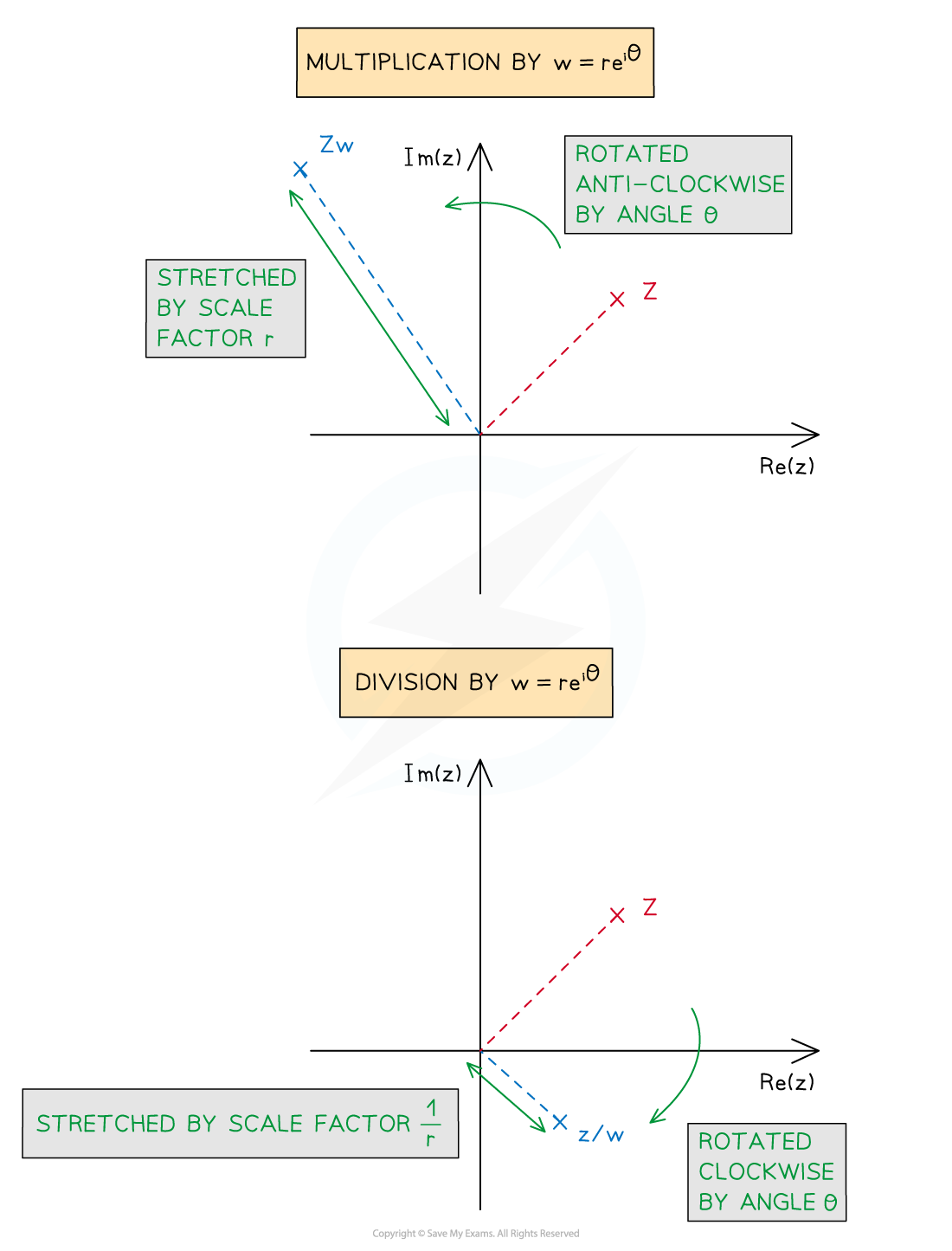
Which geometric transformations represent complex multiplication and division?
-
Let w be a given complex number with modulus r *and argument θ
- In exponential form
-
Let z be any complex number represented on an Argand diagram
-
Multiplying z by w results in z being:
-
Stretched from the origin by a scale factor of r
- If r > 1 then z will move further away from the origin
- If 0 < r < 1 then z will move closer to the origin
- If r = 1 then z will remain the same distance from the origin
-
Rotated anti-clockwise about the origin by angle θ
- If θ < 0 then the rotation will be clockwise
-
-
Dividing z by w results in z being:
-
Stretched from the origin by a scale factor of
- If r > 1 then z will move closer to the origin
- If 0 < r < 1 then z will further away from the origin
- If r = 1 then z will remain the same distance from the origin
-
Rotated clockwise about the origin by angle θ
- If θ < 0 then the rotation will be anti-clockwise
-
Worked Example
Exam Hint
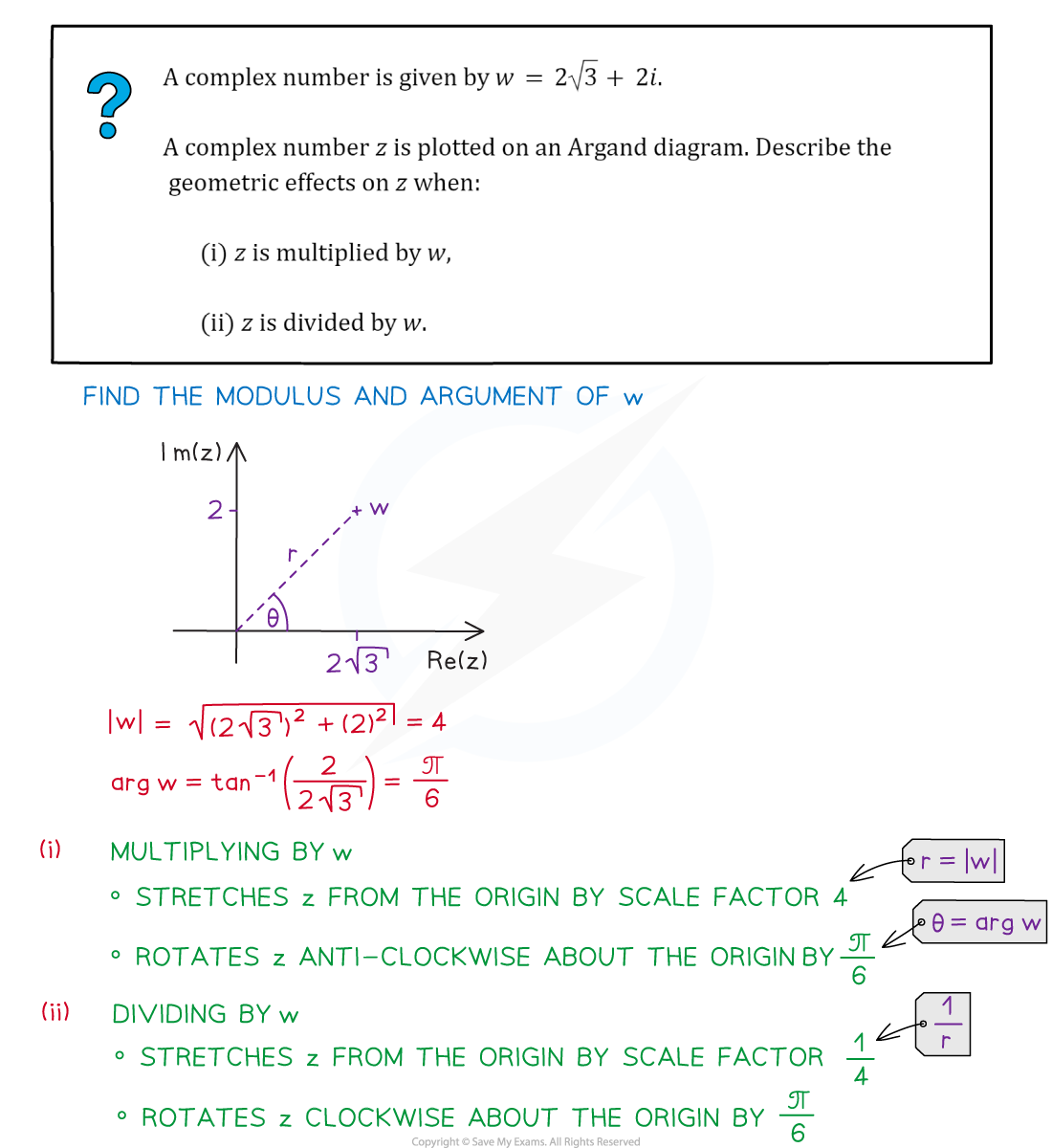
- If a complex number is given in Cartesian form, first convert it to polar form or exponential form to find the modulus and argument.
Was this revision note helpful?
Build on this topic