Marginal Revenue Product Theory (Cambridge International A-Level Economics)
Marginal revenue product theory
-
Wage rates are determined by the contribution of labour to the firm
-
Demand for labour depends on:
- The Marginal Physical Product of Labour (MPPL)
- The Marginal Revenue Product of Labour (MRPL)
-
-
The Marginal Physical Product of Labour (MPPL) is the extra output produced when an additional unit of labour is employed
- This is also known as law of diminishing marginal returns for labour
- As more workers are employed, their marginal product will eventually begin to decline
- MPP**L = **Change in **total output **divided by change in quantity of labour
-
The** Marginal Revenue Product of Labour (MRP**L) is the extra revenue earned when an additional unit of labour is employed
- If output is sold in a perfectly competitive market, then marginal revenue is equal to price charged
- MRPL = MPPL X Price
Using the MRP of labour to make a hiring decision
-
If the extra output produced when one additional labour unit is employed is 5 units and selling price of each unit is £15,
- MRPL = 5 x £15 = £75
-
Firms will only hire an additional unit of labour if the cost of hiring is equal to or less than the wage rate
-
Therefore, an extra worker needs to cost equal to or less than £75 to hire, according to marginal productivity theory of wages
Deriving an individual firm’s demand for labour
- The demand for labour/MRP curve slopes downward
- The demand curve for labour reflects diminishing marginal returns
The demand curve for labour
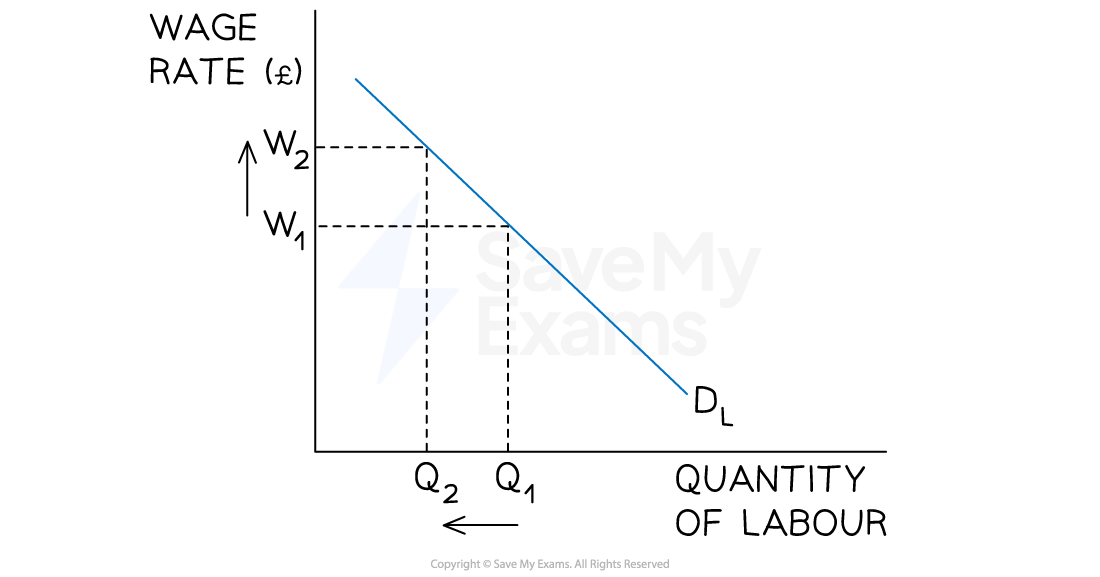
As wages rise, the quantity demanded of labour falls
-
As more workers are hired (with capital fixed):
- Each extra worker adds less extra output
- So the demand for labour contracts
- Therefore MRP falls
-
The firm hires labour until W=MRP
- At a high wage, fewer workers satisfy the condition
- At a low wage, more workers satisfy the condition
-
For every possible wage, there is a corresponding quantity of labour demanded
Was this revision note helpful?
Build on this topic