Determination of Wage Differentials (Cambridge International A-Level Economics)
Determination of wage differentials by labour market forces
Spec point —
8.3.9
-
Wage differentials are differences in pay between workers across occupations, industries and firms
- In competitive labour markets, these are determined primarily by the interaction of labour demand and labour supply
-
The equilibrium wage in any labour market is set where demand for labour equals supply of labour
- Workers in markets with high demand and restricted supply earn more than those in markets with low demand and abundant supply
-
The starting point for explaining any wage differential is marginal revenue product (MRP) theory: a firm's demand for labour is derived from the value that an additional worker adds to output
-
A worker's MRP = marginal product × price of the good or service produced
-
Firms hire up to the point where MRP = wage rate
- workers whose MRP is higher will command higher wages
-
1. Differences in the demand for labour
-
Higher demand for labour raises the equilibrium wage, shifting the demand curve for labour to the right and increasing the wage rate at any given level of supply
-
Demand for labour is a derived demand — it depends on the demand for the final good or service the worker helps produce
- A Premier League footballer generates enormous revenues for their club — their MRP is very high, so clubs are willing to pay exceptionally high wages
- A supermarket cashier contributes to the sale of low-margin goods — their MRP is modest, and wage rates reflect this
-
Changes in the demand for skills can widen or narrow differentials over time
- Rising demand for data scientists and software engineers — driven by rapid growth in the technology sector — has shifted their labour demand curve significantly to the right, raising wages substantially relative to other graduate occupations
2. Differences in the supply of labour
-
Restricted supply of labour pushes wages up
- Where few workers can do a job, employers must offer higher wages to attract and retain staff
-
Supply of labour to an occupation depends on:
-
Length and cost of training
- Becoming a surgeon requires over a decade of training; the supply of surgeons is highly inelastic, sustaining high wages even when demand is relatively stable
-
Non-monetary characteristics of the job
- Dangerous, unpleasant, or antisocial-hours work requires a compensating wage differential to attract workers
-
Barriers to entry
- Professional licensing, qualifications, and union membership restrictions all limit the supply of labour, keeping wages above the level that would prevail in a fully competitive market
-
The role of elasticity of supply
| Supply condition | Effect on wages | Example |
|---|---|---|
| - Wage-inelastic supply (very limited workers available) | - High wages; large wage differentials | - Brain surgeons, commercial airline pilots |
| - Wage-elastic supply (many workers available) | - Low wages; small wage differentials | - Supermarket cashiers, unskilled manual workers |
-
Where supply is wage-inelastic, even a small rightward shift in demand produces a large increase in the wage rate
- This explains extreme differentials at the top of the earnings distribution
3. Compensating wage differentials
-
Some wage differentials arise not from skill differences but from the characteristics of the job itself
-
Workers must be compensated for jobs that are:
- physically dangerous (e.g. deep-sea fishing, construction)
- unpleasant or socially stigmatised
- requiring unsociable hours or significant geographical mobility
-
These compensating differentials are a labour market force
- Without them, supply to these occupations would fall, creating labour shortages
Exam Hint Always anchor your explanation of wage differentials in MRP theory - the demand for labour is derived from the value a worker adds, so differences in productivity and the price of the final product explain much of why wages differ. A surgeon and a retail assistant both work hard, but their MRPs - and therefore their wages - differ enormously.
The elasticity of labour supply is the key supply-side concept: inelastic supply (due to long training or scarce talent) keeps wages high; elastic supply keeps wages down by ensuring employers always have alternative workers available.
Avoid treating discrimination, government policy or bargaining power as labour market forces - these are institutional factors. Keep analysis rooted in demand, supply, MRP, and elasticity.
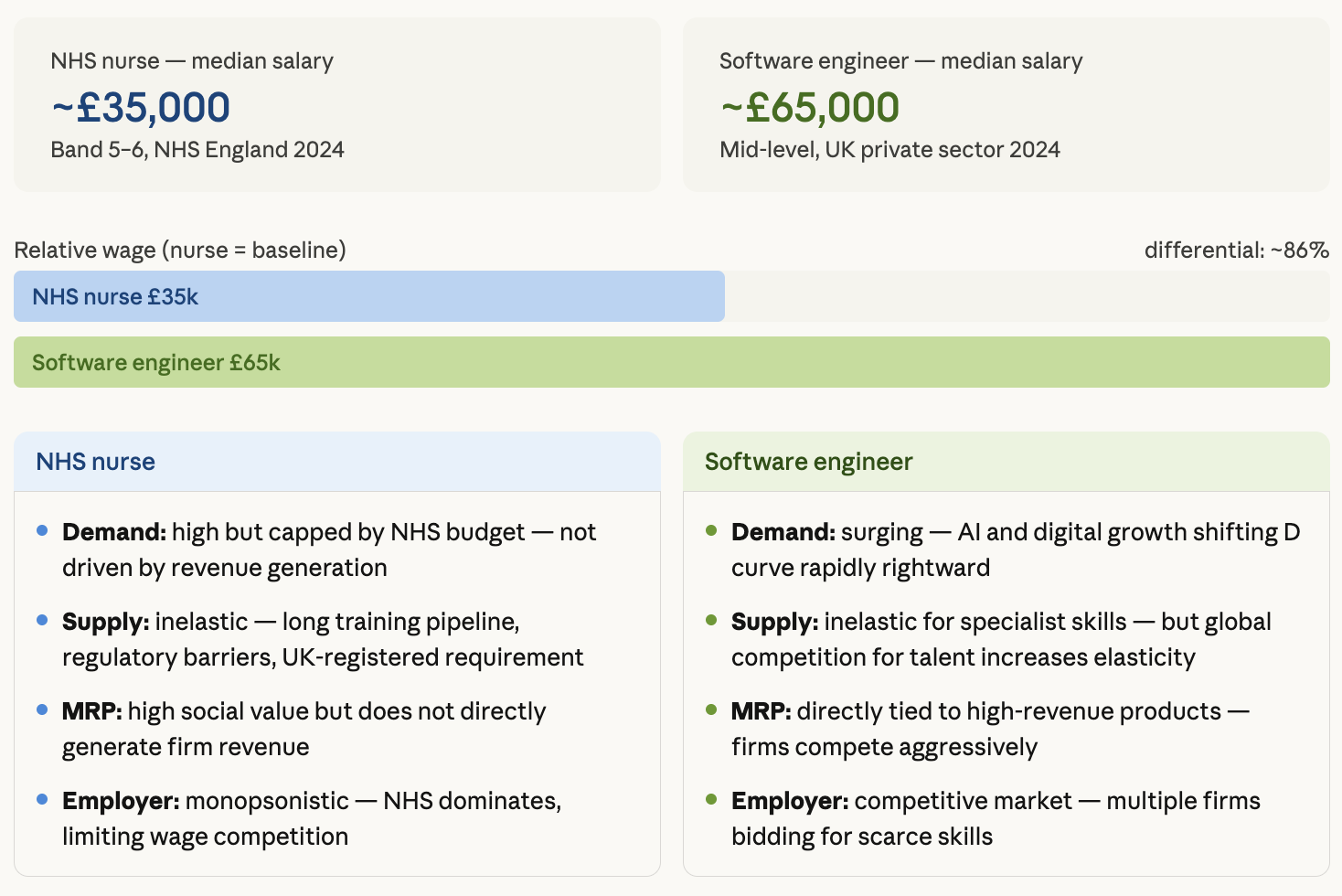
Case Study Wage differentials in the UK - nurses vs. software engineers
The context
Both nursing and software engineering require significant post-secondary training and carry professional responsibilities. Yet median annual earnings for software engineers in the UK are roughly double those of NHS nurses — a persistent differential that illustrates how labour market forces operate in practice.
The labour market verdict
Both occupations require significant training and carry high responsibility — but the software engineer's MRP is tied directly to private sector revenue, supply conditions are shaped by global tech demand, and multiple employers compete for talent
The nurse faces a monopsonistic employer whose wage bill is politically constrained. The differential reflects market forces, not social worth.
Was this revision note helpful?