Boolean Algebra (Cambridge International A-Level Computer Science)
Exam board Cambridge International · A-LevelUpdated 2026-10-01
Boolean algebra
What is Boolean algebra?
- Boolean algebra is a mathematical system used to manipulate Boolean values
- Complex expressions can be made simpler using the rules of Boolean algebra
- This is a more powerful simplification method than Karnaugh maps and can simplify expressions that Karnaugh maps cannot
- There are various different **rules **that you need to learn and that can then be applied to certain expressions to simplify them
- Combining these rules can mean that complex expressions can be** reduced to much simpler ones**
General rules
-
General AND rules
- X AND 0 = 0
- X AND 1 = X
- X AND X = X
- NOT X AND X = 0
-
Note, the value of X is unknown and it is used as a placeholder
-
Therefore X AND 1 = X means that the output will be whatever the value of X is
-
General OR rules
- X OR 0 = X X OR 1 = 1 X OR X = X NOT X OR X = 1
Boolean algebra notation
- In Boolean algebra, expressions are written using shorthand notation:
| Symbol | Meaning | Example | Explanation |
|---|---|---|---|
or AB | AND | A · B | True only if both A and B are 1 |
| OR | A + B | True if either A or B is 1 | |
| NOT / complement | True if A is 0, False if A is 1 | ||
( ) | Brackets / grouping | (A + B)·C | Do A OR B first, then AND with C |
Exam Hint A dot (
·) for AND is often omitted, soABmeansA AND B
- A line drawn above a variable or expression means that the value is inverted or negated
- It's the NOT of that value
| Notation | Meaning | Explanation |
|---|---|---|
| NOT A | True if A is False, False if A is True | |
| A AND (NOT B) | B is negated before the AND operation | |
| NOT (A OR B) | The entire OR expression is negated (use De Morgan) | |
| NOT (A AND B AND C) | All values are ANDed together, then the result is negated |
- When you see multiple horizontal lines, for example:
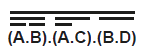
- It means the whole expression is negated, not just one part
- Always apply De Morgan’s Law starting with the outermost line first
De Morgan's Law
What is De Morgan’s Law?
-
De Morgan’s Laws are used to simplify Boolean expressions involving negation of conjunctions (AND) or disjunctions (OR)
-
They are particularly useful for rewriting logic circuits using only NAND or NOR gates
-
There are two key rules:
- NOT (A AND B) is equivalent to (NOT A) OR (NOT B)
- NOT (A OR B) is equivalent to (NOT A) AND (NOT B)
A + B -bar = top A . top B
Worked example 1: Simplify ¬(A ∧ B)
| Step | Explanation | Expression |
|---|---|---|
| Step 1 | Start with the original expression | top A . B |
| Step 2 | Apply De Morgan’s Law: change ∧ to ∨ and negate both terms | |
| Step 3 | Remove unnecessary brackets |
Worked example 2: Simplify ¬(A ∨ B)
| Step | Explanation | Expression |
|---|---|---|
| Step 1 | Start with the original expression | top A + B |
| Step 2 | Apply De Morgan’s Law: change ∨ to ∧ and negate both terms | |
| Step 3 | Remove unnecessary brackets |
Why use De Morgan’s Laws?
-
Simplifying Boolean expressions using De Morgan’s Laws:
- Allows for implementation using only NAND or NOR gates
- Makes circuit design more efficient and cost-effective
- Is essential in hardware where NAND/NOR logic is cheaper or faster to implement
- Is commonly used in microprocessor and memory device design (e.g. flash drives)
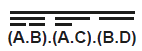
Worked Example Simplify the following expression using Boolean algebra, including De Morgan’s laws. Show your working.[3]
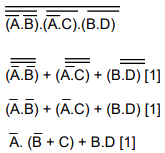
Final answer: Answer
- Correct application of De Morgan’s Law [1 mark]
- Correct application of Double Negation Law or Distributive Law [1 mark]
- Correct answer [1 mark]
Was this revision note helpful?