Interpreting & Explaining Carbon-13 NMR Spectroscopy (Cambridge International A-Level Chemistry)
Interpreting & Explaining Carbon-13 NMR Spectra
-
Nuclear Magnetic Resonance (NMR) spectroscopy is used for analysing organic compounds
-
Atoms with odd mass numbers usually show signals on NMR
- For example isotopes of atoms
- Many of the carbon atoms on organic molecules are carbon-12
- A small quantity of organic molecules will contain the isotope carbon-13 atoms
- These will show signals on a 13C NMR
-
In 13C NMR, the magnetic field strengths of carbon-13 atoms in organic compounds are measured and recorded on a spectrum
-
Just as in 1H NMR, all samples are measured against a reference compound – Tetramethylsilane (TMS)
-
On a 13C NMR spectrum, non-equivalent carbon atoms appear as peaks with different chemical shifts
Chemical shift values (relative to TMS) for 13C NMR analysis table
| Hybridisation of carbon atom | Environment of carbon atom | Example | Range of chemical shift (ppm) |
|---|---|---|---|
| sp3 | alkyl | CH3–, CH2–, CH–, –C– | 0 - 50 |
| sp3 | next to alkene / arene | –C–C=C, –C–Ar* | 25 - 50 |
| sp3 | next to carbonyl / carboxyl | C–COR, C–CO2R | 30 - 65 |
| sp3 | next to halogen | C–X | 30 - 60 |
| sp3 | next to oxygen | C–O | 50 - 70 |
| sp2 | alkene / arene | –C=C–, –Ar– | 110 - 160 |
| sp2 | carboxyl | R–COOH, R–COOR | 160 - 185 |
| sp2 | carbonyl | R–CHO, R–CO–R | 190 - 220 |
| sp | nitrile | R–CN– | 100 - 125 |
- represents a benzene ring
Features of a 13C NMR spectrum
-
13C NMR spectra display sharp single signals
- There aren’t any complicated spitting patterns as seen with 1H NMR spectra
-
The height of each signal is not proportional to the number of carbon atoms present in a single molecular environment
-
CDCl3 is used as a solvent to dissolve samples for 13C NMR
- On spectra, a single solvent peak appears at 80 ppm caused by 13C atoms in the CDCl3
- This can be ignored when interpreting 13C spectra
Explaining 13C molecular environments
- On an organic molecule, the carbon-13 environments can be identified in a similar way to the proton environments in 1H NMR
- For example, propanone
Identifying molecular environments in propanone
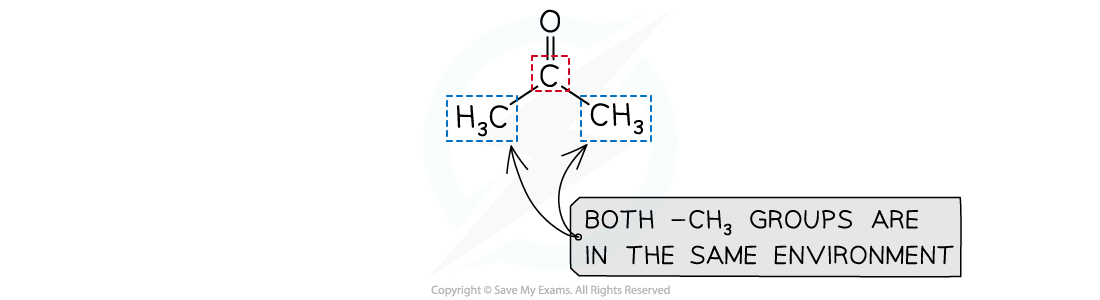
There are 2 molecular environments in propanone
-
There are 2 molecular environments
- Therefore, 2 signals will be present on its 13C NMR spectrum
-
The carbonyl carbon will produce a 13C peak in the range of 190 - 220 ppm
-
The 2 methyl groups will produce a 13C peak in the range of 30 - 65 ppm
Carbon-13 NMR spectrum for propanone
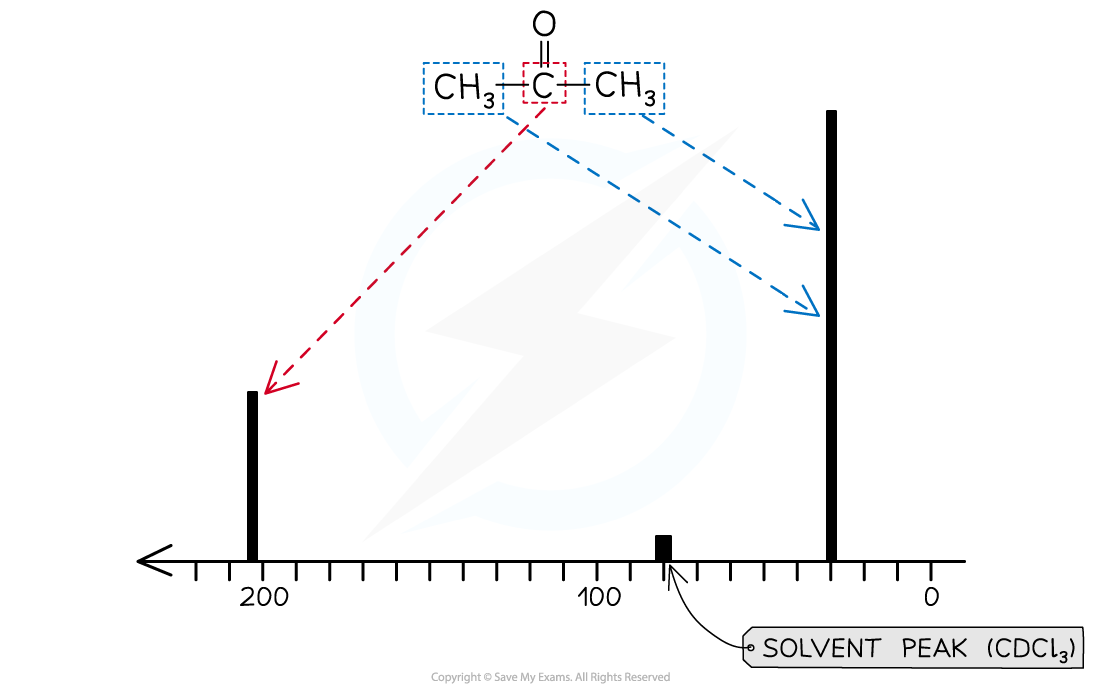
The13C NMR of propanone shows 2 signals for the 2 molecular environments
Was this revision note helpful?
Build on this topic