Income Elasticity of Demand (Cambridge International A-Level Business)
The concept of income elasticity of demand
-
Income elasticity of demand (YED) measures the responsiveness of demand for a product to a change in income levels
- Businesses are interested in how much the quantity demanded will change for different products
-
When household incomes change, spending on goods and services will either increase or decrease, depending on the type of good or service it is
- Normal good: A good where demand rises when income increases, e.g. restaurant meals or new clothes
- Inferior good: A good where demand falls when income increases, e.g. instant noodles or bus travel
- Luxury good: A good where demand increases more than proportionally as income increases, e.g. designer handbags or sports cars
Calculating and interpreting income elasticity of demand
-
The YED value can be positive or negative, and the value is important in determining the type of good
-
A good with a positive YED value is considered to be a normal good
- Normal goods can be classified as necessities or luxuries
-
A good with a negative YED value is considered to be an inferior good
-
-
YED is calculated using the formula
Worked Example An individual’s income falls from £450 to £405 per week. As a result, their demand for takeaway meals falls from 50 to 30 per week.
Calculate the income elasticity of demand (YED) for takeaway meals.
[4]
Step 1: State the YED formula
(1)
Step 1: Calculate the % change in QD
$% \text{change} \text{in} \text{QD} = \frac{50 - 30}{50} \times 100
= - 40 %$ (1)
Step 2: Calculate the % change in Y
$% \text{change} \text{in} \mathrm{Y} = \frac{\pounds 450 - \pounds 405}{\pounds 450}
= - 10 %$ (1)
Step 3: Insert the above values in the YED formula
$\text{YED} = \frac{- 40 %}{- 10 %}
= 4$(1)
Influences on YED
-
YED is influenced by many factors in an economy that change the wages of workers
- During a recession,wages usually fall and demand for inferior goods **rises while demand for luxury goods falls
- During a period of economic growth and rising wages, demand for luxury goods increases while demand for inferior goods decreases
- Other influences on income include minimum wage legislation**, taxation and increased international trade
-
Understanding the income elasticity of demand is useful to businesses, as it can help them plan their production and products
- Planning in this way will help them generate higher profits and be less exposed to economic downturns
Interpreting YED values
YED is more than 1 and positive
-
Normal good
- Examples: cars, foreign holidays, cinema visits and branded goods
- Demand rises when income rises
- Demand falls when income falls
- Demand is responsive to a change in income (income elastic)
YED is between 0 and 1 and positive
-
Necessity good
- Examples: bread, milk, fuel, toothpaste
- Demand rises slightly as income rises
- Demand falls slightly as incomes fall
- Demand is not very responsive to a change in income (income inelastic)
YED is negative
-
Inferior good
- Examples: public transport, domestic holidays, canned foods, own-label goods
- Demand rises when income falls
- Demand falls when income rises
- Negative income elasticity
The impact of income elasticity of demand on decisions
Pricing and promotion
-
Firms can anticipate changes in demand when incomes rise or fall:
- Products with high positive YED (luxury goods) will see demand increase more than proportionally as income rises
- During a downturn, demand for such products may fall sharply, so businesses may need to lower prices or offer discounts
- For necessities (low YED, close to zero), demand is less sensitive to income, so businesses can maintain prices even in economic downturns
Product and capacity planning
-
Positive income elasticity signals a non-necessity or luxury item, where sales rise as incomes rise
- Burberry enjoys strong growth when wages improve, so the firm expands its high‑end ranges and store space
-
Negative income elasticity identifies inferior goods
- Supermarket "value" noodles sold more during the 2022–23 cost‑of‑living squeeze, so factories increased night shifts to cope
- Oatly’s premium oat milk drink saw fast UK sales growth as incomes recovered in 2024, so the brand invested in a new Peterborough packing facility
Marketing objectives
-
Firms set objectives using elasticity estimates
- B&Q identified that spending on DIY products is income elastic, so it continued to add products to its portfolio during the recent economic downturn
Inventory and production schedules
- Knowing that Pumpkin Spice Lattes have a high positive PED but a strong seasonal YED, Starbucks launches them every August and adjusts its coffee bean orders months ahead
Risk management
-
Airlines such as Ryanair use dynamic pricing models built on PED estimates
- If a flight is 80% full, prices rise sharply because late bookers are less price‑sensitive
Exam Hint If you're using PED or YED data, don’t stop at calculating it
Always say how it affects pricing or sales decisions
Limitations of income elasticity of demand
- Income elasticity of demand helps businesses understand if their product is a luxury, necessity or inferior good
- However, just like with PED, there are limits to how useful YED is when making business decisions
Key limitations of YED
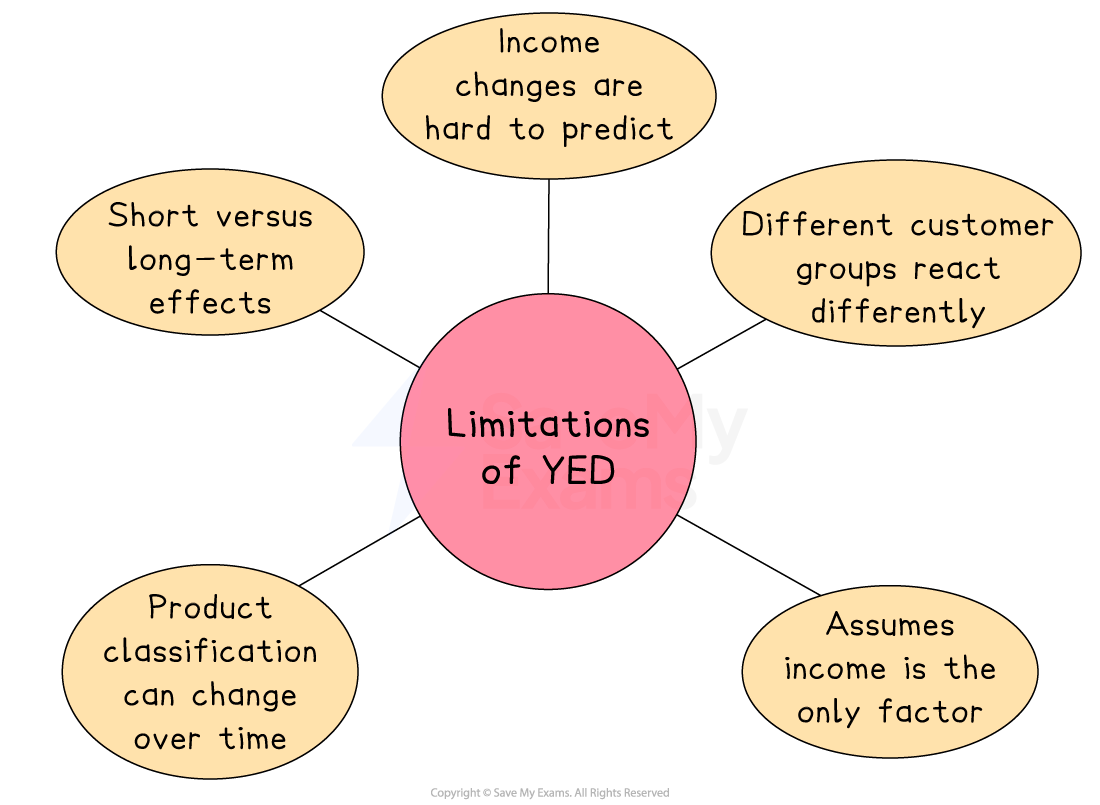
Limitations of YED include the different reactions of customer groups and the assumption that income is the only factor affecting demand
-
Income changes are hard to predict
-
It’s difficult to know exactly when or how much people’s income will rise or fall
- E.g. A sudden cost-of-living crisis could reduce incomes and demand for luxury items faster than expected
-
-
Different customer groups react differently
-
Not everyone’s income changes in the same way, so demand might not shift evenly
- E.g. A business may target high earners, but average YED data includes lower-income groups too
-
-
Assumes income is the only factor
-
YED focuses on income changes but ignores other factors like trends, advertising or substitutes
- E.g. A healthy food company may see demand rise due to a trend, not just because incomes have increased
-
-
Product classification can change over time
-
A product that is seen as a luxury today might become a necessity tomorrow
- E.g. Smartphones were once luxuries, but now they are widely considered to be essential
-
-
Short-term versus long-term effects
-
Demand might react slowly to income changes, especially if customers delay spending
- E.g. After getting a pay rise, an individual may not upgrade their car straight away
-
Was this revision note helpful?
Build on this topic