Price Elasticity of Demand (Cambridge International A-Level Business)
The concept of price elasticity of demand
-
Price elasticity of demand (PED) measures how responsive demand* for a product is to a change in price
-
In general,
- when the price for a product increases, demand falls
- when the price for a product decreases, demand rises
-
PED answers the question: By how much will demand change?
-
Calculating and interpreting price elasticity of demand
Calculating price elasticity of demand
-
PED will always be a negative value due to the inverse relationship between price and quantity
- If the price goes up, the quantity demanded goes down
- If the price goes down, the quantity demanded goes up
-
PED can be calculated using the formula
- To calculate a % change, use the formula
Worked Example Helsinki Hurricanes sells team shirts for $24. In 2024 it sold 3,240 shirts at this price. Due to increased costs, the team manager has decided to increase the price to $30 per shirt from 2025. She expects demand to fall by 12%.
Calculate the price elasticity of demand for Helsinki Hurricanes team shirts.
(2)
Step 1: Calculate the percentage change in price
= \frac{\ 30 - $ 24}{$ 24} \times 100
= 25 %$ [1]
Step 2: Divide the percentage change in demand by the percentage change in price
$= \frac{- 12 %}{25 %}
= - 0.48$ [1]
- In some cases, you may be required to calculate the percentage change in price or demand
- This involves rearranging the PED formula
Worked Example The price elasticity of demand for popcorn at the cinema is –0.8. The current price of a box of popcorn is $5.
Using the data, calculate the percentage change in quantity demanded following a $1 increase in the price of a box of popcorn. You are advised to show your work.
[4]
Step 1: State the PED formula
**(1 )
** Step 2: Calculate the percentage change in price
= \frac{\ 6 - $ 5}{$ 5} \times 100
= 20 % \text{increase}$ **(1 )
** Step 3: Insert the data you have been given into the formula
**(1 )
** Step 4: **Rearrange and solve for x
$x = - 0.8 \times 20
x = - 16 %$** (1 )
Step 5: Present the final answer
- The quantity demanded falls by 16% (4)
Exam Hint Remember the key facts:
- If price decreases, demand increases
- If price increases, demand decreases
In the example above, price increases, so demand must fall
Interpreting price elasticity of demand
1. Price elastic demand
-
PED value lower than -1 (e.g -1.2)
-
Demand is more responsive to a change in price
- For every 1% change in price, demand will change by more than 1%
-
An increase in price will lead to a fall in revenue; a decrease in price will lead to an increase in revenue
- Examples include luxury products such as cars, smartwatches, foreign holidays, cinema visits, jewellery and branded goods
2. Price inelastic demand
-
PED value is between 0 and -1 (e.g -0.7)
-
Demand is less responsive to a change in price
- For every 1% change in price, demand will change by less than 1%
-
An increase in price will lead to an increase in revenue; a decrease in price will lead to an decrease in revenue
-
Examples include necessities such as bread, milk, eggs and potatoes; fuel; rent; toothpaste
- Also addictive products such as cigarettes and sugary foods
-
Exam Hint Focus on the size of the number
−1.2 is price elastic, −0.5 is price inelastic. Always link what that means for the business revenue when the price changes
The impact of price elasticity of demand on decisions
The impact of price elasticity of demand on pricing decisions
-
If businesses can determine the price elasticity of demand for their products, they can adjust pricing strategy to maximise revenue
-
If demand for their products is relatively price inelastic (between 0 and -1), raising the price will lead to an increase in total revenue
-
However, lowering the price will lead to a fall in total revenue
- Price skimming strategies are best employed for products that are price inelastic in demand
-
If demand for their products is relatively price elastic (PED > -1), raising the price will lead to a fall in total revenue
-
However, lowering the price will lead to a rise in total revenue
- Competitive pricing strategies are best employed for products that are price elastic in demand
Price elasticity of demand and total revenue
Price elastic demand
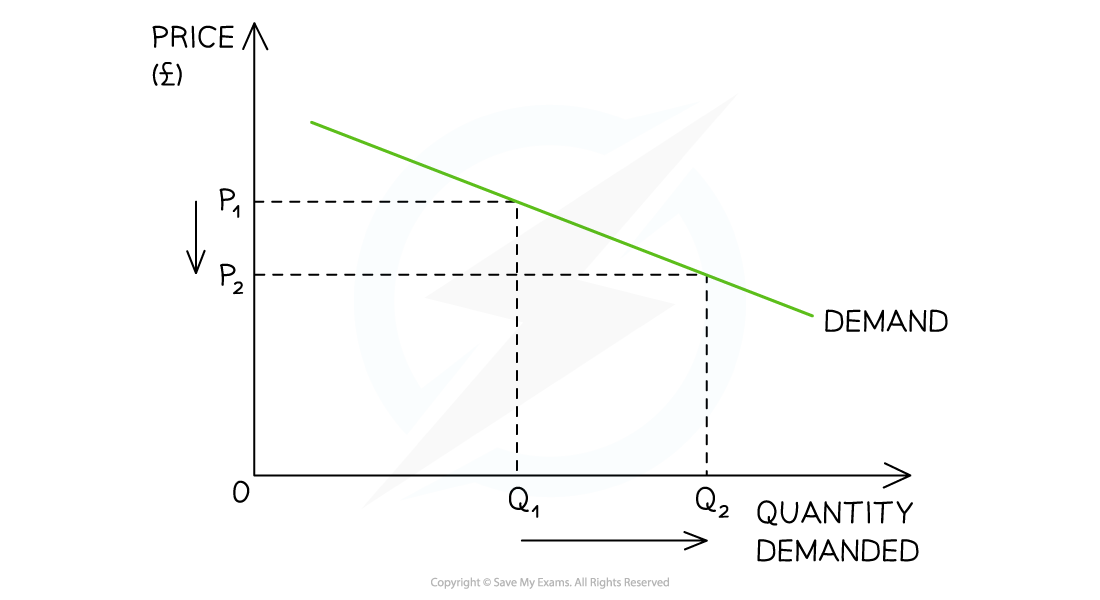
Price elastic demand
- PED is greater than 1
- An increase in selling price reduces the total amount of revenue generated from sales
- A reduction in selling price increases the total amount of revenue generated from sales
Price inelastic demand
Price inelastic demand
- PED is between 0 and 1
- An increase in selling price increases the total amount of revenue generated from sales
- A reduction in selling price reduces the total amount of revenue generated from sales
Limitations of price elasticity of demand
- Price elasticity of demand (PED) can help businesses decide how much to charge for their products by showing how sensitive customers are to price changes
- However, relying too much on PED when making decisions can lead to problems, especially if the data is wrong or if other important factors are ignored
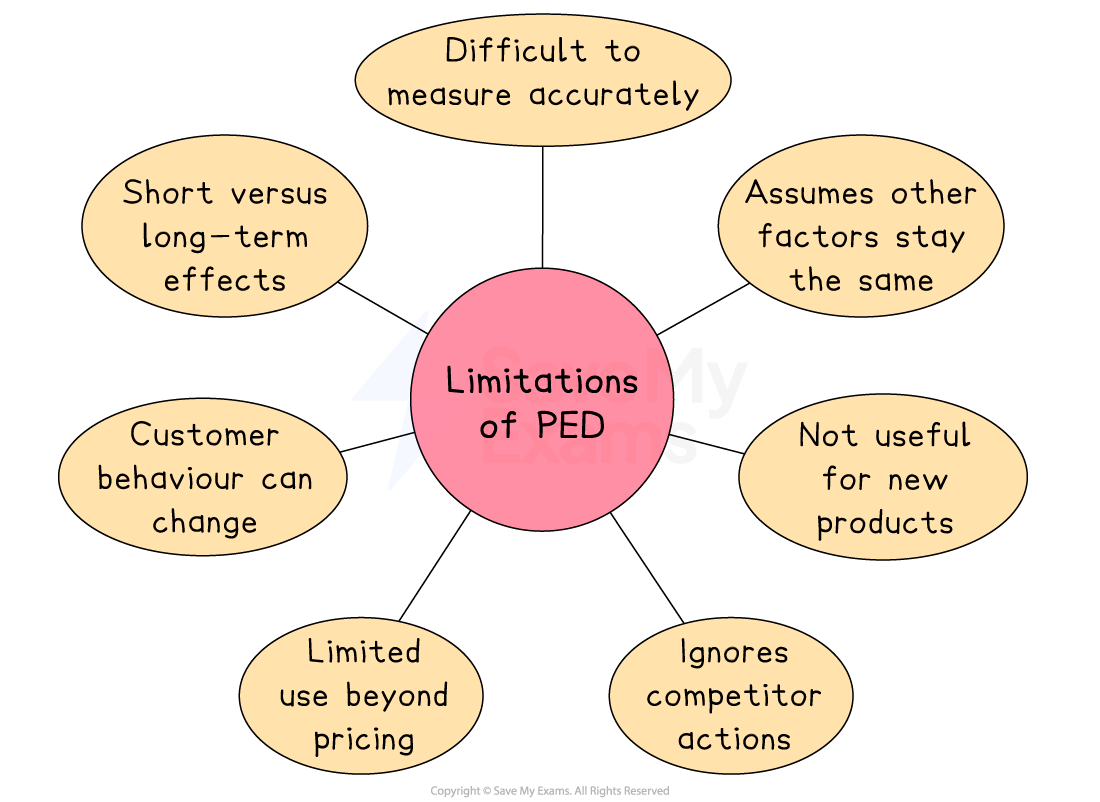
Limitations of PED include the difficulty of measuring demand change accurately and its limited use beyond pricing
-
Difficult to measure accurately
-
PED calculations need reliable data on how demand changes with price, which can be hard to collect
- E.g. A business may not know exactly how much demand will fall if it raises prices by 10%
-
-
Assumes other factors stay the same
-
PED only looks at price and demand, but things like income, trends or marketing also affect sales
- E.g. A fashion brand may raise prices expecting little change in demand, but a trend shift makes the item less popular
-
-
Not useful for new products
-
Without past data, it’s hard to estimate PED for products that haven’t been sold before
- E.g. A tech company launching a new gadget can’t predict how price changes will affect demand
-
-
Ignores competitor actions
-
PED doesn’t consider how rival businesses might respond to a price change
- E.g. A supermarket lowers prices to boost sales, but rivals do the same, so demand stays unchanged
-
-
Customer behaviour can change
-
PED is not fixed – it can change as customer preferences or incomes change
- E.g. Petrol demand may become more elastic as electric cars become more common
-
-
Limited use beyond pricing
- PED mainly helps with pricing decisions, not choices like product design, location or hiring
- However, it can give clues about brand strength or customer loyalty, which may influence other areas
-
Short versus long-term effects
- Demand might be inelastic in the short term but more elastic in the long term as customers adjust
- E.g. A mobile network raises prices and sees little change at first, but over time people switch providers
Was this revision note helpful?
Build on this topic