The Principle of Moments (Edexcel IGCSE Physics)
Guided lessons are live for this note
Work through it step by step — key points, depth layers, a worked example and self-checks.
Spec point —
1.32P· use the principle of moments for a simple system of parallel forces acting in one plane (physics only)
The principle of moments
- The principle of moments states that: If an object is balanced, the total clockwise moment about a pivot equals the total anticlockwise moment about that pivot
- For a balanced object, the moments on both sides of the pivot are equal
clockwise moment = anticlockwise moment
Clockwise and anticlockwise moments
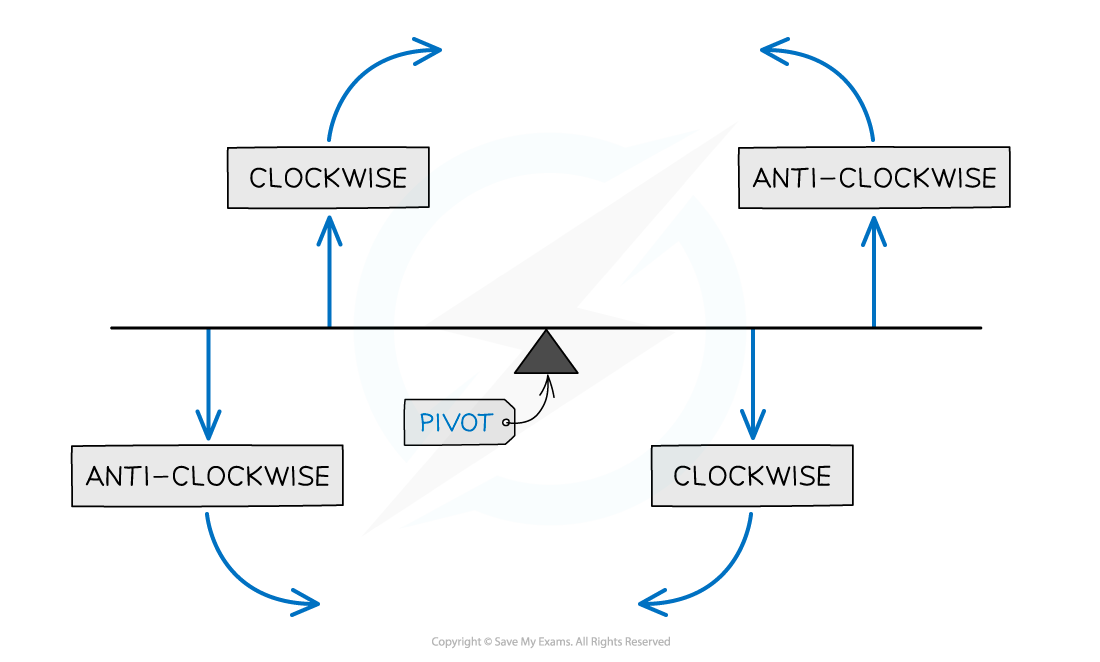
Imagine holding the beam about the pivot and applying just one of the forces. If the beam moves clockwise then the force applied is clockwise.
-
In the example below, the forces and distances of the objects on the beam are different, but they are arranged in a way that balances the whole system
-
Remember that the moment = force × distance from a pivot
-
The forces should be perpendicular to the distance from the pivot
- For example, on a horizontal beam, the forces which will cause a moment are those directed upwards or downwards
Using the principle of moments
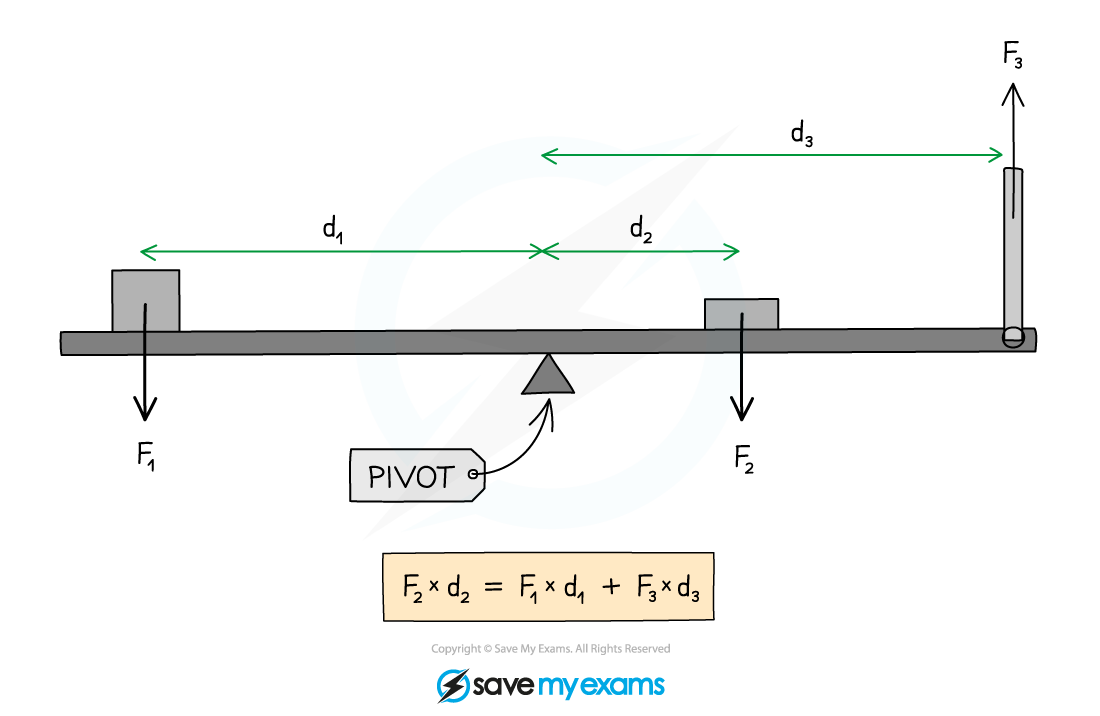
The clockwise and anticlockwise moments acting on a beam are balanced
-
In the above diagram:
- Force causes an anticlockwise moment of about the pivot
- Force causes a clockwise moment of about the pivot
- Force causes an anticlockwise moment of about the pivot
-
Collecting the clockwise and anticlockwise moments:
- Sum of the clockwise moments =
- Sum of the anticlockwise moments =
(F_ 1×d_ 1)+(F_ 3×d_ 3)
-
Using the principle of moments, the beam is balanced when:
Sum of the clockwise moments = Sum of the anticlockwise moments
F_ 2×d_ 2=(F_ 1×d_ 1)+(F_ 3×d_ 3)
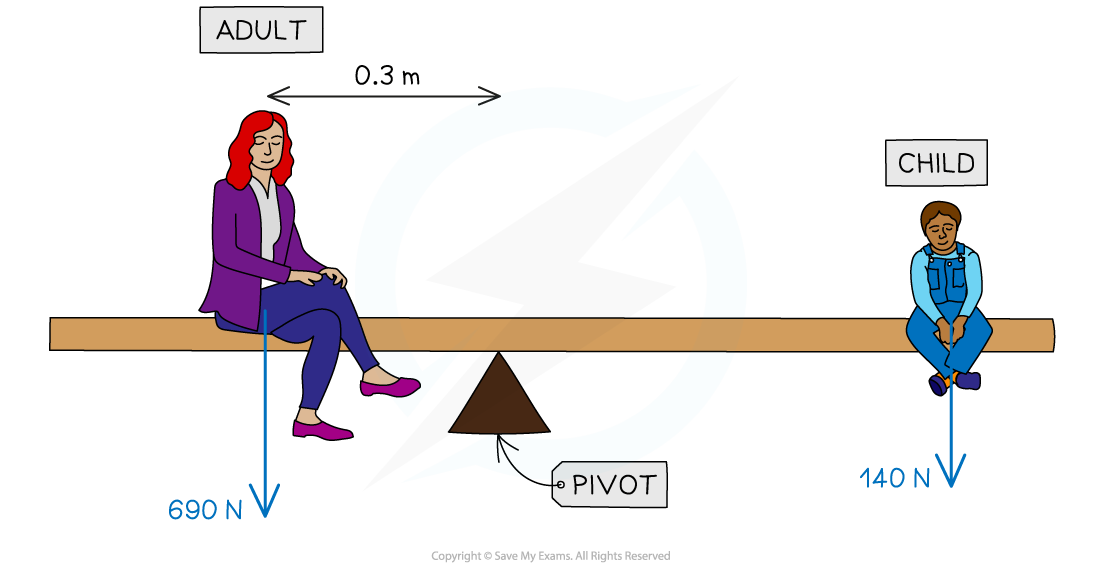
Worked Example A parent and child are at opposite ends of a playground see-saw. The parent weighs 690 N and the child weighs 140 N. The adult sits 0.3 m from the pivot.
Calculate the distance the child must sit from the pivot for the see-saw to be balanced.
Answer:
Step 1: List the known quantities
- Clockwise force (child), Fchild = 140 N
- Anticlockwise force (adult), Fadult = 690 N
- Distance of adult from the pivot, dadult = 0.3 m
Step 2: Write down the relevant equation
- Moments are calculated using:
Moment = force × distance from pivot
- For the see-saw to balance, the principle of moments states that
Total clockwise moments = Total anticlockwise moments
Step 3: Calculate the total clockwise moments
- The clockwise moment is from the child
Moment of child (clockwise) = Fchild × dchild
Moment of child (clockwise) = 140 × dchild
Step 4: Calculate the total anticlockwise moments
- The anticlockwise moment is from the adult
Moment of adult (anticlockwise) = Fadult × dadult
Moment of adult (anticlockwise) = 690 × 0.3 = 207 N m
Step 5: Substitute into the principle of moments equation
Moment of child (clockwise) = Moment of adult (anticlockwise)
140 × dchild = 207
Step 6: Rearrange for the distance of the child from the pivot
dchild = = 1.5 m
- The child must sit 1.5 m from the pivot to balance the see-saw
Exam Hint Make sure that all the distances are in the same units and that you’re considering the correct forces as clockwise or anticlockwise.
In your IGCSE exam, you will only be expected to apply the principle of moments to a situation where an object rotates in one plane (up and down or side to side)
Supporting a beam
Spec point —
1.33P· understand how the upward forces on a light beam, supported at its ends, vary with the position of a heavy object placed on the beam (physics only)
- A light beam is one that can be treated as though it has no mass
- The supports, therefore, must exert upward forces that balance the downward acting weight of any object placed on the beam
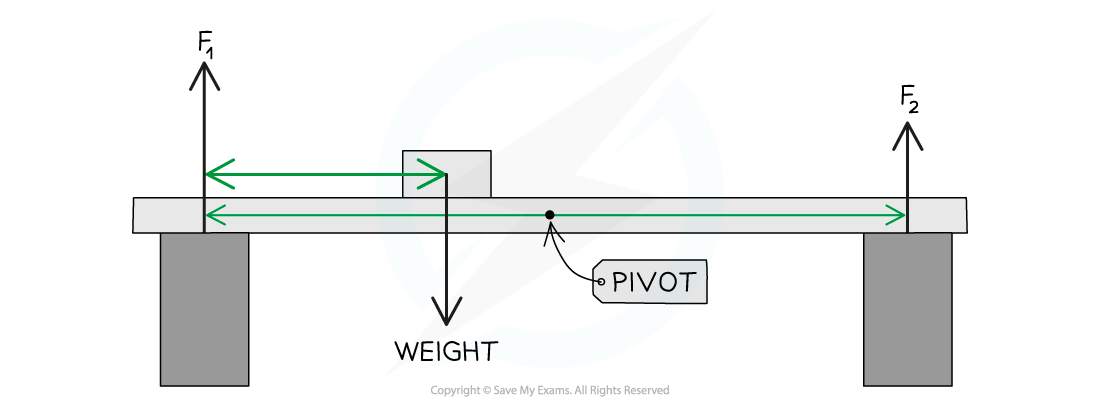
F1and F2upwards balance the weight of the beam downwards
- As the mass in the above diagram is moved from the left-hand side to the right-hand side of the beam, force F1 will decrease and force F2 will increase
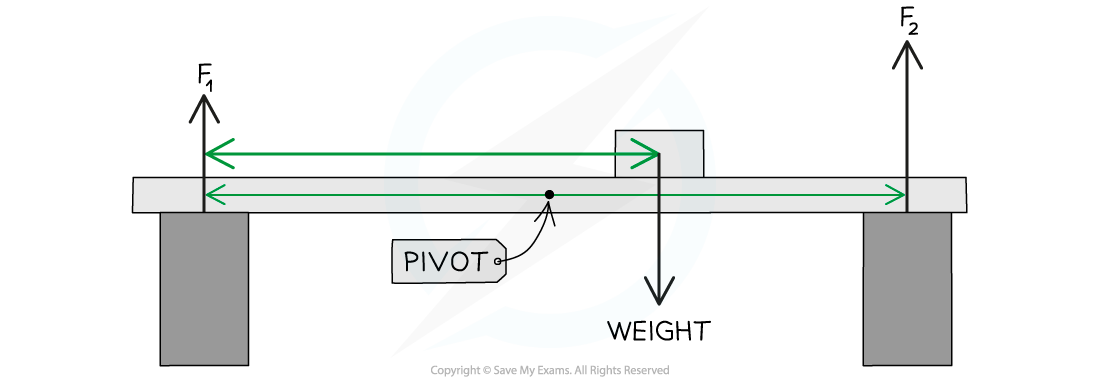
F1decreases F2increases keep the beam balanced
-
Consider what would happen to the beam if the right-hand support was removed:
- Force F2 would be 0
- The weight of the object would produce a moment about the left-hand support, causing the beam to pivot in a clockwise direction
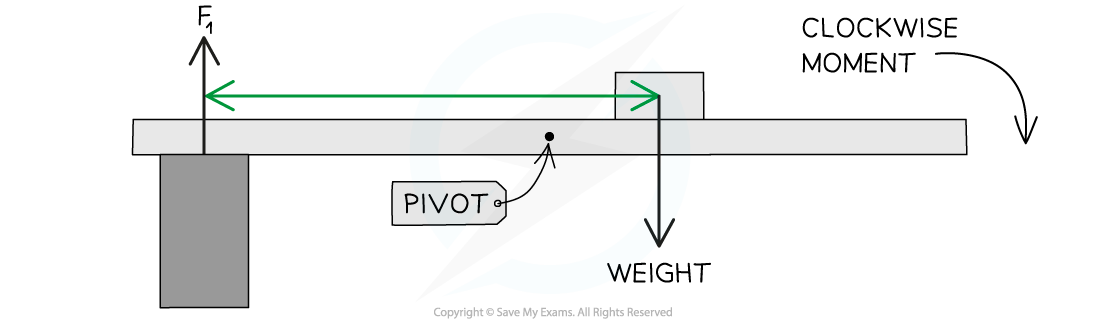
When F2is removed the beam will rotate by the clockwise moment
- Therefore, the force F2 must therefore supply an anticlockwise moment about the left-hand support, which balances the moment supplied by the object
Was this revision note helpful?