Conductors & Insulators (Edexcel IGCSE Physics)
Guided lessons are live for this note
Work through it step by step — key points, depth layers, a worked example and self-checks.
Spec point —
2.22P· identify common materials which are electrical conductors or insulators, including metals and plastics (physics only)
Conductors, insulators & electrons
Conductors
-
A conductor is a material that allows charge (usually electrons) to flow through it easily
-
Examples of conductors are:
- Silver
- Copper
- Aluminium
- Steel
-
Conductors tend to be metals

Different materials have different properties of conductivity
-
On the atomic scale, conductors are made up of positively charged metal ions with their outermost electrons delocalised
- This means the electrons are free to move
-
Metals conduct electricity very well because:
- Current is the rate of flow of electrons
- So, the more easily electrons are able to flow, the better the conductor
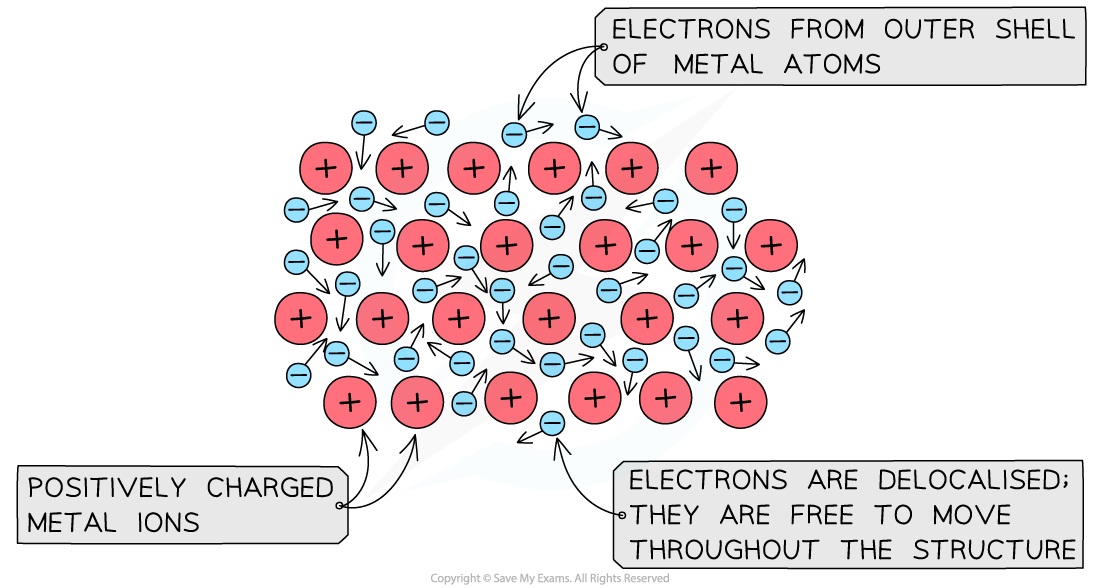
The lattice structure of a conductor with positive metal ions and delocalised electrons
Insulators
-
An insulator is a material that has no free charges, hence does not allow the flow of charge through them very easily
-
Examples of insulators are:
- Rubber
- Plastic
- Glass
- Wood
-
Some non-metals, such as wood, allow some charge to pass through them
-
Although they are not very good at conducting, they do conduct a little in the form of static electricity
- For example, two insulators can build up charge on their surfaces and if they touch this would allow that charge to be conducted away
Was this revision note helpful?
Build on this topic