Hooke's Law (Edexcel IGCSE Physics)
Guided lessons are live for this note
Work through it step by step — key points, depth layers, a worked example and self-checks.
Spec point —
1.23· know that the initial linear region of a force-extension graph is associated with Hooke’s law
Hooke's law
-
The relationship between the extension of an elastic object and the applied force is defined by Hooke's Law
-
Hooke's Law states that: The extension of an elastic object is directly proportional to the force applied, up to the limit of proportionality
-
Directly proportional means that as the force is increased, the extension increases
- If the force is doubled, then the extension will double
- If the force is halved, then the extension will also halve
-
The limit of proportionality is the point beyond which the relationship between force and extension is no longer directly proportional
- This limit varies according to the material
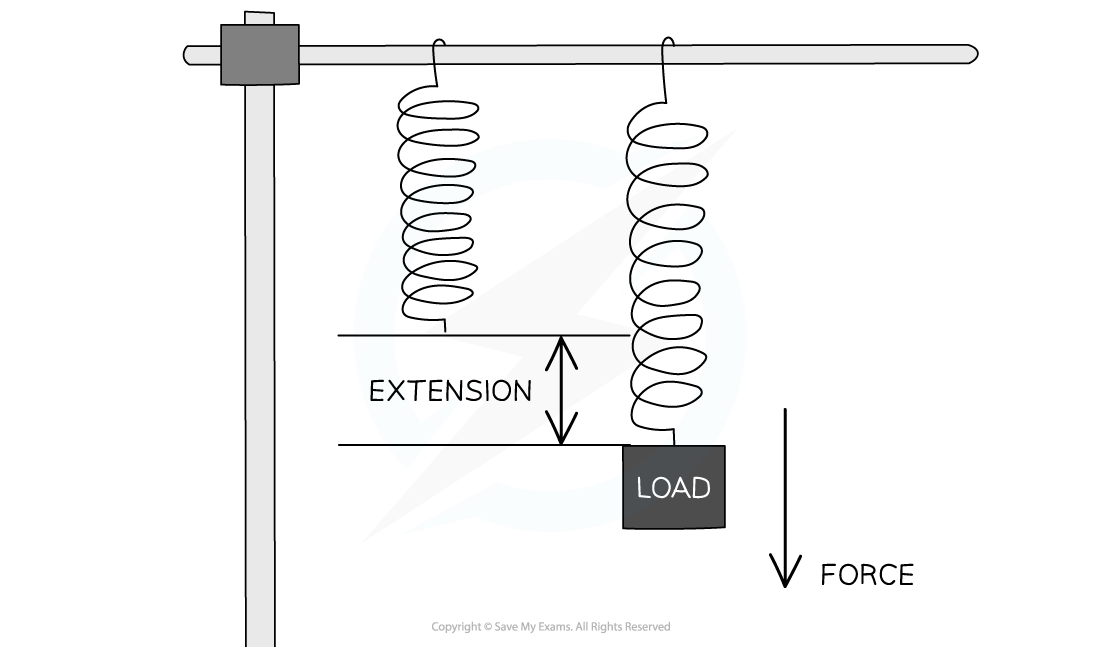
Hooke's Law states that a force applied to a spring will cause it to extend by an amount proportional to the force
The force-extension graph
-
Hooke’s law is the linear relationship between force and extension
- This is represented by a straight line on a force-extension graph
-
Any material beyond its limit of proportionality will have a non-linear relationship between force and extension
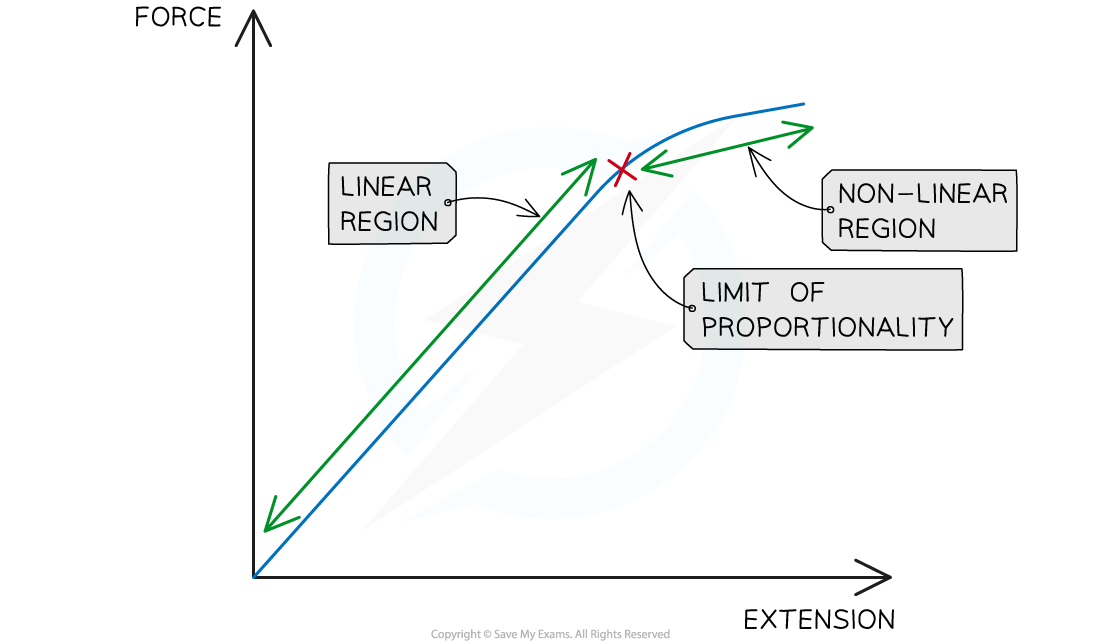
Hooke's Law is associated with the linear region of a force-extension graph. Beyond the limit of proportionality, Hooke's law no longer applies
Elastic behaviour
Spec point —
1.24· describe elastic behaviour as the ability of a material to recover its original shape after the forces causing deformation have been removed
-
Elastic behaviour is the ability of a material to recover its original shape after the forces causing the deformation have been removed
-
Deformation is a change in the original shape of an object
-
Deformation can be either:
- elastic
- inelastic
Elastic Deformation
-
Elastic deformation is when the object does return to its original shape after the deforming forces are removed
-
Elastic deformation results in a change in the object's shape that is not permanent
-
Examples of materials that undergo elastic deformation are:
- Rubber bands
- Fabrics
- Steel springs
Inelastic Deformation
-
Inelastic deformation is when the object does not return to its original shape after the deforming forces are removed
-
Inelastic deformation results in a change in the object's shape that is permanent
-
Examples of materials that undergo inelastic deformation are:
- Plastic
- Clay
- Glass
Elastic behaviour of a spring
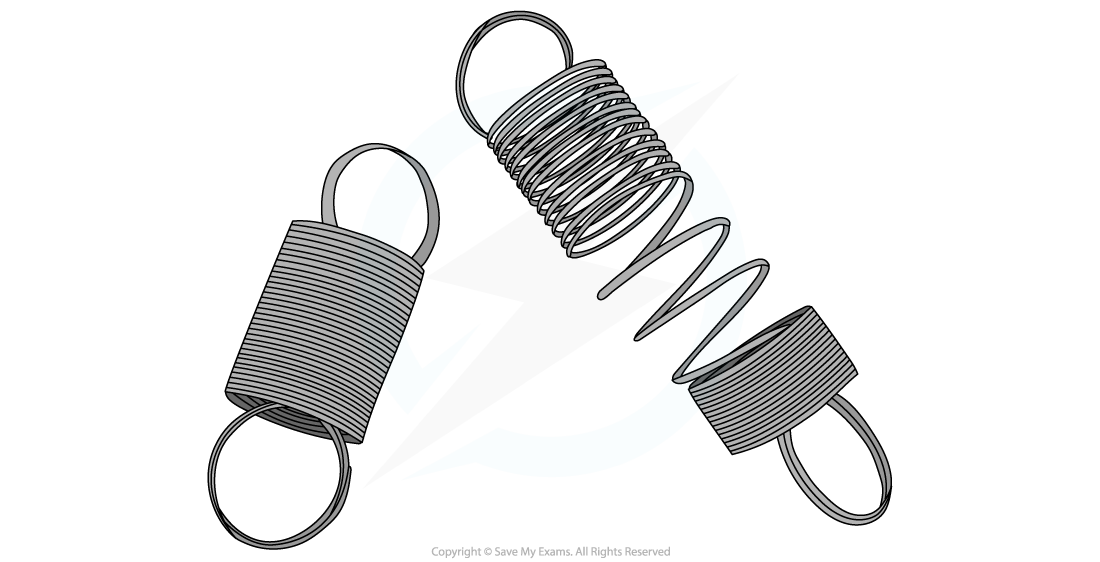
The spring on the right has undergone inelastic deformation, it's shape has been permanently deformed
Was this revision note helpful?