Hooke's Law
2 guided lessons · 18 checks · 1. Forces & Motion → Forces, Movement & Changing Shape
Guided lessons for this note
Which concept don't you understand yet?
We'll explain it simply and check your understanding. Pick any lesson — any order works.
0 of 18 checks correct so far
Lesson 1 of 2
Hooke's law and the force-extension graph
Stretch something gently and it obeys; stretch it too far and it betrays you. Hooke's law is the obedience — extension tracking the applied force point-for-point until the limit of proportionality ends the agreement. This lesson draws the graph, names the limit, and shows where the straight region ends.
What you know already
Stretch something gently and it obeys; stretch it too far and it betrays you. Hooke's law is the obedience — extension proportional to force up to a limit — and elastic behaviour is the full recovery afterwards. This note draws the graph, names the limit, and sorts materials by their recovery.
Key points of understanding
- Hooke's law: an elastic object's extension answers point-for-point to the applied force, until the limit of proportionality.
- Directly proportional means doubling the force doubles the extension, and halving the force halves it.
- The limit of proportionality is the point beyond which force and extension are no longer proportional.
- On a force-extension graph the law is the initial straight-line (linear) region.
- The limit's position varies from material to material.
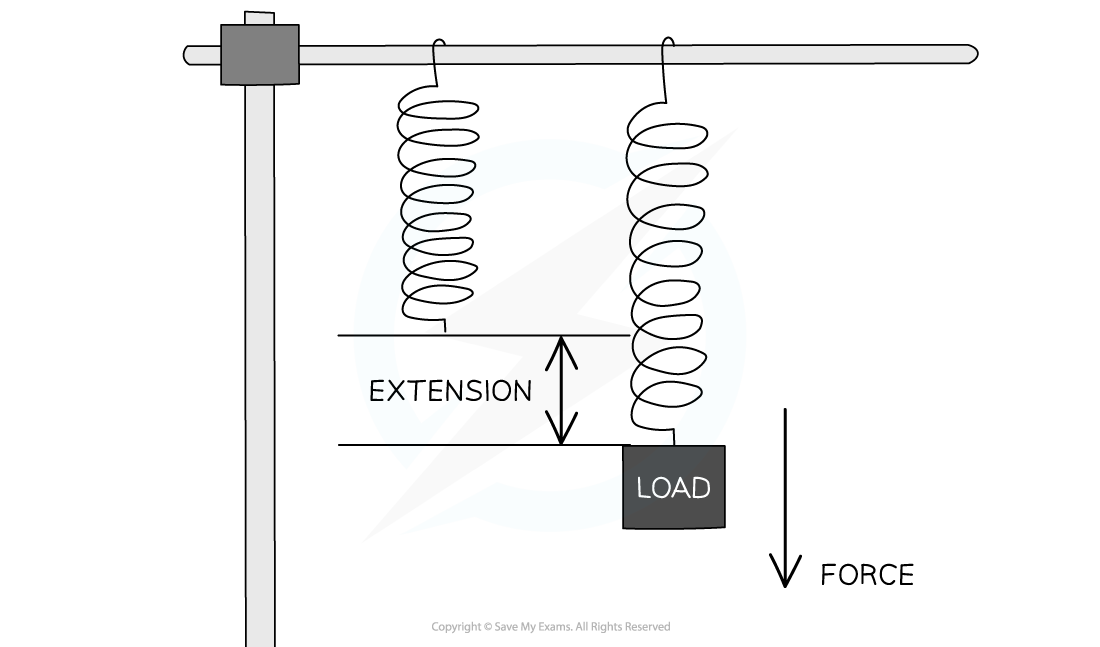
Hooke's Law states that a force applied to a spring will cause it to extend by an amount proportional to the force
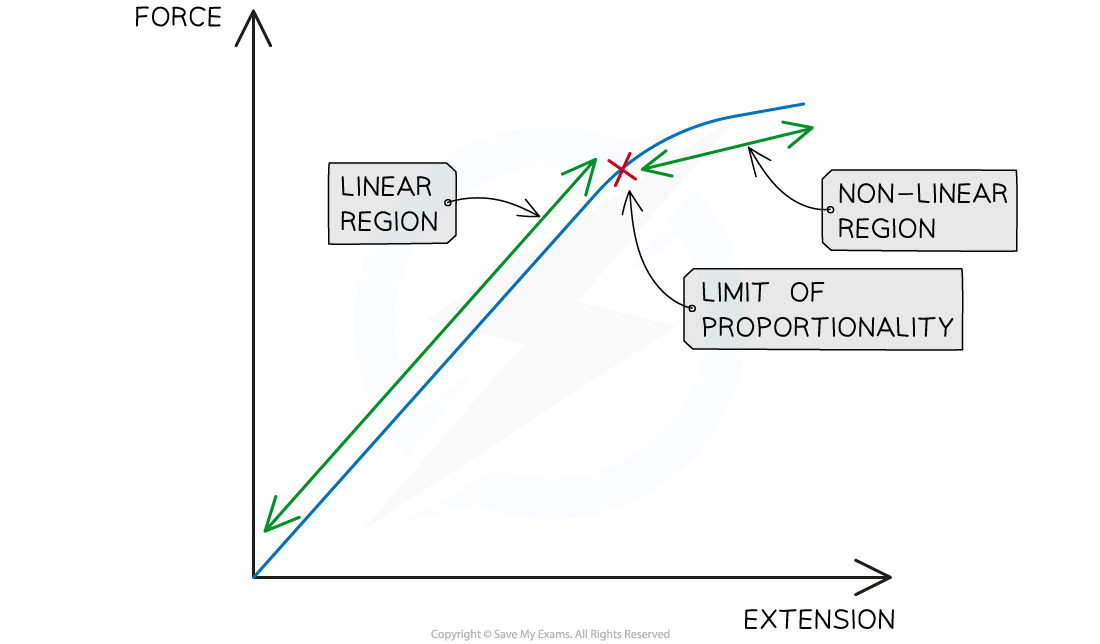
Hooke's Law is associated with the linear region of a force-extension graph. Beyond the limit of proportionality, Hooke's law no longer applies
Choose a confidence level to continue.
Prefer to read it all at once? Show the full lesson as a page
1.Hooke's law and the force-extension graph
Stretch something gently and it obeys; stretch it too far and it betrays you. Hooke's law is the obedience — extension tracking the applied force point-for-point until the limit of proportionality ends the agreement. This lesson draws the graph, names the limit, and shows where the straight region ends.
Hooke's Law states that a force applied to a spring will cause it to extend by an amount proportional to the force
Hooke's Law is associated with the linear region of a force-extension graph. Beyond the limit of proportionality, Hooke's law no longer applies
Key points
- Hooke's law: an elastic object's extension answers point-for-point to the applied force, until the limit of proportionality.
- Directly proportional means doubling the force doubles the extension, and halving the force halves it.
- The limit of proportionality is the point beyond which force and extension are no longer proportional.
- On a force-extension graph the law is the initial straight-line (linear) region.
- The limit's position varies from material to material.
First pass
Double the pull, double the stretch — until the limit, where the deal ends.
Analogy — A fair taxi meter: every extra newton buys the same extra stretch, until the meter's rules change at the limit.
Exam pointer — Quote the law with its escape clause — 'up to the limit of proportionality' — or the statement is incomplete.
Going deeper
The graph's geometry is the law: the linear region's straightness is the proportionality, and the bend marks the limit; the limit is material-specific, not universal.
Analogy — A rubber ruler drawn on elastic: the printed centimetres obey while the elastic is fresh, then drift once it is overstretched.
Exam pointer — Graph questions: identify the linear region, mark the limit, and state what changes there — three marks, three statements.
Checks
0 of 9 attempted · 0 correct
2.Elastic behaviour and deformation
Deformation is any change of an object's original shape, and it comes in two kinds: elastic, where the shape recovers once the forces let go, and inelastic, where the change is permanent. The unloaded spring springs back; the moulded clay keeps its new form.
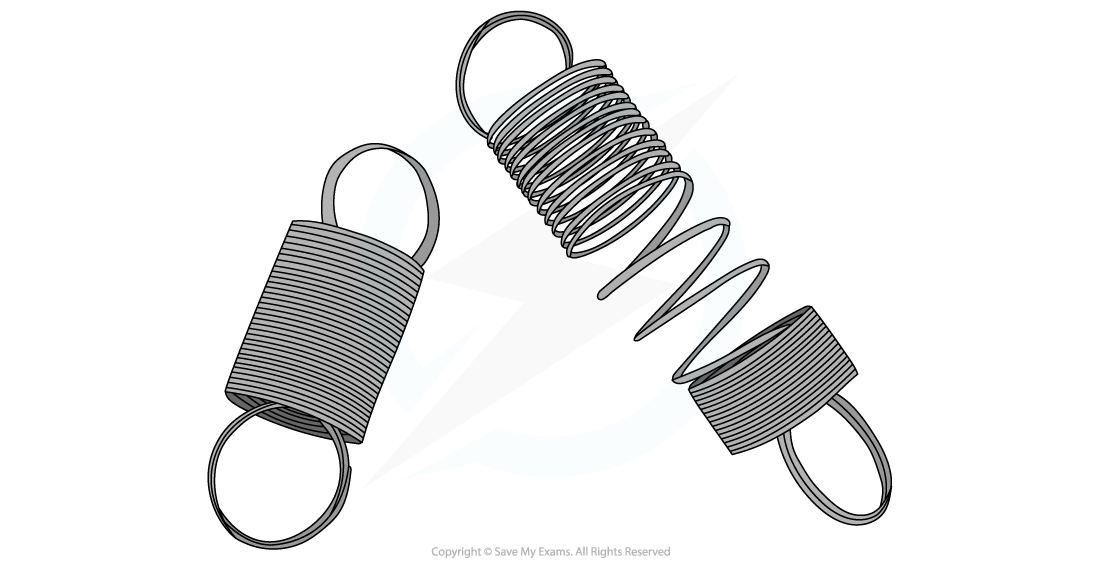
The spring on the right has undergone inelastic deformation, it's shape has been permanently deformed
Key points
- Elastic behaviour: the material regains the shape it started with once the deforming forces are gone.
- Deformation is a change in the object's original shape.
- Elastic deformation is not permanent: the object returns to its original shape.
- Inelastic deformation is permanent: the object keeps its new shape.
- Rubber bands, fabrics and steel springs deform elastically; plastic, clay and glass deform inelastically.
First pass
Let go and the shape either comes back (elastic) or stays changed (inelastic).
Analogy — A hotel bed: the mattress recovers by morning (elastic); the dent in the chocolate bar does not (inelastic).
Exam pointer — The definition of record centres on recovery after the forces are removed — quote it whole.
Going deeper
The classification is about the material's response, not the force's size — though the same material can cross from elastic to inelastic behaviour past its limit.
Analogy — A paperclip bends gently and springs back, bent harder and it keeps the kink: same clip, two regimes.
Exam pointer — Examples earn marks: springs, rubber bands and fabrics for elastic; plastic, clay and glass for inelastic.
Checks
0 of 9 attempted · 0 correct
Guided content from the SME authoring corpus — note rn_nC3BswtJzYw8k6nX, pinned at bfae99778094 · promoted SyllabAI/syllabai-resources b3caaaa90c5e