Forces & Momentum (Edexcel IGCSE Physics)
Guided lessons are live for this note
Work through it step by step — key points, depth layers, a worked example and self-checks.
Spec point —
1.28P· use the relationship between force, change in momentum and time taken:
force = change in momentum/ time taken F = (mv − mu) /t (physics only)
Forces & momentum
-
When a force acts on an object that is moving, or able to move, the object will accelerate (or decelerate)
- This causes a change in momentum
Rate of change in momentum
- The resultant force acting on an object is defined by the equation:
- Momentum is calculated using the equation:
- Change in momentum is given as:
- Combining these equations gives:
-
Where:
- F = resultant force, measured in newtons (N)
- a = acceleration, measured in metres per second squared (m/s2)
- m = mass, measured in kilograms (kg)
- ∆p = change in momentum, measured in kilogram metres per second (kg m/s)
- v = final velocity, measured in metres per second (m/s)
- u = initial velocity, measured in metres per second (m/s)
- t = time, measured in seconds (s)
-
Remember to consider the direction of object's motion
- If you take the initial direction as positive then the reverse direction is negative
-
Force can also be described as the rate of change of momentum on a body
- The rate of change describes how a variable changes with respect to time
-
The shorter the time over which momentum changes, the bigger the force
-
So, force and time are inversely proportional to each other
Exam Hint When two quantities are inversely proportional, it means that as one increases, the other decreases by a proportional amount
- If one is doubled, the other is halved
- If one is decreased by a factor of 4, the other is increased by a factor of 4
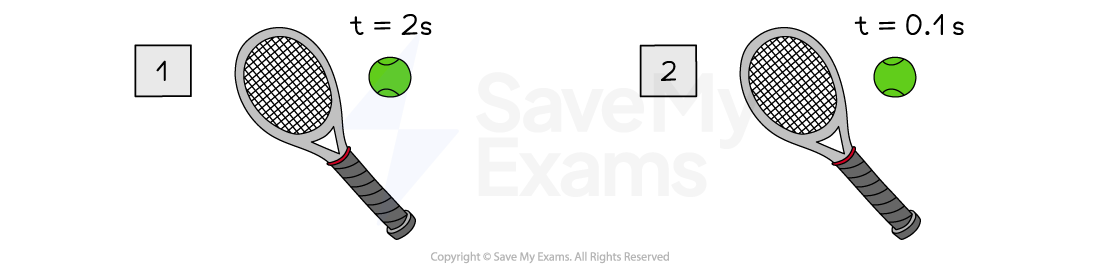
Worked Example A tennis ball hits a racket twice, with a change in momentum of 0.5 kg m/s both times.
During the first hit, the contact time is 2.0 s, and during the second hit, the contact time is 0.1 s.
Determine which strike of the tennis racket experiences the greatest force from the tennis ball.
Answer:
Step 1: List the known quantities
- Change in momentum each time, = 0.5 kg m/s
- Contact time of first hit, = 2.0 s
- Contact time of second hit, = 0.1 s
Step 1: Calculate the force during the first hit
Step 2: Calculate the force during the second hit
Step 3: State your answer
- The tennis racket experiences the greatest force from the ball during the second hit
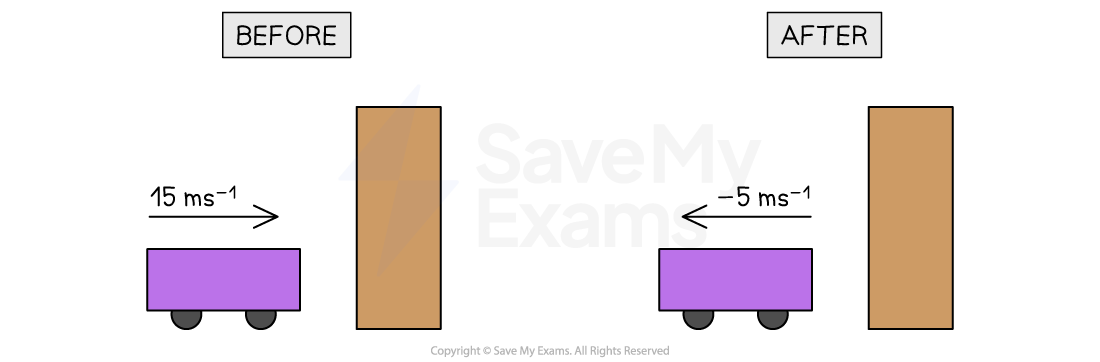
Worked Example A car of mass 1500 kg hits a wall at an initial velocity of 15 m/s and rebounds with a velocity of 5 m/s. The car is in contact with the wall for 3 seconds.
Calculate the average force experienced by the car and state the direction of the force.
Answer:
Step 1: List the known quantities and assign direction
- Mass of car, m = 1500 kg
- Initial velocity before collision, u = 15 m/s
- Final velocity after collision, v = −5 m/s
- Time of impact, t = 3 s
Step 2: Draw a diagram of the collision
The diagram should include:
- The velocity before and after the collision
- The direction of motion before and after the collision
In momentum questions , a positive direction is always chosen
- Here, right is chosen as the positive direction
- This means final velocity, which is in the left direction, must be negative
Step 3: Write out the force and momentum equation
- Recall that force is change in momentum over time
Momentum is mass × velocity
- Initial momentum is mass × initial velocity, u
- Final momentum is mass × final velocity, v
and
Step 4: Substitute in the known values to calculate force
- The minus sign means the direction of the force is to the left (or in the opposite direction to the car's initial motion)
Was this revision note helpful?