Forces & Momentum
2 guided lessons · 18 checks · 1. Forces & Motion → Momentum
Guided lessons for this note
Which concept don't you understand yet?
We'll explain it simply and check your understanding. Pick any lesson — any order works.
0 of 18 checks correct so far
Lesson 1 of 2
Forces & momentum
Push a moving trolley and it speeds up; drag your feet on it and it slows down. Either way its momentum changes, and this lesson turns that observation into the syllabus equation: force equals change in momentum divided by time. You will also learn the symbol-by-symbol anatomy of F = (mv − mu)/t and the sign rule that keeps rebound questions honest.
What you know already
From the Momentum subtopic you already know how to compute momentum as mass multiplied by velocity, and from earlier in Forces & Motion you know that a resultant force changes an object's velocity. This note joins the two ideas: a resultant force acting on a moving object changes that object's momentum, and how quickly the change happens decides how large the force must be.
Key points of understanding
- A resultant force on a moving object changes its velocity — speeding it up or slowing it down — and so changes the object's momentum.
- Combining F = ma with p = mv gives F = (mv − mu)/t: force equals change in momentum divided by the time taken.
- In the equation, m is mass in kilograms, u the initial velocity, v the final velocity and t the time in seconds.
- A momentum change is quoted in kg m/s, and the force that causes it in newtons (N).
- Choose one direction as positive before substituting: motion the opposite way enters the equation as a negative value.
Choose a confidence level to continue.
Prefer to read it all at once? Show the full lesson as a page
1.Forces & momentum
Push a moving trolley and it speeds up; drag your feet on it and it slows down. Either way its momentum changes, and this lesson turns that observation into the syllabus equation: force equals change in momentum divided by time. You will also learn the symbol-by-symbol anatomy of F = (mv − mu)/t and the sign rule that keeps rebound questions honest.
Key points
- A resultant force on a moving object changes its velocity — speeding it up or slowing it down — and so changes the object's momentum.
- Combining F = ma with p = mv gives F = (mv − mu)/t: force equals change in momentum divided by the time taken.
- In the equation, m is mass in kilograms, u the initial velocity, v the final velocity and t the time in seconds.
- A momentum change is quoted in kg m/s, and the force that causes it in newtons (N).
- Choose one direction as positive before substituting: motion the opposite way enters the equation as a negative value.
First pass
A force that speeds an object up or slows it down is changing its momentum, and the force equals that momentum change divided by the time taken.
Analogy — Momentum is the cargo of motion in a trolley; a force is the hand loading or unloading it, and time is how long the hand gets to work.
Exam pointer — When a question names the relationship, write F = (mv − mu)/t in full — marks sit in the formula as well as in the final number.
Going deeper
The equation is a double substitution: p = mv turned into before-and-after values (mu and mv), then fed into F = ma with a = (v − u)/t.
Analogy — Treat momentum like a bank balance: mu is the opening balance, mv the closing balance, and force the payment rate moving money between them during time t.
Exam pointer — Sign discipline earns the marks: fix the initial direction as positive and carry every minus through mv − mu before you divide.
Checks
0 of 9 attempted · 0 correct
2.Rate of change in momentum
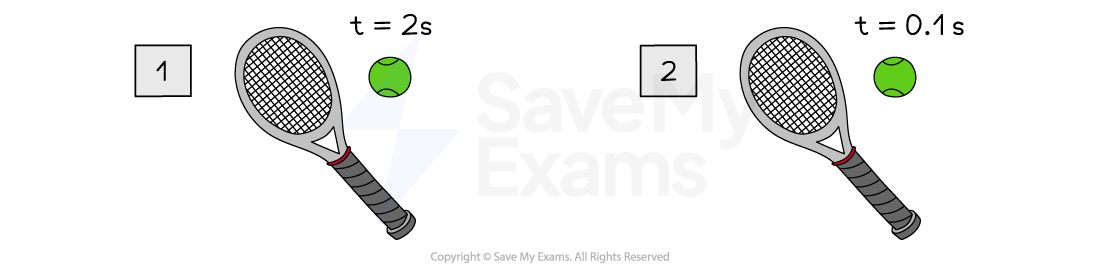
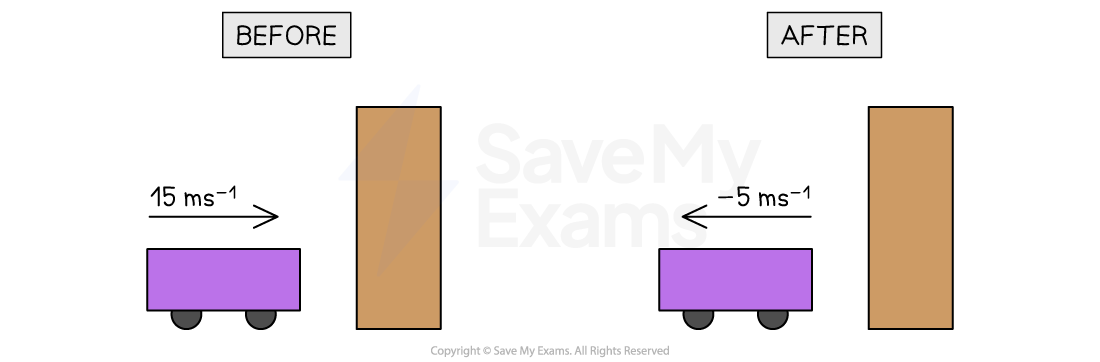
A change of momentum can arrive gently or with a bang, and the only difference is time. Divide the same change by a long contact time and the force is tame; divide it by a blink and the force is brutal. This lesson reads the equation as a rate, then follows two worked collisions — a ball on a racket and a car on a wall.
Key points
- Force is the momentum change per second — the rate at which a body's momentum changes.
- Squeezing a momentum change into a shorter time makes the force bigger.
- Force and contact time are inversely proportional: doubling the time halves the force, and halving the time doubles it.
- The same 0.5 kg m/s momentum change delivers 0.25 N over 2.0 s but 5.0 N over just 0.1 s.
- A car rebounding from a wall carries a negative final velocity, so the calculated force comes out negative — opposite to its initial motion.
First pass
The same momentum change divided by a shorter time gives a bigger force — force and time pull in opposite directions.
Analogy — Catch an egg with stiff arms and it stops instantly and splats; let your hands drift back and the longer stop softens the force.
Exam pointer — When a question doubles or halves the contact time at fixed momentum change, answer with the inverse move: halve or double the force.
Going deeper
Force as a rate means how much momentum changes each second, not how much changes in total.
Analogy — A fixed momentum change is a fixed journey; contact time is the pace you travel it, and rushing the journey spikes the force.
Exam pointer — Airbags, seatbelts and crumple zones are this law in disguise: they stretch the contact time to cut the peak force.
Checks
0 of 9 attempted · 0 correct
Guided content from the SME authoring corpus — note rn_NfCjFmPfmMQ8pQSw, pinned at 0cea83a78102 · promoted SyllabAI/syllabai-resources b3caaaa90c5e