Core Practical: Investigating Snell's law (Edexcel IGCSE Physics)
Guided lessons are live for this note
Work through it step by step — key points, depth layers, a worked example and self-checks.
Core practical 5: investigating snell's law
Spec point —
3.19· Core practical 5: investigate the refractive index of glass, using a glass block
Aims of the experiment
- To investigate the refractive index of glass, using a glass block
Variables
-
Independent variable = angle of incidence, i
-
Dependent variable = angle of refraction , r
-
Control variables:
- Use of the same perspex block
- Width of the light beam
- Same frequency / wavelength of the light
Equipment
Equipment list
| Equipment | Purpose |
|---|---|
| Ray Box | To provide a narrow beam of light that can be easily refracted |
| Protractor | To measure the angles of incidence and refraction |
| Sheet of Paper | To mark the lines indicating the incident and refracted rays |
| Pencil | To draw the incident and refracted ray lines onto the paper |
| Ruler | To draw the incident and refracted ray lines onto the paper |
| Perspex rectangle | To refract the light beam |
-
Resolution of measuring equipment:
- Protractor = 1°
- Ruler = 1 mm
Method
Diagram of equipment set up
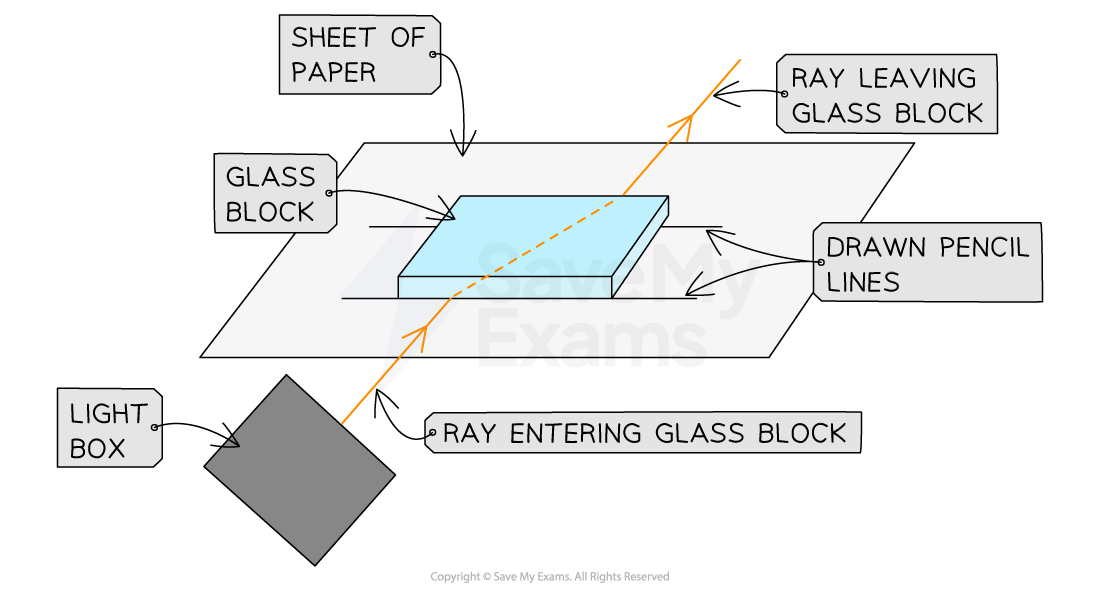
Apparatus set-up to investigate Snell's Law
- Place the glass block on a sheet of paper, and carefully draw around the block using a pencil
- Draw a dashed line normal (at right angles) to the outline of the block
- Use a protractor to measure the angles of incidence to be studied and mark these lines on the paper
- Switch on the ray box and direct a beam of light at the side face of the block at the first angle to be investigated
- Mark on the paper:
- A point on the ray close to the ray box
- The point where the ray enters the block
- The point where the ray exits the block
- A point on the exit light ray which is a distance of about 5 cm away from the block
- Remove the block and join the points marked with three straight lines
- Replace the block within its outline and repeat the above process for a rays striking the block at the next angle
An example results table
| Angle of incidence, i / ° | Angle of refraction, r / ° |
|---|---|
| 0 | |
| 10 | |
| 20 | |
| 30 | |
| 40 | |
| 50 | |
| 60 | |
| 70 | |
| 80 |
Analysis of results
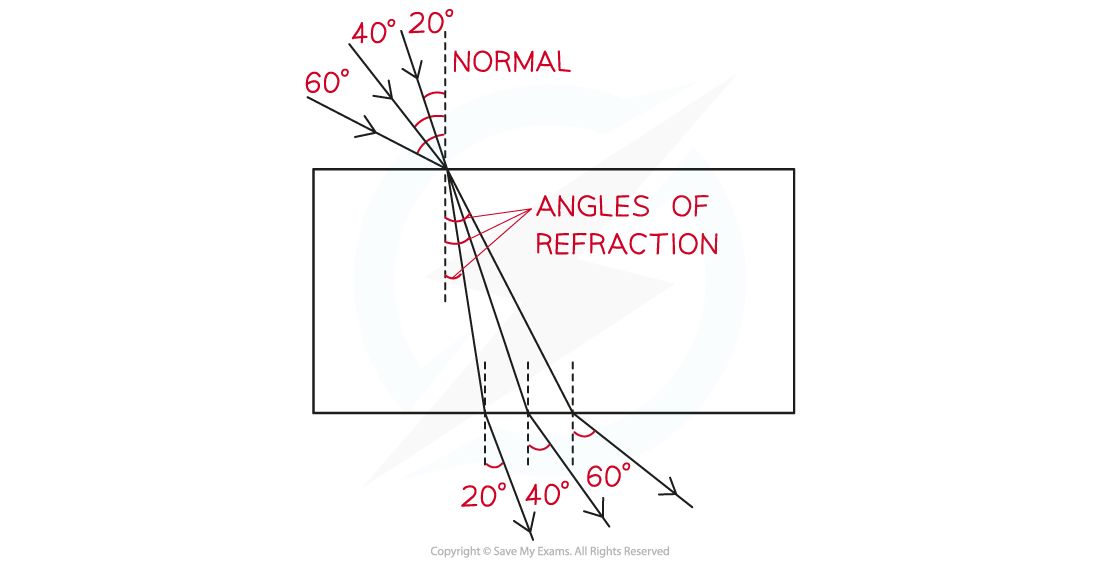
- If the angles have been measured correctly, the paper should end up looking like this:
A diagram showing how to measure the angles of incidence and refraction
-
Snell's Law relates the angles of incidence and refraction
- This is covered in the Snell's law revision note
-
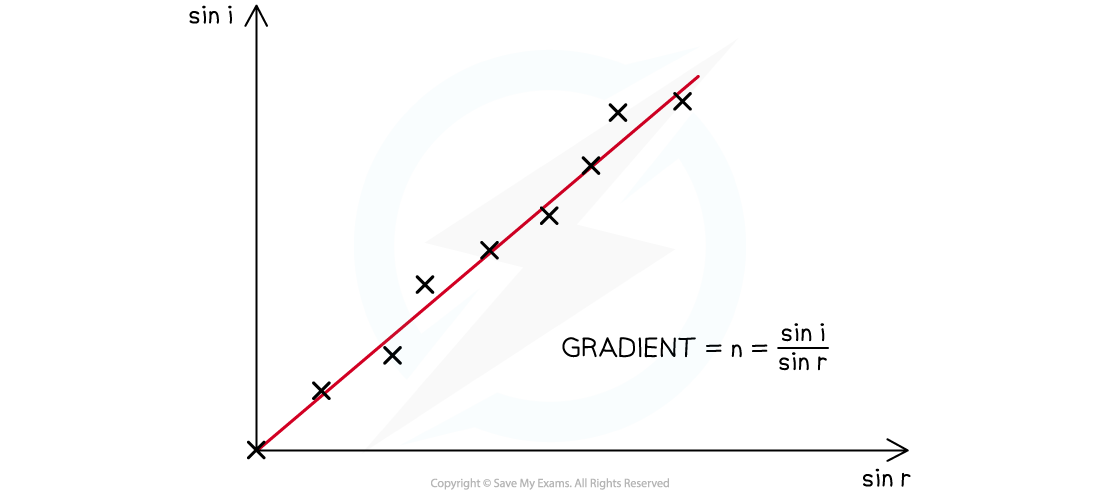
Plot a graph of sin i on the y-axis against sin r on the x-axis
- The refractive index is equal to the gradient of the graph
A graph of the results of snell's law experiment
Evaluating the experiment
Systematic Errors:
-
An error could occur if the 90° lines are drawn incorrectly
- Use a set square to draw perpendicular lines
Random Errors:
-
The points for the incoming and reflected beam may be inaccurately marked
- Use a sharpened pencil and mark in the middle of the beam
-
The protractor resolution may make it difficult to read the angles accurately
- Use a protractor with a higher resolution
Safety considerations
-
The ray box light could cause burns if touched
- Run burns under cold running water for at least five minute
-
Looking directly into the light may damage the eyes
- Avoid looking directly at the light
- Stand behind the ray box during the experiment
-
Keep all liquids away from the electrical equipment and paper
Was this revision note helpful?
Build on this topic