Core Practical: Investigating Snell's law
1 guided lesson · 9 checks · 3. Waves → Reflection & Refraction
Guided lessons for this note
Which concept don't you understand yet?
We'll explain it simply and check your understanding. Pick any lesson — any order works.
0 of 9 checks correct so far
Lesson 1 of 1
Core Practical: Investigating Snell's law
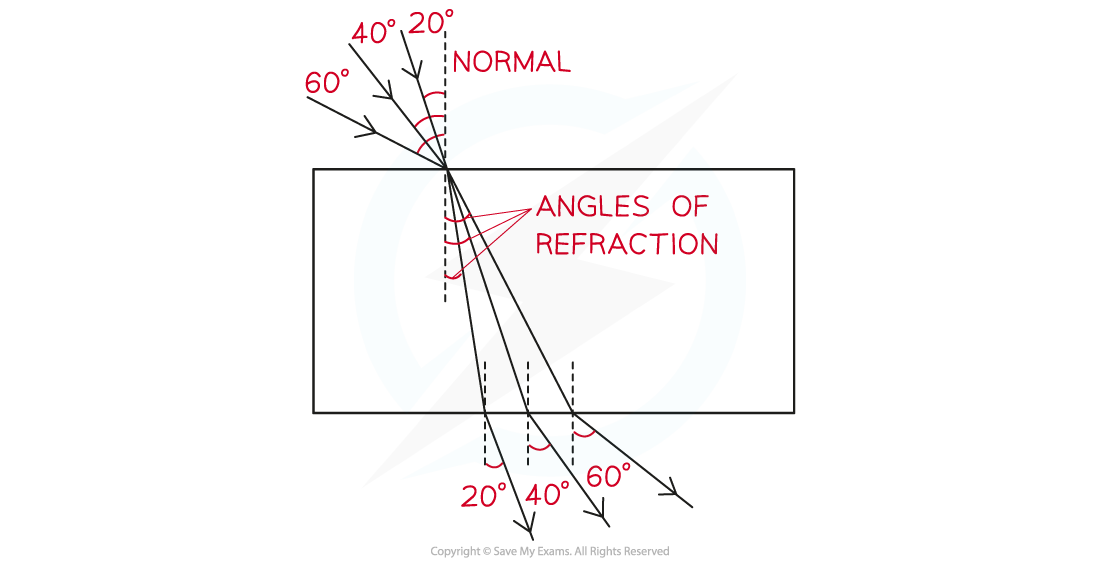
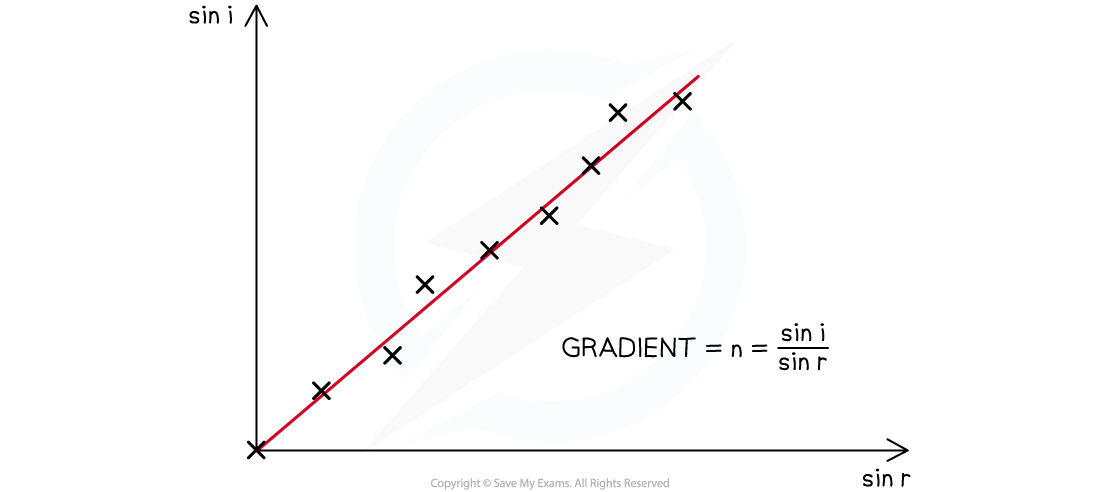
The apparatus is simple: a ray box, a protractor and a perspex block on paper. Trace the beam at one incidence angle after another, join the entry and exit points, and measure the refraction angle each time. Plotting the sine of one against the sine of the other gives a straight line, and the gradient of that line is the refractive index you set out to find.
What you know already
Core practical 5 asks you to measure the refractive index of a glass block for yourself. You will trace a ray box beam through the block at several incidence angles, record the matching refraction angles and turn the pairs into a straight-line graph. Along the way you will name variables, choose sensible equipment and judge where errors creep in — the full experimental toolkit in one investigation.
Key points of understanding
- The experiment investigates the refractive index of glass using a glass block.
- The independent variable is the angle of incidence; the dependent variable is the angle of refraction.
- Control variables include the same perspex block, the beam width and the light frequency.
- Equipment: a ray box provides the beam, a protractor measures both angles, and plotting sin i against sin r gives a straight line whose gradient is the refractive index.
- Systematic errors come from wrongly drawn perpendicular lines; random errors come from imprecise marking and the protractor resolution.
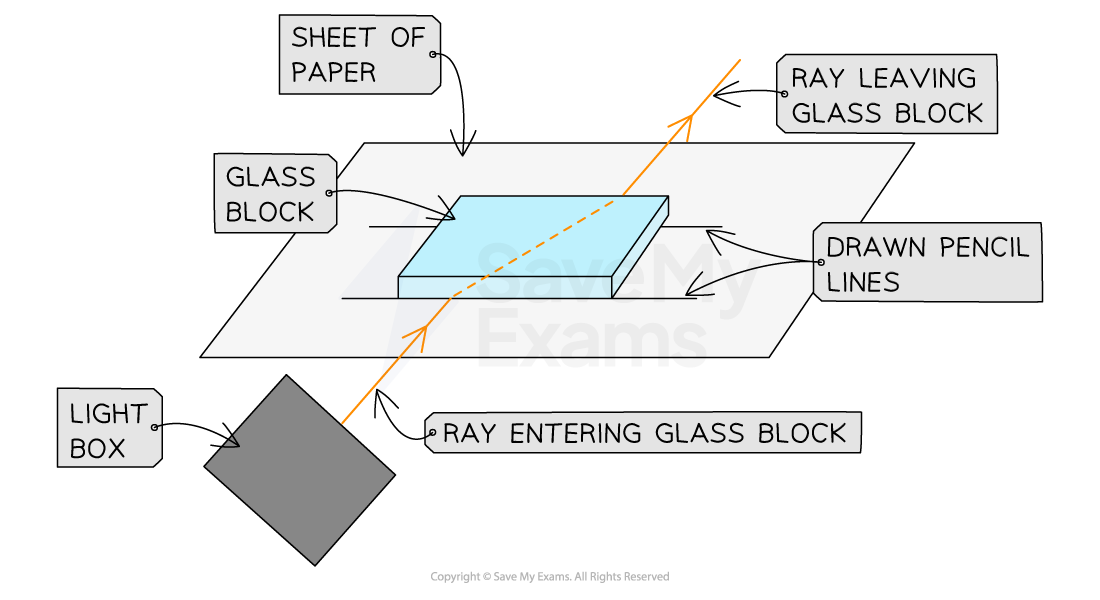
Apparatus set-up to investigate Snell's Law
Choose a confidence level to continue.
Prefer to read it all at once? Show the full lesson as a page
1.Core Practical: Investigating Snell's law
The apparatus is simple: a ray box, a protractor and a perspex block on paper. Trace the beam at one incidence angle after another, join the entry and exit points, and measure the refraction angle each time. Plotting the sine of one against the sine of the other gives a straight line, and the gradient of that line is the refractive index you set out to find.
Apparatus set-up to investigate Snell's Law
Key points
- The experiment investigates the refractive index of glass using a glass block.
- The independent variable is the angle of incidence; the dependent variable is the angle of refraction.
- Control variables include the same perspex block, the beam width and the light frequency.
- Equipment: a ray box provides the beam, a protractor measures both angles, and plotting sin i against sin r gives a straight line whose gradient is the refractive index.
- Systematic errors come from wrongly drawn perpendicular lines; random errors come from imprecise marking and the protractor resolution.
First pass
Shine the beam into the block at different angles, trace each path, measure both angles and read the refractive index off the gradient of the sine graph.
Analogy — Fingerprinting glass: every material leaves its own straight-line signature when you plot sine against sine.
Exam pointer — Questions often ask only for the aim — "investigate the refractive index of glass using a glass block" — word it exactly.
Going deeper
Changing the incidence angle while holding the block, beam and light fixed isolates how the refraction angle responds; the sine-sine plot linearises Snell's law so its gradient equals the index.
Analogy — A fair race: one runner varies, everything else — track, shoes, wind — stays identical, so the result means something.
Exam pointer — Name all three variable roles in method questions; forgetting the control variables is the most common lost mark.
Checks
0 of 9 attempted · 0 correct
Guided content from the SME authoring corpus — note rn_MfKYy7mHFkx7zF9x, pinned at dad406f1ecd8 · promoted SyllabAI/syllabai-resources b3caaaa90c5e