Electromagnetic Induction (Edexcel IGCSE Physics)
Guided lessons are live for this note
Work through it step by step — key points, depth layers, a worked example and self-checks.
Spec point —
6.15· know that a voltage is induced in a conductor or a coil when it moves through a magnetic field or when a magnetic field changes through it and describe the factors that affect the size of the induced voltage
Electromagnetic induction
-
Electromagnetic (EM) induction is used to generate electricity
-
EM induction is when: A voltage is induced in a conductor or a coil when it moves through a magnetic field or when a magnetic field changes through it
-
This is done by the conductor or coil cutting through the magnetic field lines of the magnetic field
-
This is often referred to as the generator effect and is the opposite to the motor effect
- In the motor effect, there is already a current in the conductor which experiences a force
- In the generator effect, there is no initial current in the conductor, but one is induced (created) when it moves through a magnetic field
-
This is done by the conductor or coil cutting through the magnetic field lines of the magnetic field
Generating potential difference
-
A potential difference will be induced in the conductor if there is relative movement between the conductor and the magnetic field
-
Moving the electrical conductor in a fixed magnetic field
- When a conductor (such as a wire) is moved through a magnetic field, the wire cuts through the fields lines
- This induces a potential difference in the wire
Electromagnetic induction diagram
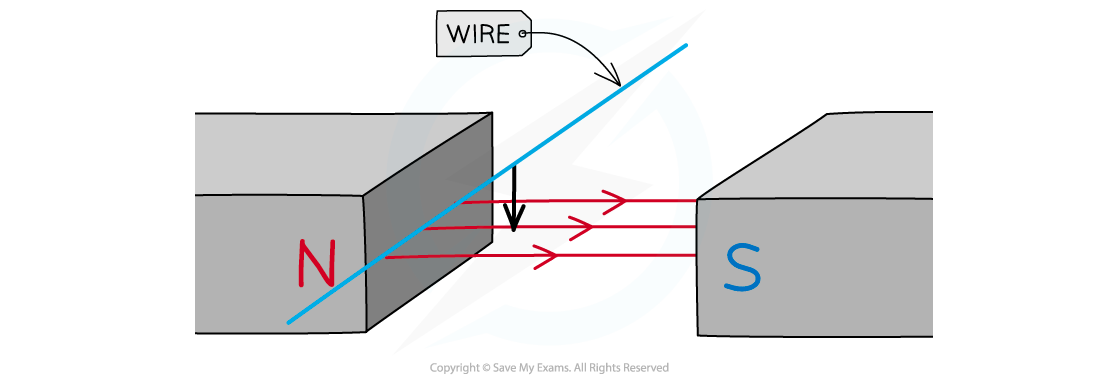
Moving an electrical conductor in a magnetic field to induce a potential difference
-
Moving the magnetic field relative to a fixed conductor
- As the magnet moved through the coil, the field lines cut through the turns on the coil
- This induces a potential difference in the coil
Diagram of electromagnetic induction in a coil
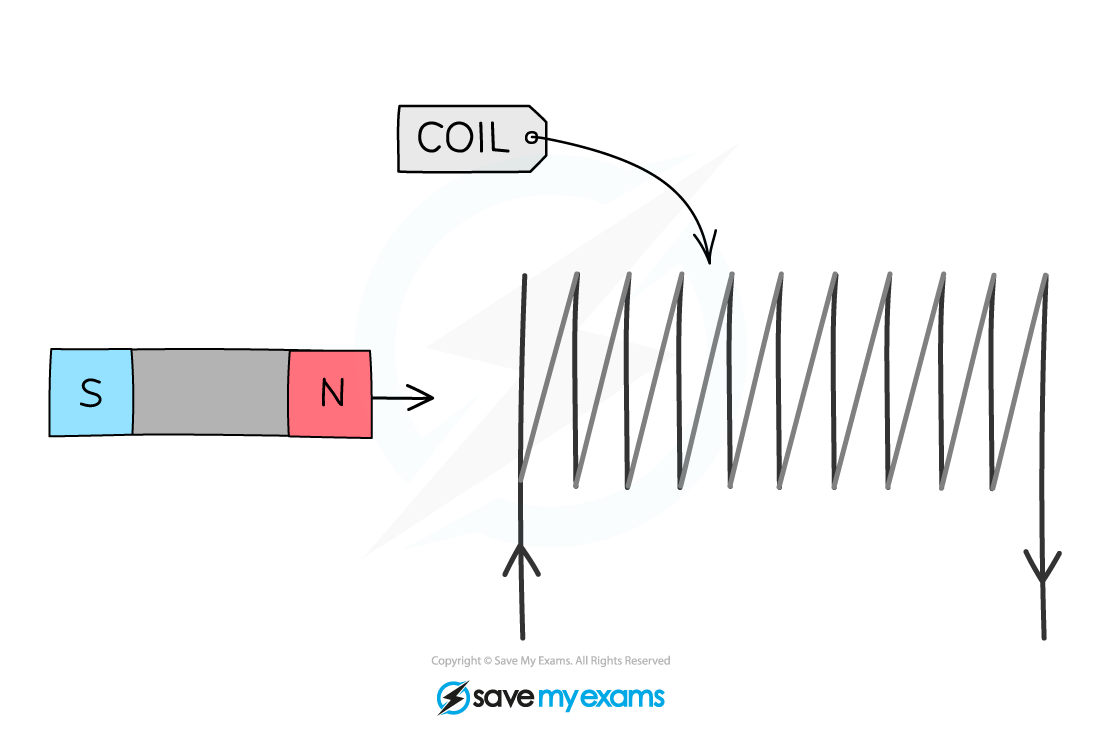
When the magnet enters the coil, the field lines cut through the turns, inducing a potential difference
- A sensitive voltmeter can be used to measure the size of the induced potential difference
- If the conductor is part of a complete circuit then a current is induced in the conductor
Factors affecting the induced potential difference
-
The size of the induced potential difference is determined by:
- The speed at which the wire, coil or magnet is moved
- The number of turns on the coils of wire
- The size of the coils
- The strength of the magnetic field
-
The direction of the induced potential difference is determined by:
- The orientation of the poles of the magnet
-
Each of these factors is examined below
- The speed at which the wire, coil or magnet is moved:
- Increasing the speed will increase the rate at which the magnetic field lines are cut
- This will increase the induced potential difference
- The number of turns on the coils in the wire:
- Increasing the number of turns on the coils for a given length of wire will increase the potential difference induced
- Reducing the length of wire but maintaining the number of turns will also increase the potential difference induced
- This is because each coil will cut through the magnetic field lines and the total potential difference induced will be the result of all the coils cutting the magnetic field lines
- The size of the coils:
- Increasing the area of the coils will increase the potential difference induced
- This is because there will be more wire to cut through the magnetic field lines
- The strength of the magnetic field:
- Increasing the strength of the magnetic field will increase the potential difference induced
- The orientation of the poles of the magnet:
- Reversing the direction of motion or swapping the magnet’s poles reverses the direction of the induced p.d., but not its magnitude
Exam Hint When discussing factors affecting the induced potential difference:
Make sure you state:
- “Add more turns to the coil” instead of “Add more coils”
- This is because these statements do not mean the same thing
Likewise, when referring to the magnet, use the phrase:
- “A stronger magnet instead of “A bigger magnet”
- This is because larger magnets are not necessarily stronger
Was this revision note helpful?
Build on this topic