Scalar & Vectors (Edexcel IGCSE Physics)
Guided lessons are live for this note
Work through it step by step — key points, depth layers, a worked example and self-checks.
Scalar & vector quantities
Spec point —
1.13· understand how vector quantities differ from scalar quantities
-
All quantities can be one of two types:
- a scalar
- a vector
Scalars
-
Scalars are quantities that have magnitude but not direction
- For example, mass is a scalar quantity because it has magnitude but no direction
Vectors
-
Vectors are quantities that have both magnitude and direction
- For example, weight is a vector quantity because it is a force and has both magnitude and direction
Distance and displacement
-
Distance is a measure of how far an object has travelled, regardless of direction
- Distance is the total length of the path taken
- Distance, therefore, has a magnitude but no direction
- So, distance is a scalar quantity
-
Displacement is a measure of how far it is between two points in space, including the direction
- Displacement is the length and direction of a straight line drawn from the starting point to the finishing point
- Displacement, therefore, has a magnitude and a direction
- So, displacement is a vector quantity
What is the difference between distance and displacement?
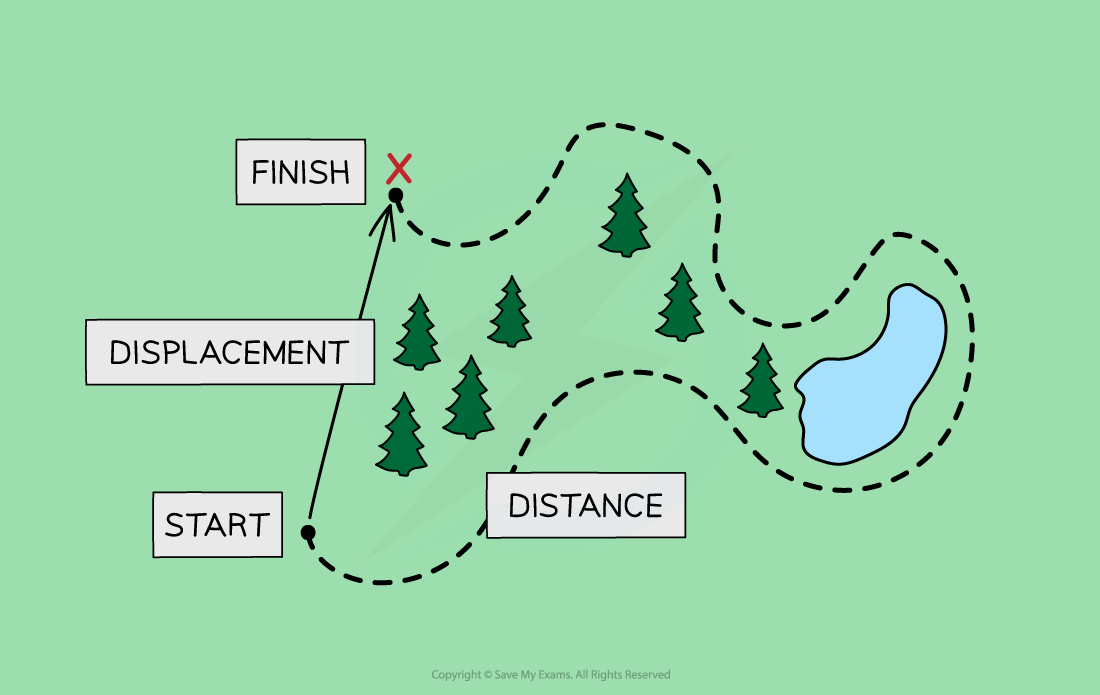
Displacement is a vector quantity while distance is a scalar quantity
-
When a student travels to school, there will probably be a difference in the distance they travel and their displacement
- The overall distance they travel includes the total lengths of all the roads, including any twists and turns
- The overall displacement of the student would be a straight line between their home and school, regardless of any obstacles, such as buildings, lakes or motorways, along the way
Speed and velocity
-
Speed is a measure of the distance travelled by an object per unit time, regardless of the direction
- The speed of an object describes how fast it is moving, but not the direction it is travelling in
- Speed, therefore, has magnitude but no direction
- So, speed is a scalar quantity
-
Velocity is a measure of the displacement of an object per unit time, including the direction
- The velocity of an object describes how fast it is moving and which direction it is travelling in
- An object can have a constant speed but a changing velocity if the object is changing direction
- Velocity, therefore, has magnitude and direction
- So, velocity is a vector quantity
Examples of scalars & vectors
- The table below lists some common examples of scalar and vector quantities
- Corresponding vectors and their scalar counterparts are aligned in the table where applicable
Table of scalars and vectors
| Scalar | Vector |
|---|---|
| distance | displacement |
| speed | velocity |
| mass | |
| weight | |
| force | |
| acceleration | |
| momentum | |
| energy | |
| volume | |
| density | |
| temperature | |
| power |
Worked Example Astronaut A is in charge of training junior astronauts. For one of their sessions, they would like to explain the difference between mass and weight.
Suggest how Astronaut A should explain the difference between mass and weight, using definitions of scalars and vectors in your answer.
Answer:
Step 1: Recall the definitions of a scalar and vector quantity
- Scalar quantities have only a magnitude
- Vector quantities have both magnitude and direction
Step 2: Identify which quantity has magnitude only
Mass is a quantity with magnitude only
So mass is a scalar quantity
- Astronaut A might explain to the junior astronauts that their mass will not change if they travel to outer space
Step 3: Identify which quantity has magnitude and direction
Weight is a quantity with magnitude and direction (it is a force)
So weight is a vector quantity
- Astronaut A might explain to the junior astronauts that their weight will vary depending on their location in space
Forces as vectors
Spec point —
1.14· understand that force is a vector quantity
-
Vector quantities can be represented by arrows
- The length of the arrow represents the magnitude
- The direction of the arrow indicates the direction
-
Force is a vector quantity because force has magnitude and direction
-
When using arrows to represent forces:
-
the length of the arrow represents the magnitude of the force
-
the direction of the arrow indicates the direction of the force
-
the scale of the arrows should be proportional to the relative magnitudes of the forces
- an arrow for a 4 N force should be twice as long as an arrow for a 2 N force
-
the arrows should be labelled with the names of the forces, or a description of the forces
- for example, weight, W, or the gravitational pull of the Earth on the object
-
Two forces acting on an object
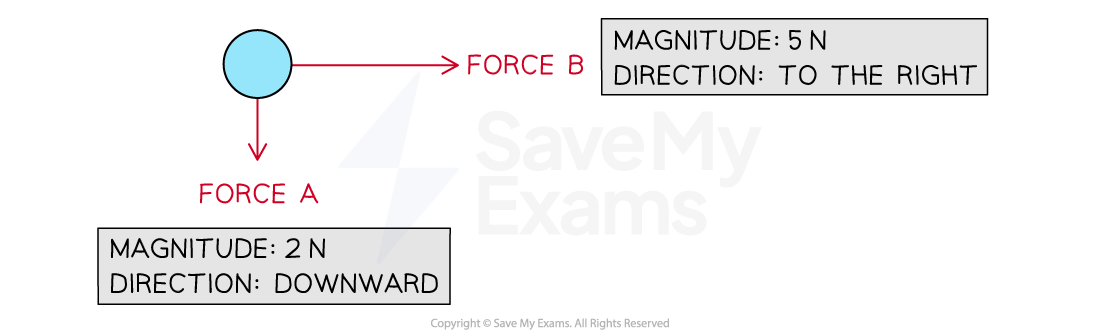
The length of the arrows are proportional to the magnitude of the forces, and show the direction that forces act in
-
Not all forces are directed perfectly horizontally or vertically and so need to have an angle described for the direction
- It is useful to describe an angle with respect to the vertical or the horizontal
A force acting at an angle
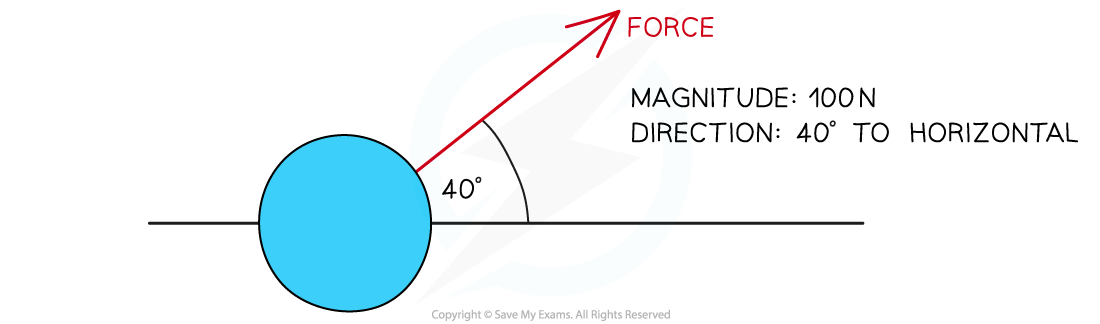
A force of magnitude 100 N directed 40° from the horizontal
Was this revision note helpful?