Scalar & Vectors
2 guided lessons · 18 checks · 1. Forces & Motion → Forces, Movement & Changing Shape
Guided lessons for this note
Which concept don't you understand yet?
We'll explain it simply and check your understanding. Pick any lesson — any order works.
0 of 18 checks correct so far
Lesson 1 of 2
Scalars, vectors and their paired quantities
A scalar reports a size and nothing else; a vector reports a size plus a direction. The distinction looks small until you meet the paired quantities: distance against displacement, and the route a walker actually takes against the straight line home. This lesson fixes the definitions and the standard pairings.
What you know already
Every measured quantity in this course belongs to one of two families. One family reports only 'how much'; the other also reports 'which way'. This note defines the two families, sorts the familiar pairs — distance and displacement, speed and velocity — and then shows why force itself sits in the second family.
Key points of understanding
- A scalar carries a magnitude only, with no direction attached.
- A vector carries both a magnitude and a direction.
- Distance is the total length of the path travelled, regardless of direction, so it is a scalar.
- Displacement is the straight-line separation of the finishing point from the starting point, including the direction, so it is a vector.
- Mass, energy, volume, density, temperature and power are scalars; weight, force, acceleration and momentum are vectors.
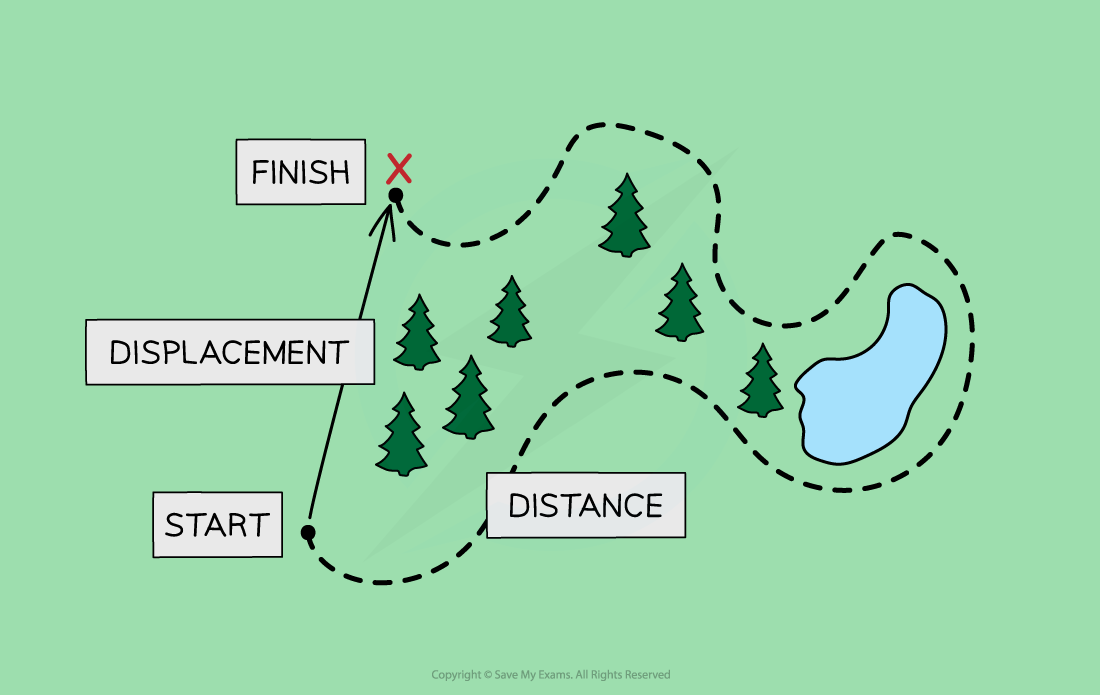
Displacement is a vector quantity while distance is a scalar quantity
Choose a confidence level to continue.
Prefer to read it all at once? Show the full lesson as a page
1.Scalars, vectors and their paired quantities
A scalar reports a size and nothing else; a vector reports a size plus a direction. The distinction looks small until you meet the paired quantities: distance against displacement, and the route a walker actually takes against the straight line home. This lesson fixes the definitions and the standard pairings.
Displacement is a vector quantity while distance is a scalar quantity
Key points
- A scalar carries a magnitude only, with no direction attached.
- A vector carries both a magnitude and a direction.
- Distance is the total length of the path travelled, regardless of direction, so it is a scalar.
- Displacement is the straight-line separation of the finishing point from the starting point, including the direction, so it is a vector.
- Mass, energy, volume, density, temperature and power are scalars; weight, force, acceleration and momentum are vectors.
First pass
Ask one question: does the quantity need a direction to be complete? If no, it is a scalar; if yes, it is a vector.
Analogy — A shopping receipt gives amounts only — that is scalar-style data. Directions to a hidden treasure need steps with headings — vector-style data.
Exam pointer — Sort-the-list questions are common; memorise the two columns rather than re-deriving them in the exam.
Going deeper
Distance and displacement disagree whenever the path bends: the path length accumulates every turn, while the displacement records only the net straight-line outcome with its heading.
Analogy — The odometer adds up every bend of a mountain road (distance); the map's ruler ignores the bends and draws one arrow start-to-finish (displacement).
Exam pointer — A full lap of a track gives a large distance but zero displacement — a favourite one-mark discriminator.
Checks
0 of 9 attempted · 0 correct
2.Velocity and force as vectors
The pairing idea now meets motion and force. Speed copies distance's magnitude-only habit; velocity inherits displacement's direction. Force behaves the same way, which is why force arrows are drawn with proportional lengths and stated headings. This lesson turns both statements into working rules.
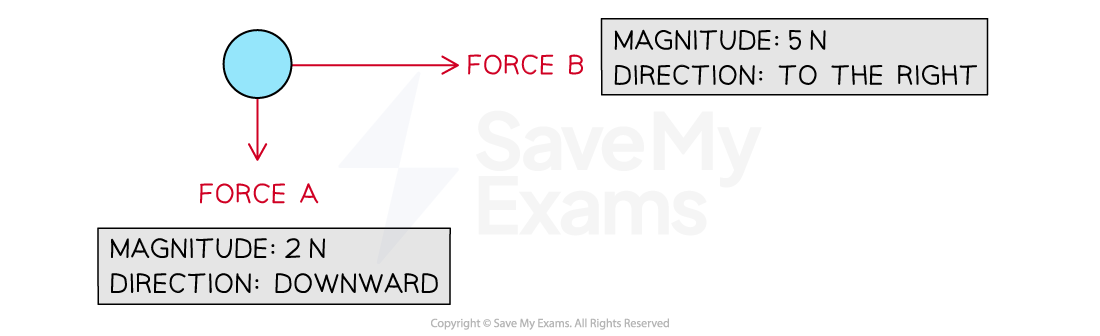
The length of the arrows are proportional to the magnitude of the forces, and show the direction that forces act in
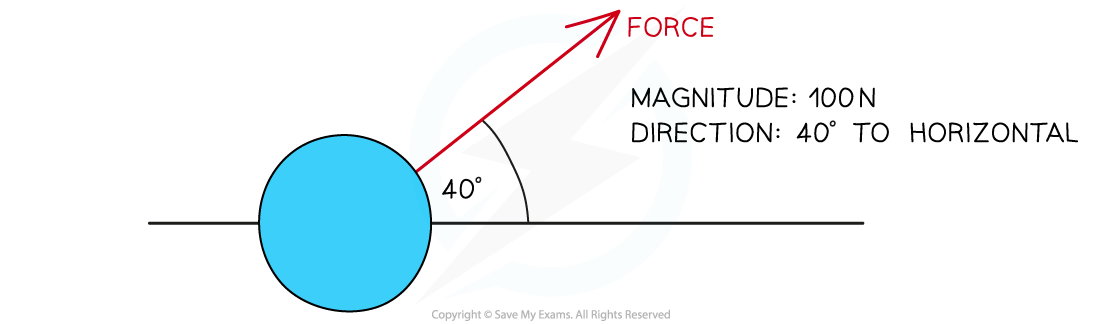
A force of magnitude 100 N directed 40° from the horizontal
Key points
- Speed measures the distance covered per unit time regardless of direction, so it is a scalar.
- Velocity measures the displacement per unit time with the direction included, so it is a vector.
- An object can keep a constant speed while its velocity changes, because the heading is turning.
- Force is a vector: it has a magnitude and acts along a stated direction.
- Force arrows are drawn with length proportional to magnitude, in the force's direction, and labelled with the force's name.
- Directions that are neither horizontal nor vertical are described by an angle from the horizontal or the vertical.
First pass
Velocity is speed with a heading; force is a push or pull with a heading. Arrows show both facts at once.
Analogy — A delivery app pin shows distance only; the rider's arrow on the map shows where the van is heading — the vector view.
Exam pointer — Any describe-the-force answer should carry a size in newtons and a direction — one without the other is incomplete.
Going deeper
Because velocity is displacement per time, a turning path changes the velocity even at fixed pace; because force is a vector, two equal-magnitude forces can cancel or combine depending on their directions.
Analogy — Two identical dogs pulling a post in opposite ways hold it still; the same two pulling the same way drag it off — magnitudes alone never tell the story.
Exam pointer — For diagram marks: state the scale, keep lengths proportional (a 4 N arrow twice a 2 N arrow) and label every arrow.
Checks
0 of 9 attempted · 0 correct
Guided content from the SME authoring corpus — note rn_4zdmGRWTg5ksK44N, pinned at bfae99778094 · promoted SyllabAI/syllabai-resources b3caaaa90c5e