Wireless Communications (Edexcel IGCSE Ict)
Wi-Fi
Spec point —
2.1.4
What is Wi-Fi?
-
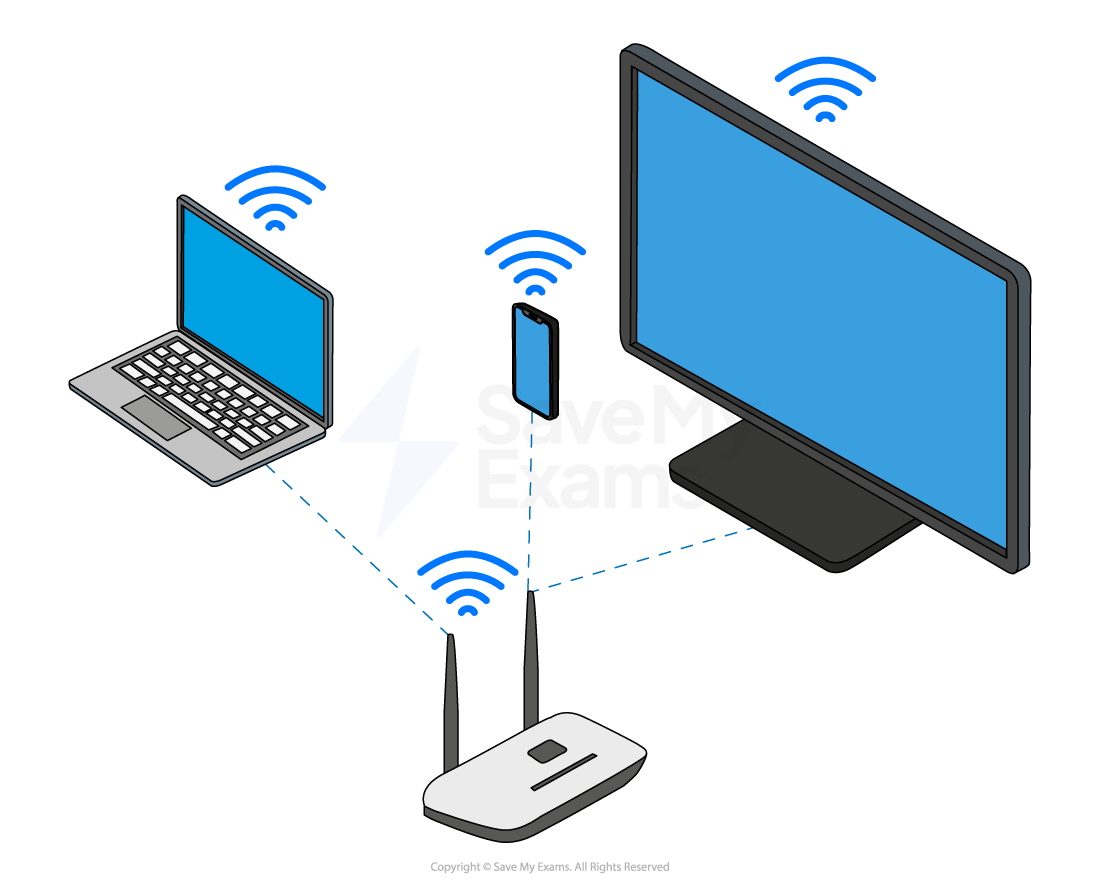
Wireless fidelity (Wi-Fi) is a common standard for wireless networks
-
Wi-Fi is common in most homes and offices to connect devices such as laptops, tablets& smart phones
-
Using Wi-Fi, devices communicate with a hotspot or a wireless access point (WAP), which can be a standalone device or built into a router or switch
-
Wi-Fi may be preferred over Bluetooth when:
- High speed data transfer is required
- Long range communication is required
- Many devices are needed to be connected at the same time
| Advantages | Disadvantages |
|---|---|
| - Portability- Easy to move around, location is only limited by range - Cost- Less expensive to setup and add new devices - Compatibility- Most devices are manufactured with a built in Wi-Fi adapter | - Speed- Slower data transfer than Ethernet - Security- Less secure than Ethernet - Range- Relies on signal strength to the WAP, signals can be obstructed (up to 100m) |
Bluetooth
Spec point —
2.1.4
What is Bluetooth?

- Bluetooth is another common standard for wireless networks
- Bluetooth is common in most homes and offices to connect devices such as headphones, controllers, keyboards& mice
- Bluetooth is used typically for a direct connection between two devices
- When two devices pair, they both exchange a cryptographic key
- The keys are used to generate a secret shared key which is used to encrypt the data between the two devices and create a Wireless Personal Area Network (WPAN)
- Connected devices continuously change their transmitting frequency between 79 different channels to avoid interference and improve the reliability of the connection
- This is known as the frequency hopping spread spectrum (FHSS)
| Advantages | Disadvantages |
|---|---|
| - Compatibility- Ideal for personal devices and ad-hoc connections - Power- Very low power consumption | - Speed- Very slow transfer speeds - Security- Data can be intercepted by anyone in range - Range- Short range (30m) |
Differences between Bluetooth and Wi-Fi
| Bluetooth | Wi-Fi | |
|---|---|---|
| Maximum number of connections | 7 | 30 |
| Transmission frequency | 2.4Ghz | 2.4Ghz, 5Ghz |
| Maximum range(meters) | 30 meters | 100 meters (depending on obstructions) |
| Maximum transfer speed (Depending on the standard being used) | 3 Mbytes / Sec | 75 Mbytes / Sec |
GPS
Spec point —
2.1.3
What is GPS?
- Global Positioning System (GPS) is a satellite system used to track the exact location of an object
- GPS uses orbiting satellites to receive, amplify and transmit signals
- **Radio frequencies are used **to communicate between satellites and ground stations
- GPS** requires a direct line of sight**
Case Study Sat nav in a car
- The position/location of the car is calculated using GPS software
- Data is transmitted every few seconds
- An algorithm calculates the speed/location of the car
- The map is updated every few seconds
| Advantages | Disadvantages |
|---|---|
| - Wide coverage area - Real-time data transmission - Improved communication in remote locations - Accurate location tracking | - Expensive setup and maintenance - Signal interference due to weather or obstacles - Limited bandwidth and capacity - Privacy concerns and potential for Surveillance |
3G & 4G
Spec point —
2.1.3
What is 3G & 4G?
-
3G and 4G are references to the 3rd and 4th generation of mobile data networks
-
They provide mobile devices with wireless access to the internet
-
Each generation has a faster transfer rate and an improved capacity for more users
- 3G - 256 Kbps (kilobits per second)
- 4G - 100+ Mbps (megabits per second)
-
The current generation (5G) has even faster speeds and lower latency
Infra-red (IR)
Spec point —
2.1.3
What is infra-red?
-
Infra-red is a wireless communication method used to transfer very small amounts of data to a device in direct line of sight
-
Commonly used in remotes to control devices such as:
- Televisions
- Audio receivers
- Home entertainment equipment etc.
-
Uses light waves which can cause:
- Walls or obstacles to block the signal
- Sunlight to affect the signal
-
It is a reliable and cost effective solution for many short-range wireless communication needs
NFC
Spec point —
2.1.3
What is NFC?
-
Near field communication (NFC) is a subset of RFID which allows communication between two devices in very close proximity
-
NFC can be either:
- Passive- uses energy from the reader
- Active- has it's own power source
-
Smartphones use **active NFC to allow contactless payments **by tapping a smartphone on a reader
-
Smartphones can also** exchange data using NFC** by tapping together (usually back to back)
| Advantages | Disadvantages |
|---|---|
| - Convenient - Secure - Very fast - Low power consumption | - Limited range - Slow data transfer rate (not suitable for transferring large files) - Compatibility |
Worked Example George uses a smartwatch when he exercises outside.
The smartwatch connects to a wireless health monitor to track his heart rate.
The health monitor uses Wi-Fi to transfer data to the smartwatch.
A. Speed is not a concern. Explain why Wi-Fi is a better choice than infrared for this transfer
[2]
B. Explain why distance might affect the speed of the transfer
[2]
Answers
*A. **An explanation such as: *
Wi-Fi does not require line of sight / Infrared requires line of sight** [1] which is not always possible when moving/exercising [1]
OR
Infrared is / Wi-Fi is not affected by sunlight [1] (which will affect the data transfer because) the health monitor will be used outside [1]
B. An explanation to include two from:
- More packets of data have to be requested again [1]
- ...because a signal degrades / gets weaker as it travels [1]
- ...due to (more opportunities for) interference / spreading out of the radio waves [1]
Was this revision note helpful?
Build on this topic