Central Processing Unit (CPU) (Edexcel IGCSE Ict)
Spec point —
1.7.1
Central Processing Unit (CPU)
What is the purpose of the CPU?
- The purpose of the Central Processing Unit (CPU) is to execute **instructions **
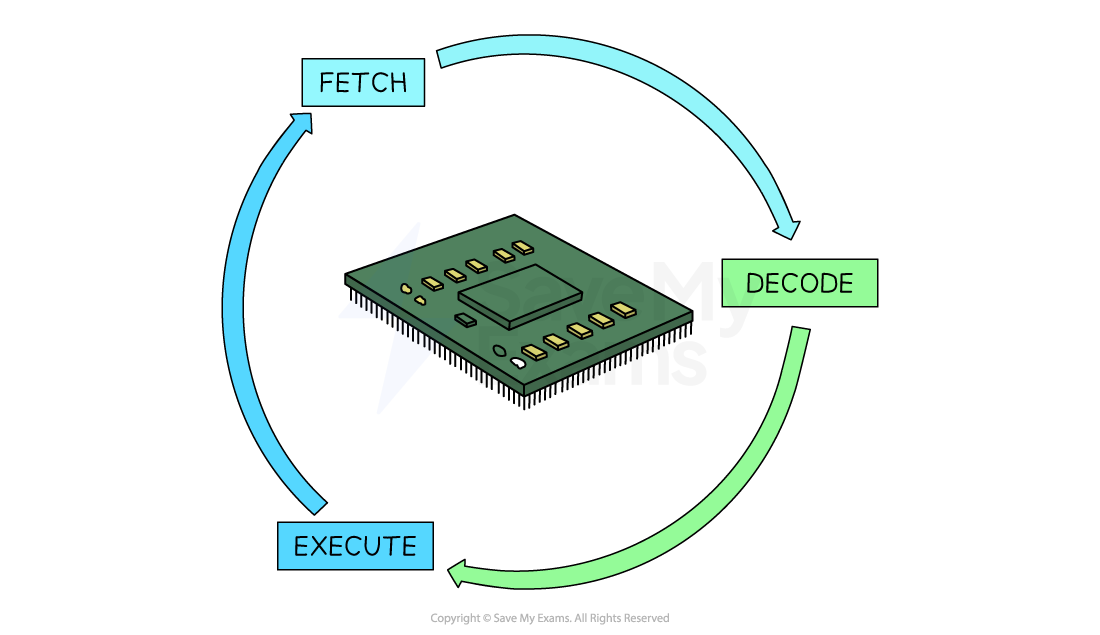
- The CPU achieves this**** by completing processor cycles
- A modern CPU is capable of performing billions of processor cycles in one second
The processor cycle stages
Fetch stage
- During the fetch stage of the cycle, the next instruction or data must be fetched from the computer's memory (RAM)
- The instruction or data is brought back to the CPU
Decode stage
- During the decode stage of the cycle, the CPU needs to work out what is required from the instruction
- This could be a range of tasks depending on what the instruction or data included
Execute stage
-
During the execute stage of the cycle, the CPU will carry out the instruction that was fetched
-
Some examples that would take place at this stage are
- Performing a calculation
- Storing a result or data back in main memory (RAM)
- Going to main memory to fetch data from a different location
How is the speed of a processor measured?
- The speed of a processor is measured by it's clock speed
- Clock speed is measured in Hertz (Hz)
- The clock speed measures the number of processor cycles that can take place in 1 second
- The faster the clock speed, the more instructions can be fetched and executed per second
- Modern computers have a clock speed in Gigahertz (GHz), meaning billion
- A clock speed of 3.5GHz can perform up to 3.5 billion instructions per second
Number of cores
-
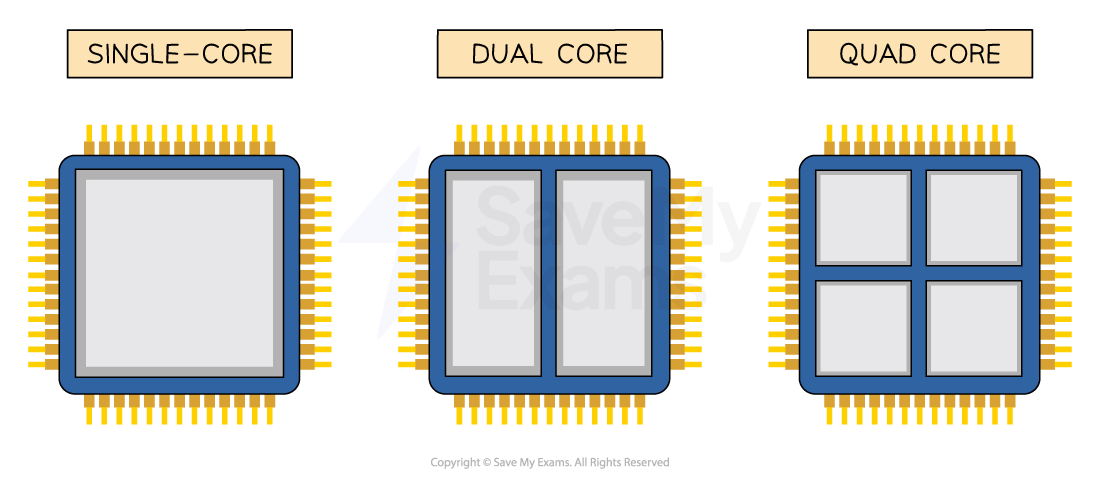
A core works like it is its own CPU
-
Multiple core processors mean they have multiple separate processing units that can fetch, decode and execute instructions at the same time
-
Multi-core processors can run more powerful programs with greater ease
-
Multiple cores increase the performance of the CPU by working with the clock speed
-
Example: A quad-core CPU (4 cores), running at a clock speed of 3Ghz
- 4 cores x 3GHz
- 4 x 3 billion instructions
- 12 billion instructions per second
-
Worked Example Describe how the speed of the processor affects a users experience when playing a game
[4]
Answer
A description to include four from:
Faster processors fetch/decode/execute more instructions/data / have more cycles [1] per second [1]
so:
- graphics render more quickly / at greater resolution [1]
- making the visuals smoother / graphics can be displayed at greater resolution [1]
- making the environment more realistic [1]
- more actions can be carried out [1]
- making the gameplay more immersive/exciting [1]
Was this revision note helpful?
Build on this topic