Impacts of Economic Sectors (Edexcel IGCSE Geography)
Exam board Pearson Edexcel · IGCSEUpdated 2026-03-04
Case Study: Sector Shift in the UK
Spec point —
4GE1-S6.067
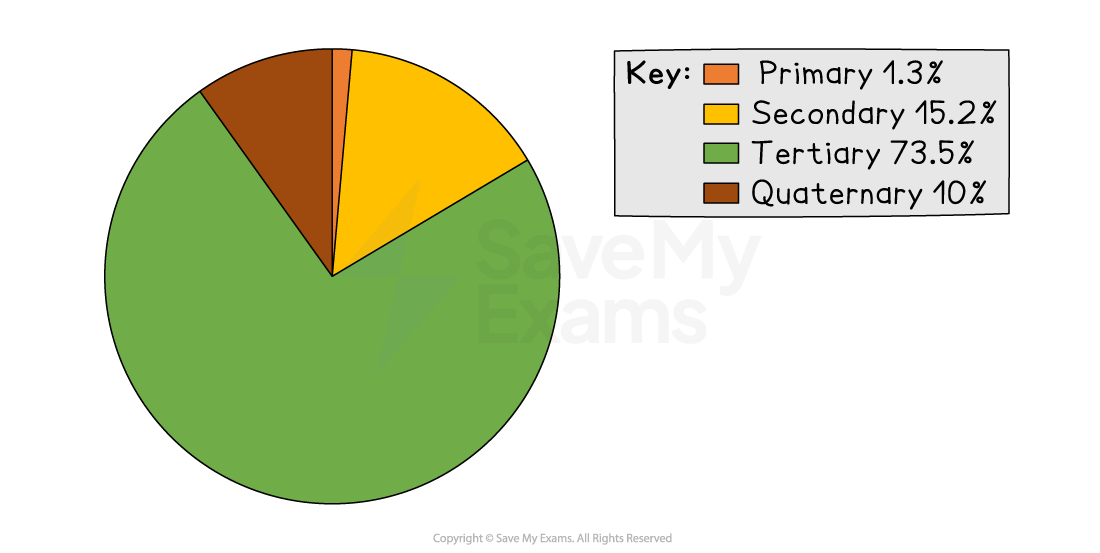
Case Study The UK is in the post-industrial stage of the Clark-Fisher model
- It was the first country to experience the Industrial Revolution
- In the 1800s jobs in primary economic activities were rapidly declining reaching 15% in 1900
- In 1900 most people (over 60%) worked in secondary economic activities and **tertiary economic activities **were also steadily increasing
- In the 1950s tertiary economic activities overtook secondary economic activities as the main employment sector
- In 2021 over 70% of people in the UK were employed in tertiary economic activities
- The UK is a global leader in financial and business services with many companies located in the financial districts of London
- Tech industries have also developed hubs in the UK in areas such as Cambridge, Manchester and Leeds
- These changes have both positive and negative impacts
% Employment in Economic Sectors 2020 - UK
Positive impacts
- Deindustrialisation has led to improvements in the environment and decreased levels of pollution
- The UK has developed expertise in secondary and tertiary economic activities which are in demand around the world
- London is the second most important financial centre in the world after New York
Negative impacts
- Deindustrialisation led to high numbers of job losses particularly in the north of the UK
- Job losses in secondary industries led to large areas of deprivation, especially in inner cities such as Liverpool and Leeds
- Increasing numbers of** transnational corporations**(TNCs) have moved their factories and offices to emerging and developing countries
Case Study: Sector Shift in China
Spec point —
4GE1-S6.067
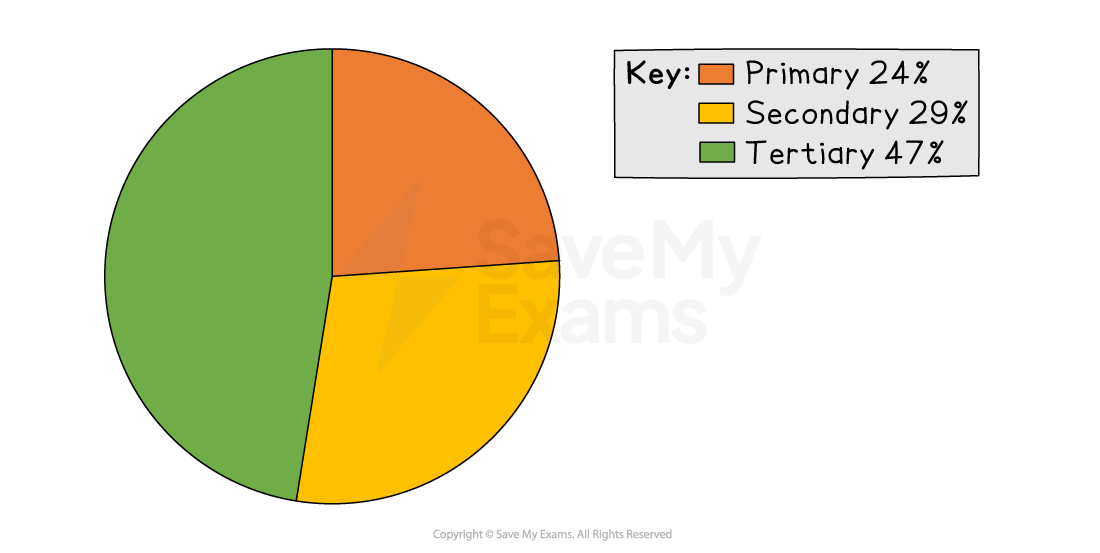
Case Study China is in the industrial stage of the Clark-Fisher model
- In 1950 over 80% of the population was employed in primary economic activities - mainly agriculture
- In 1978 China opened up to trade with the rest of the world and invested heavily in manufacturing
- By 2005 primary economic sector employment had dropped below 50% and most people were employed in secondary and tertiary economic activities
- In 2020 tertiary economic activity employment was increasingly important
*% Employment in Economic Sectors 2020- China *
Positive Impacts
- Improved incomes and higher standard of living
- More investment in education and health services
- Increased investment by transnational corporations(TNCs)
- Investment in roads, airports, ports and other infrastructure
Negative Impacts
- Increasing gap between regions as some area's economies grow more rapidly
- Increased gap between rich and poor, particularly in the gap between wealthier urban residents and poorer rural residents
- Air, water and noise pollution all increased
- Increased reliance on fossil fuels to supply energy which makes China one of the world's largest CO2 emitters
Case Study: Sector Shift in Kenya
Spec point —
4GE1-S6.067
Case Study
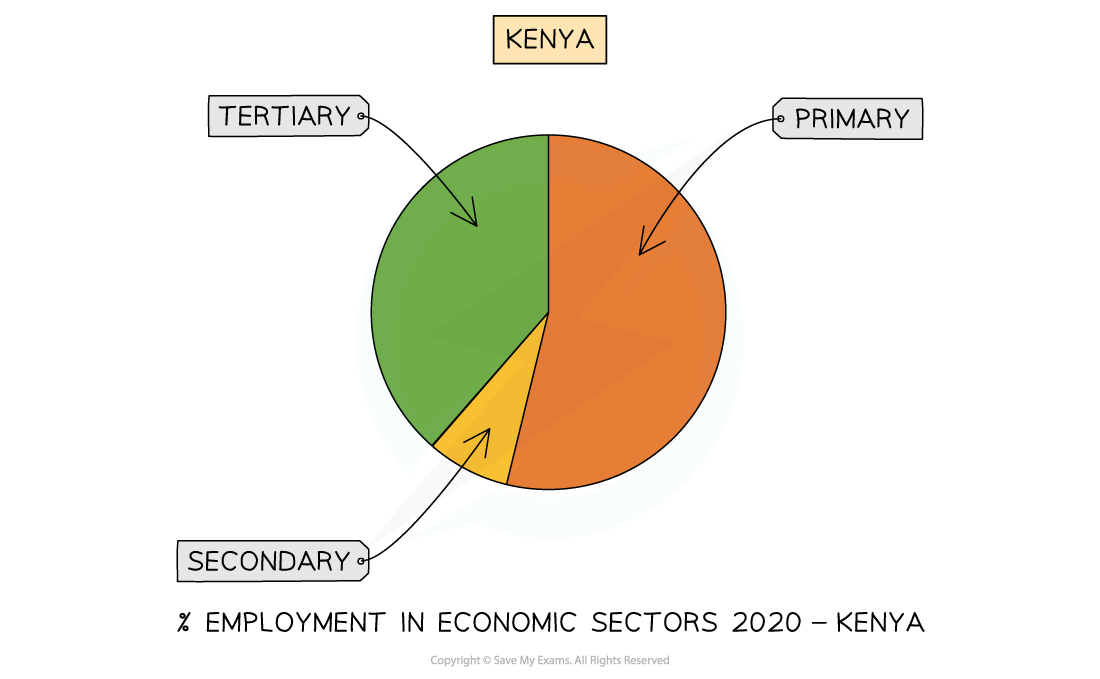
- Kenya is in the pre-industrial stage of the Clark-Fisher model
- Over 50% of the population is currently employed in agriculture, this has decreased from over 60% in 2010
- There is very little secondary economic activity due to a lack of resources and infrastructure
- Tertiary economic activities have rapidly increased - much of this is related to tourism
% Employment in Economic Sectors 2020 - Kenya
Positive Impacts
- Improved incomes and higher standard of living
- More investment in education and health
- Increased investment by **transnational corporations **(TNCs)
- Investment in roads, airports, ports and other** infrastructure**
Negative Impacts
- Increased rural-urban migration which leads to the development of informal settlements
- Increased gap between rich and poor, particularly in gap between wealthier urban residents and poorer rural residents
- Much of the profits from commercial farming and tourism go to TNCs rather than local people
- Jobs in the tertiary economic sector are often low-paid jobs in tourism
- Increased tourism can have negative impacts on the environment and animal habitats
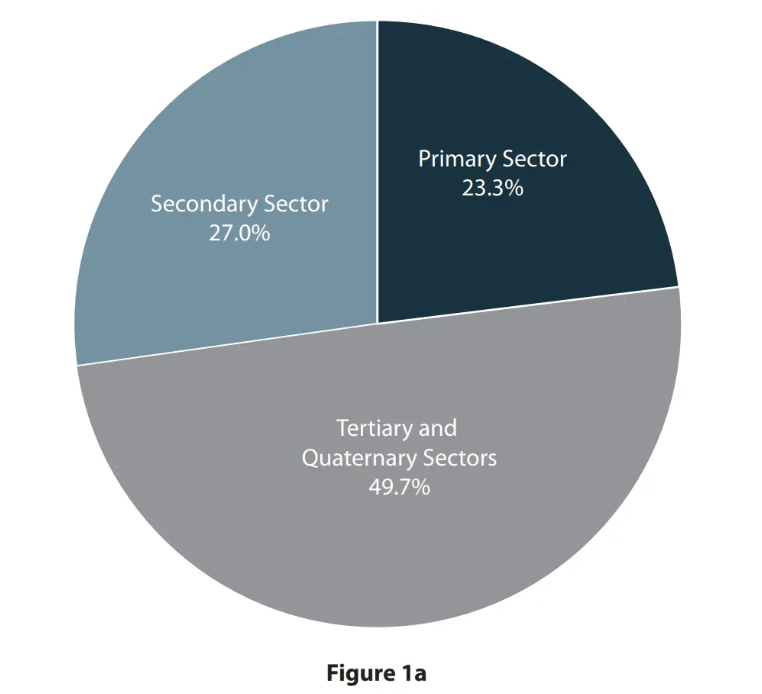
Worked Example Study Figure 1a, which shows Türkiyé's GDP by sector
Proportion of Türkiyé's GDP by different economic sector, 2002 to 2013
**Suggest one factor which has influenced the proportions of Türkiyé's GDP **
(2 Marks)
Final answer: Answer:
- Tertiary and quaternary are the largest sectors** [1]** because of improvements in education levels [1]
OR
- 27% of manufacturing (secondary) is the highest [1] because Türkiyé is developing its manufacturing economy as part of its industrialisation [1]
OR
- Globalisation means the country has received more foreign investment [1] causing the growth of the tertiary and quaternary sectors [1]
OR
- Tertiary is the largest sector [1] due to the growth of air travel and an increase in tourism [1]
OR
- The primary sector is still large at 23.3% [1] because the GDP still relies on agriculture [1]
Was this revision note helpful?