Sin, Cos & Tan (Edexcel IGCSE Further Maths)
Defining Sin, Cos and Tan
Spec point —
10B
What is the unit circle?
-
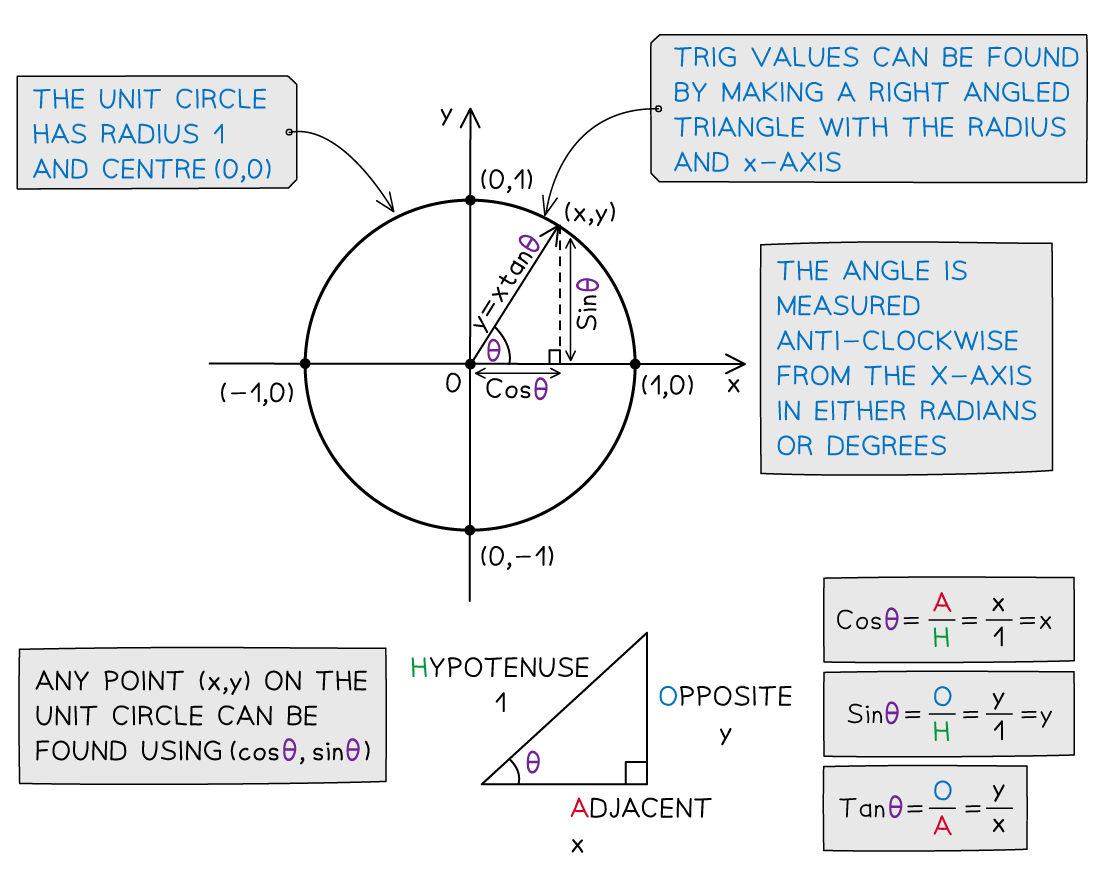
The unit circle is a circle with radius 1 and centre (0, 0)
-
It helps us to define values for sin θ,* cos θ and tan θ for all values of θ
- * *or doesn't make sense as an angle in a triangle or other shape
- But sin θ, cos θ and tan θ are defined for 'angles' like that
-
On the unit circle
-
Angles are always measured from the positive x-axis and turn:
- anticlockwise for positive angles
- clockwise for negative angles
-
After you can keep going
- So is 'all the way around' anticlockwise () and then another anticlockwise
- Or is 'all the way around twice' clockwise () and then another clockwise
-
-
It can be used to calculate trig values as coordinates (x, y) on the circle
-
Make a right triangle with the radius as the hypotenuse
- θ is the angle measured anticlockwise from the positive x-axis
- (or clockwise for negative θ)
-
The x-axis will always be adjacent to the angle, θ
-
-
SOHCAHTOA can then be used to find the values of sinθ, cosθ and tanθ
-
As the radius is 1 unit
- the x coordinate gives the value of cos θ
- the y coordinate gives the value of sin θ
-
Dividing the y coordinate by the x coordinate gives the value of tan θ
- This is also the gradient of the line through the origin and the point on the unit circle
-
-
Unlike SOHCAHTOA this allows us to calculate sin, cos and tan for
- angles greater than 90° (radians)
- negative angles
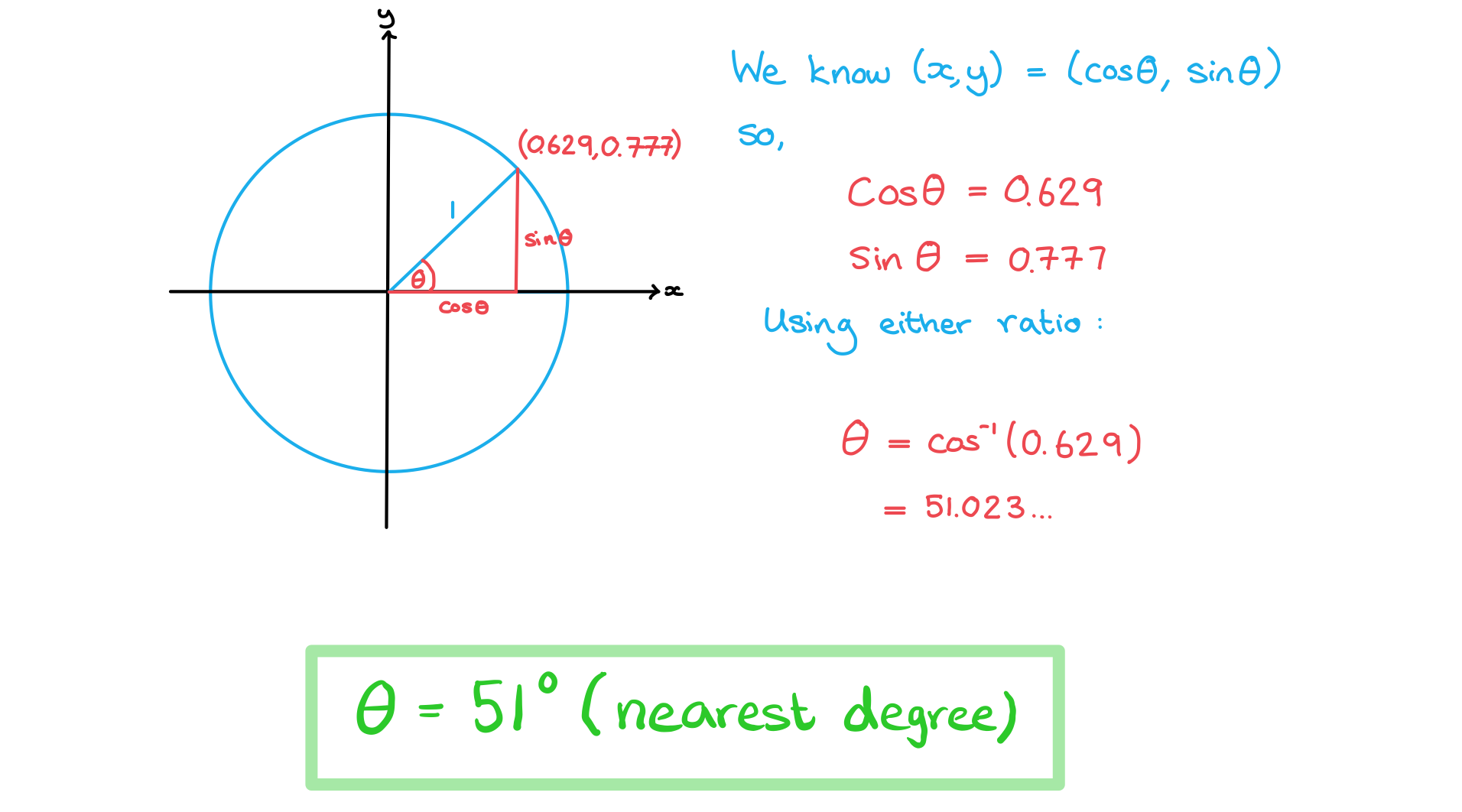
Worked Example The coordinates of a point on a unit circle, correct to 3 significant figures, are (0.629, 0.777). Find the angle with the positive *x-*axis, θ°, to the nearest degree.
Using The Unit Circle
Spec point —
10B
What are the properties of the unit circle?
-
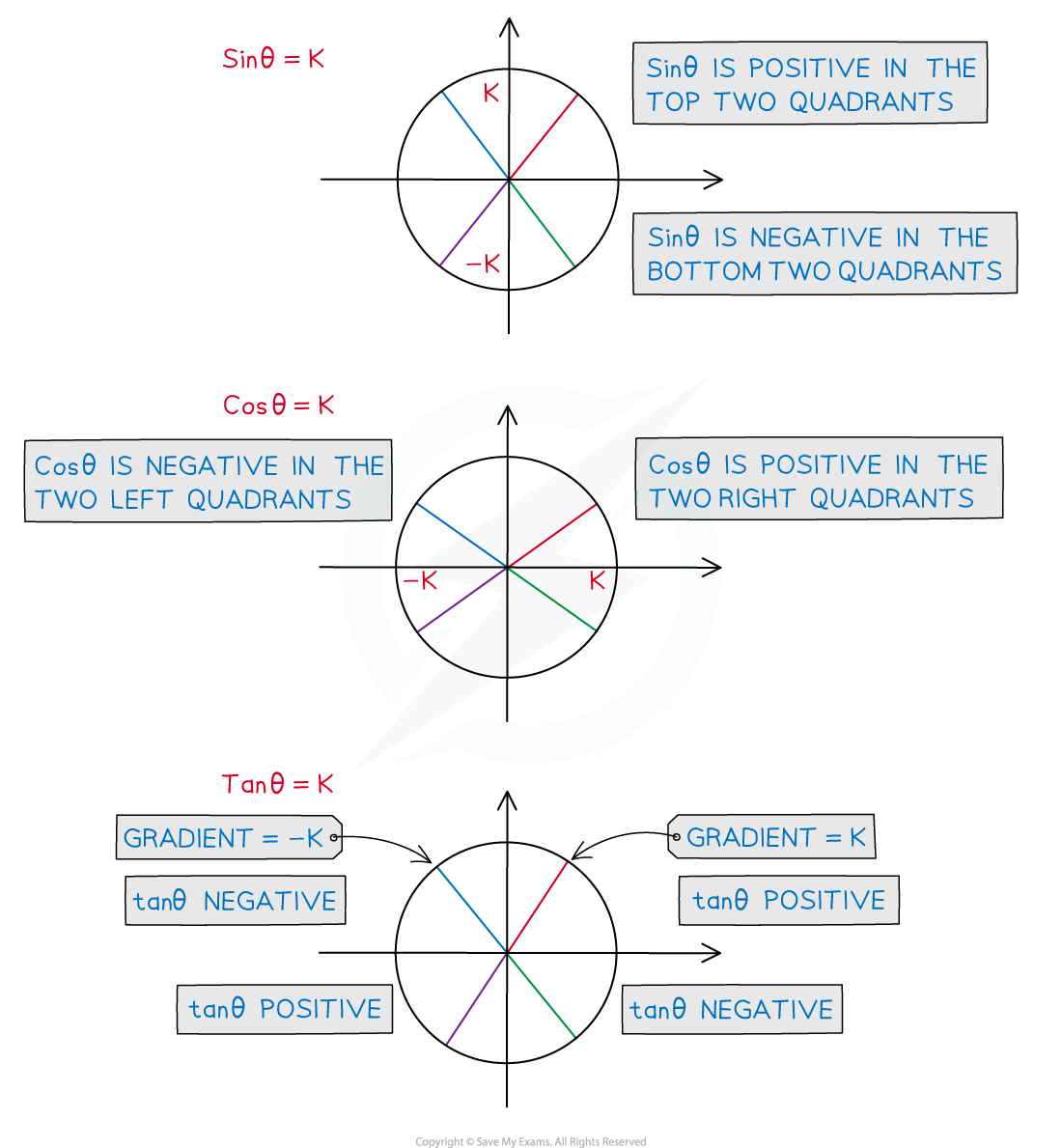
The unit circle can be split into four quadrants
-
The first quadrant is for angles between 0 and 90°
- All three of sin θ, cos θ and tan θ are positive in this quadrant
-
The second quadrant is for angles between 90° and 180° ( rad and rad)
- Sine (sin θ ) is positive in this quadrant
-
The third quadrant is for angles between 180° and 270° ( rad and rad)
- Tangent (tan θ ) is positive in this quadrant
-
The fourth quadrant is for angles between 270° and 360° ( rad and rad)
- Cosine (cos θ) is positive in this quadrant
-
Starting from the fourth quadrant (on the bottom right) and working anti-clockwise
-
the positive trig functions spell out CAST
- This is why it is often thought of as the CAST diagram
-
You may have your own way of remembering this
- A popular one starting from the first quadrant is All Students Take Calculus
-
-
To help yourself picture this try sketching all three trig graphs on one set of axes
- Look at which graphs are positive in each 90° section
How is the unit circle used to find additional solutions?
-
Trigonometric functions have more than one 'input' for each 'output'
- For example sin 30° = sin 150° = 0.5
-
This means that trigonometric equations have more than one solution
- Both 30° and 150° satisfy the equation
-
The unit circle can be used to find all solutions to trigonometric equations in a given interval
-
Your calculator will only give one solution to an equation like
- This solution is called the primary value
-
However due to the periodic nature of the trig functions there there are an infinite number of solutions
- You need to be able to find such additional values
-
On the exam you will be given an interval in which the solutions should be found
- This could either be in degrees or in radians
- If you see π or some multiple of π then you must work in radians
-
-
The following steps can help you use the unit circle to find additional values
-
STEP 1 Draw the primary value angle using the x or y coordinates to help you
-
This will be in the first or second quadrants if using to get the primary angle
- Or in the first or fourth quadrants if using or
-
If you are working with
- draw the line from the origin to the circumference of the circle
- the point on the circumference is where the y coordinate is k
-
If you are working with
- draw the line from the origin to the circumference of the circle
- the point on the circumference where the x coordinate is k
-
If you are working with
- draw the line from the origin to the circumference of the circle
- such that the gradient of the line is k
-
This will give you the angle which should be measured from the positive x-axis…
- … anticlockwise for a positive angle
- … clockwise for a negative angle
-
-
STEP 2 Draw the radius in the other quadrant which has the same...
-
... x coordinate if *solving
- This will be the quadrant which is vertically below the original quadrant
-
... y coordinate if *solving
- This will be the quadrant which is horizontally to the left of the original quadrant
-
... gradient if solving
- This will be the quadrant which is diagonally opposite to the original quadrant
-
-
STEP 3 Work out the size of the second angle, measuring from the positive x-axis
-
… anticlockwise for a positive angle
- or clockwise for a negative angle
-
Look at the given interval of solution values
- This will help you to decide whether you need a negative or positive angle measure
-
-
STEP 4 Add or subtract (multiples of) either 360° or 2π radians to or from both values
- until you have all solutions in the required interval
Exam Hint
Practice sketching out the unit circle
- and using CAST to remember what is positive in what quadrant
This can help you to find all solutions to a problem in an exam question
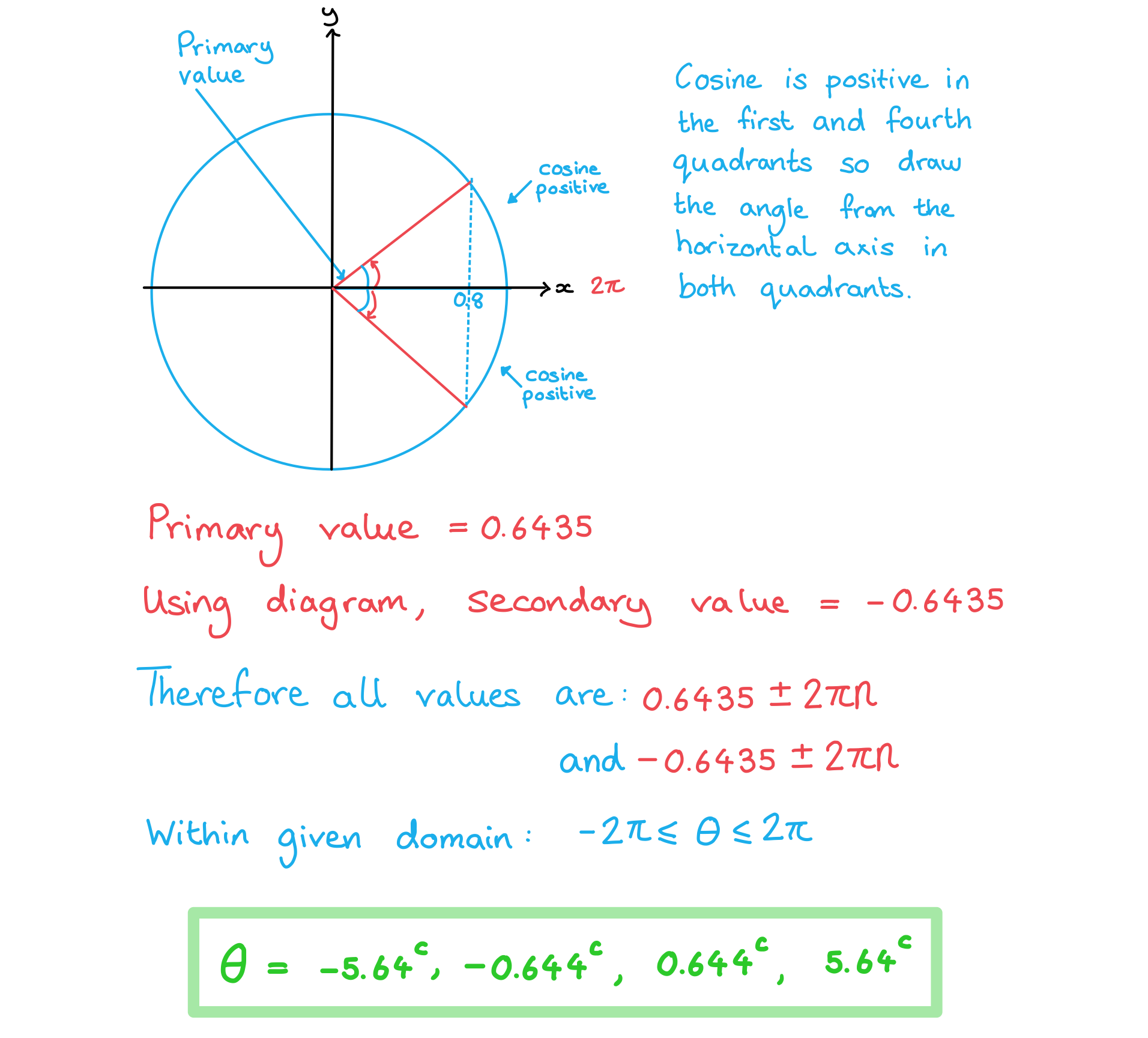
Worked Example It is given that one solution of is θ = 0.6435 radians, correct to 4 decimal places.
Use this to find all other solutions in the interval , giving your answers correct to 3 significant figures.
Trigonometry Exact Values
Spec point —
10B
What are exact values in trigonometry?
-
For certain angles the values of sin θ, cos θ and tan θ can be written exactly
-
This means using fractions and surds
-
You should be familiar with these values
- and able to derive them using geometry
-
-
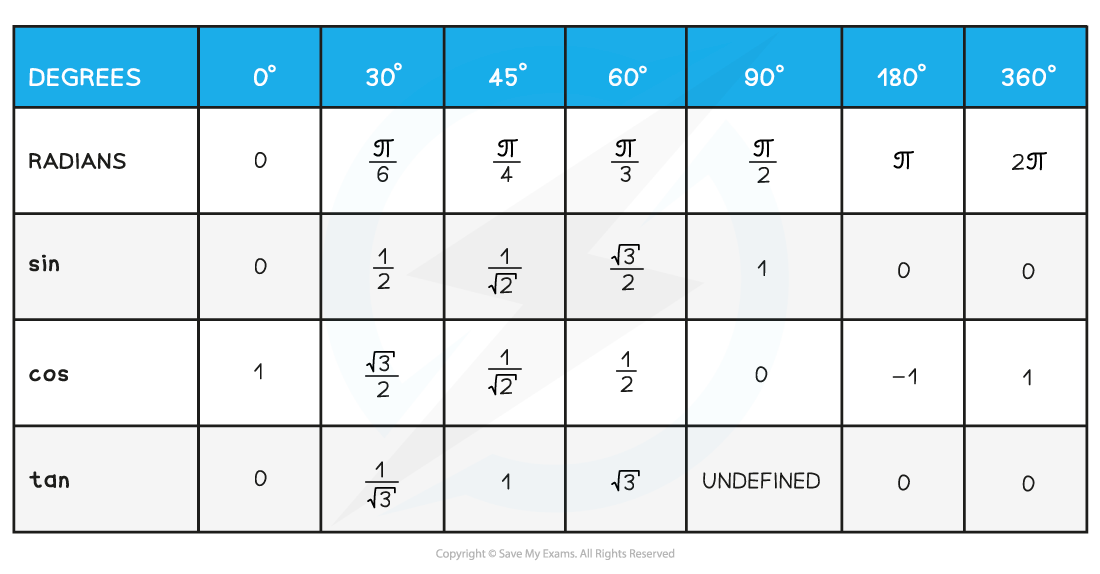
You should know the exact values of sin, cos and tan for angles of
- 0°, 30°, 45°, 60°, 90°, and 180° (in degrees)
- or and (in radians)
-
These values are in the following table
- Note that for 360° ( radians) the trig values are all the same as for 0
How do I find the exact values of other angles?
-
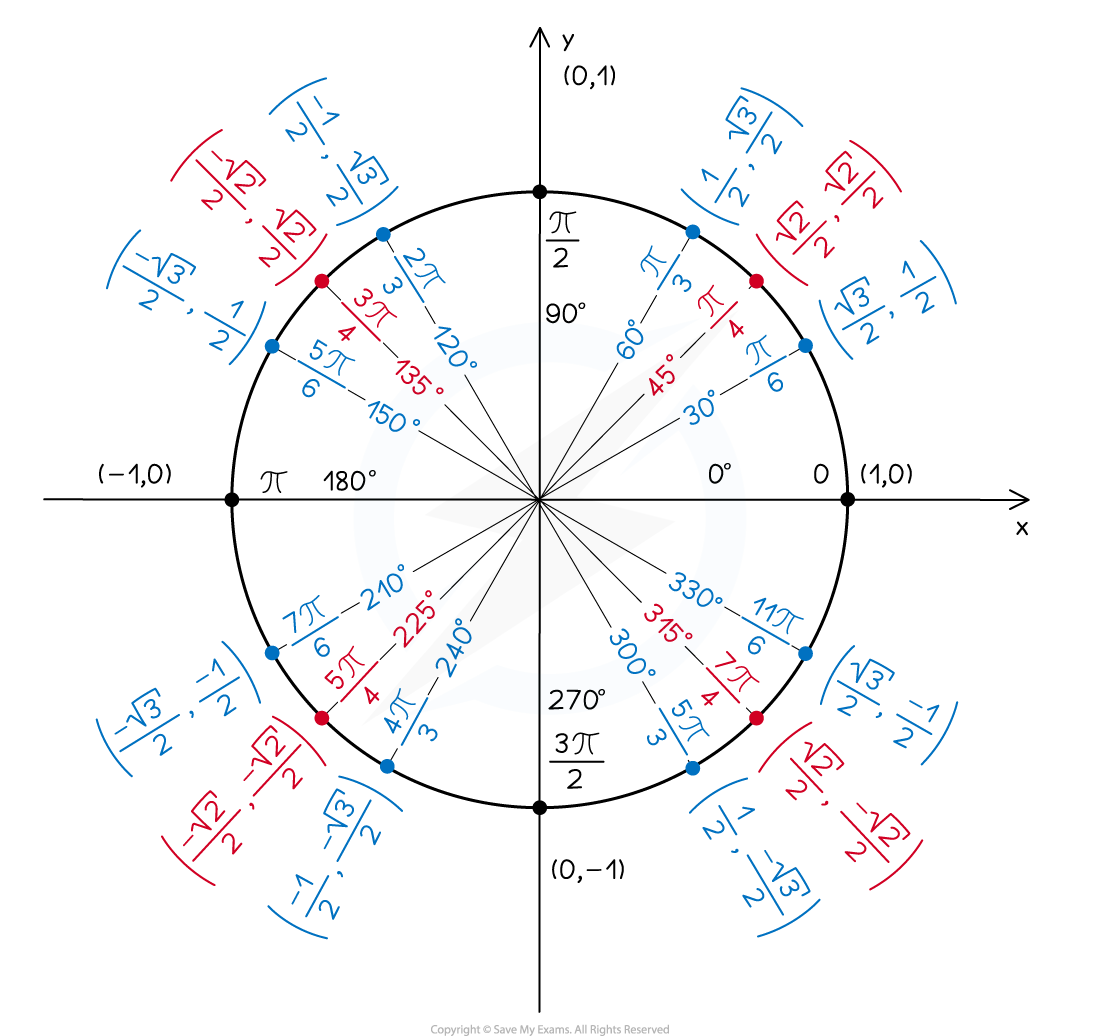
The exact values for cos and sin can be seen on the unit circle
-
They are the x and y coordinates respectively
-
If using the unit circle coordinates to memorise the exact values
- remember that cos (x value) comes before sin (y value)
-
-
The unit circle can also be used to find exact values of other angles using symmetry
-
If you know the exact values for an angle in the first quadrant
- you can draw the same angle from the *x-*axis in other quadrants to find values for other angles
-
Remember that the angles are measured anticlockwise from the positive *x-*axis
-
For example if you know that the exact value for sin 30° is 0.5
-
draw a 30° angle from the horizontal axis in the three other quadrants
-
measuring from the positive x-axis you have the angles of 150°, 210° and 330°
- sine is positive in the second quadrant so sin 150° = 0.5
- sine is negative in the third quadrant so sin 210° = - 0.5
- sine is negative in the fourth quadrant so sin 330° = - 0.5
-
-
It is also possible to find the negative angles by measuring clockwise from the positive *x-*axis
-
draw a 30° angle from the horizontal in the three other quadrants
-
measuring clockwise from the positive *x-*axis you have the angles of -30°, -150°, -210° and -330°
- sin is negative in the fourth quadrant so sin(-30°) = - 0.5
- sin is negative in the third quadrant so sin(-150°) = - 0.5
- sin is positive in the second quadrant so sin(-210°) = 0.5
- sin is positive in the fourth quadrant so sin(-330°) = 0.5
-
How can I derive exact trig values?
-
Being able to derive basic exact trig values can help if you forget them
-
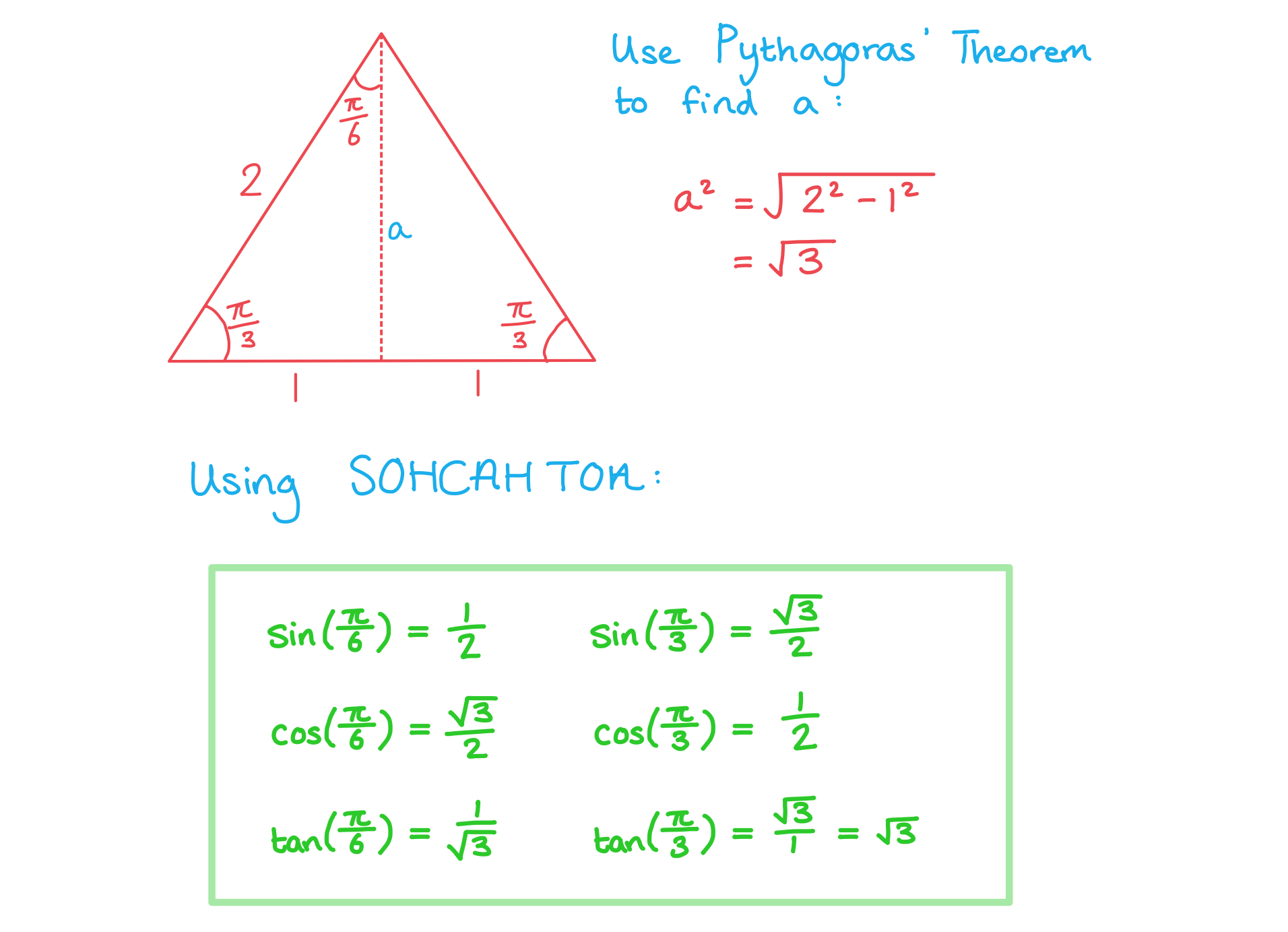
Values for 30° and 60° ( and radians) can be derived by using an equilateral triangle
- See the Worked Example below
-
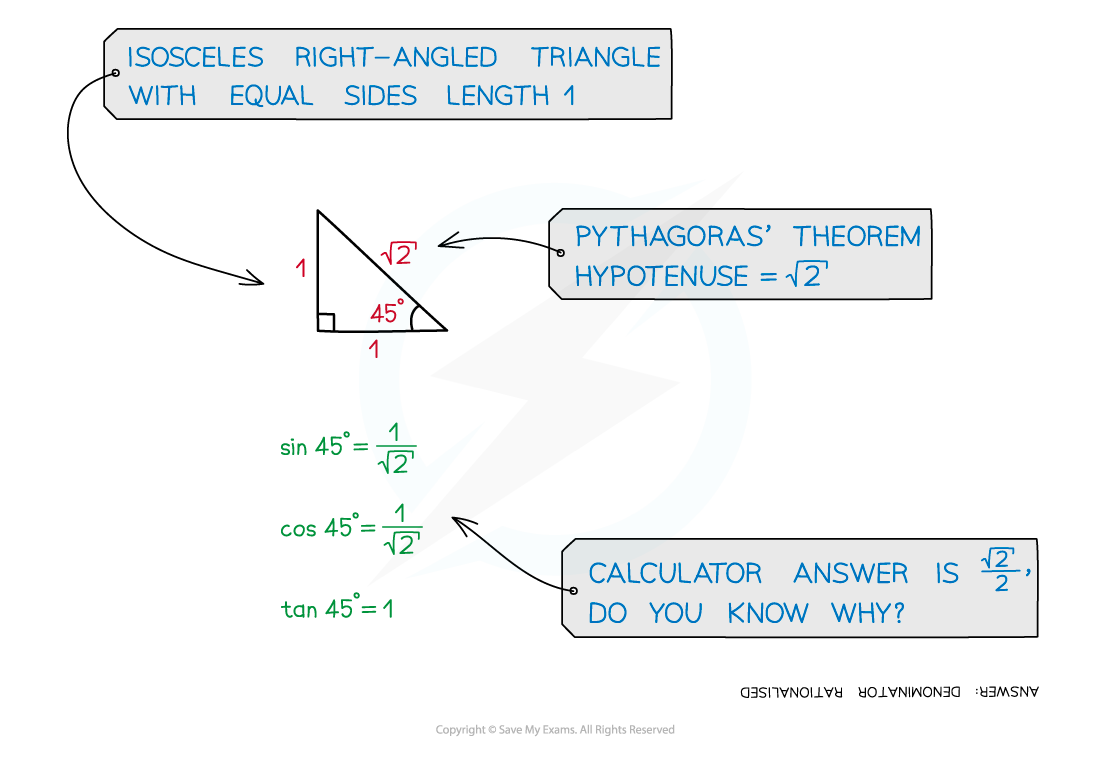
Values for 45° ( radians) can be derived using a right-angled isosceles triangle
- See the following diagram
Exam Hint
It can be easy to muddle up exact trig values if you just try to remember them from a list,
Sketch the unit circle and/or trig graphs on your exam paper
- This can help you keep the trig functions and their values straight
Note that for , , , ,
- The sine values run
- The cosine values run
- Values for tangent can be found using
Worked Example Using an equilateral triangle of side length 2 units, derive the exact values for the sine, cosine and tangent of and .
Was this revision note helpful?
Build on this topic