Price Elasticity of Supply (PES) (Edexcel IGCSE Economics)
The Definition & Calculation of PES
Spec point —
1.1.4h
-
The law of supply states that when there is an increase in price (ceteris paribus), producers will increase the quantity supplied and vice versa
- Economists are interested by how much the quantity supplied will increase
-
Price elasticity of supply (PES) reveals how responsive the change in quantity supplied is to a change in price
- The responsiveness is different for different types of products
-
PES can be calculated using the following formula
- To calculate a % change, use the following formula
Worked Example In recent months, the price of avocados has increased from AU$ 0.90 to AU$ 1.45. Bewdley Farm Shop in Margaret River has sought to maximise their profits by increasing the quantity supplied to the market. They have been able to increase sales from 110 units a week to 120 units a week. Calculate the PES of avocados and explain one reason for the value
Step 1: Calculate the % change in QS
****$% \Delta Q S = \frac{120 - 110}{110} \times 100
% \Delta Q S = 9.1 %$****
Step 2: Calculate the % change in P
$% \Delta \mathrm{P} = \frac{1.45 - 0.90}{0.90} \mathrm{x} 100
% \Delta \mathrm{P} = 61 %$
Step 3: Insert the above values in the PES formula
$\text{PE} S = \frac{% \Delta \text{in} Q S}{% \Delta \text{in} \mathrm{P} }
\text{PE} S = \frac{9.1 %}{61 %}
\text{PE} S = 0.15 $
Step 4: Explain one reason for the value
The PES value of 0.15 indicates that avocados are very price inelastic in supply. Even with a significant increase in price, suppliers are unable to supply more, likely due to the time it takes to grow additional avocados
Interpreting PES Values
Spec point —
1.1.4l
The Values of PES Vary From 0 To Infinity (∞) & They Are Classified As Follows
| Value and Name | Explanation | Diagram |
|---|---|---|
| 0 Perfectly Inelastic | - The QS is completely unresponsive to a change in P (e.g. fixed number of seats in a theatre) | 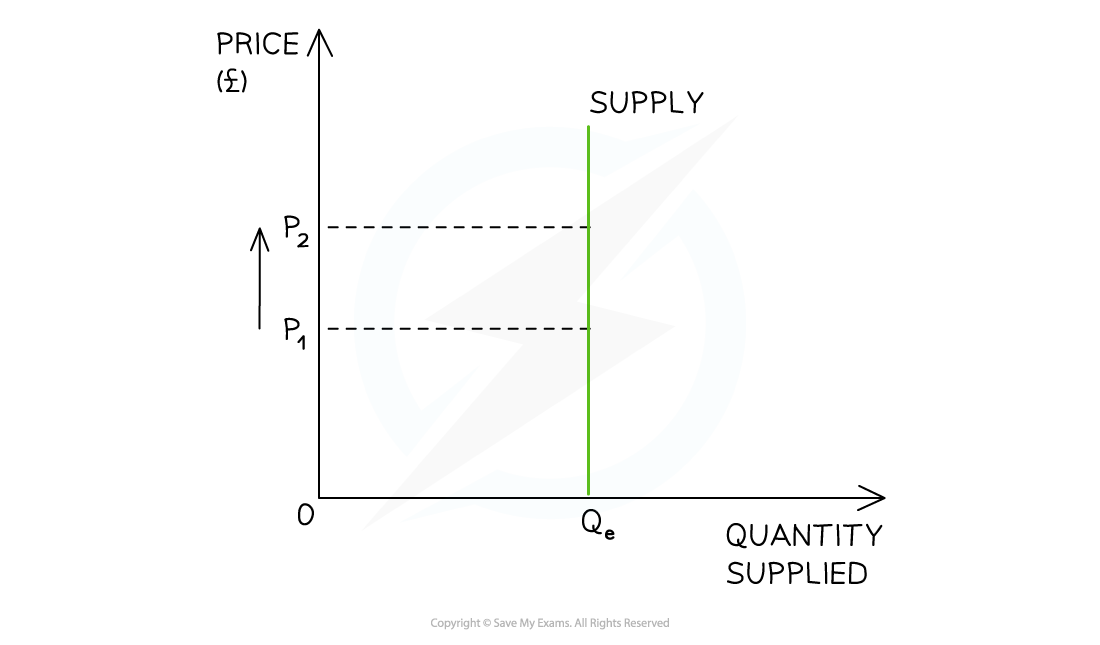 |
| 0 → 1 Relatively Inelastic | - The %∆ in QS is less than proportional to the %∆ in P (e.g agricultural products) | 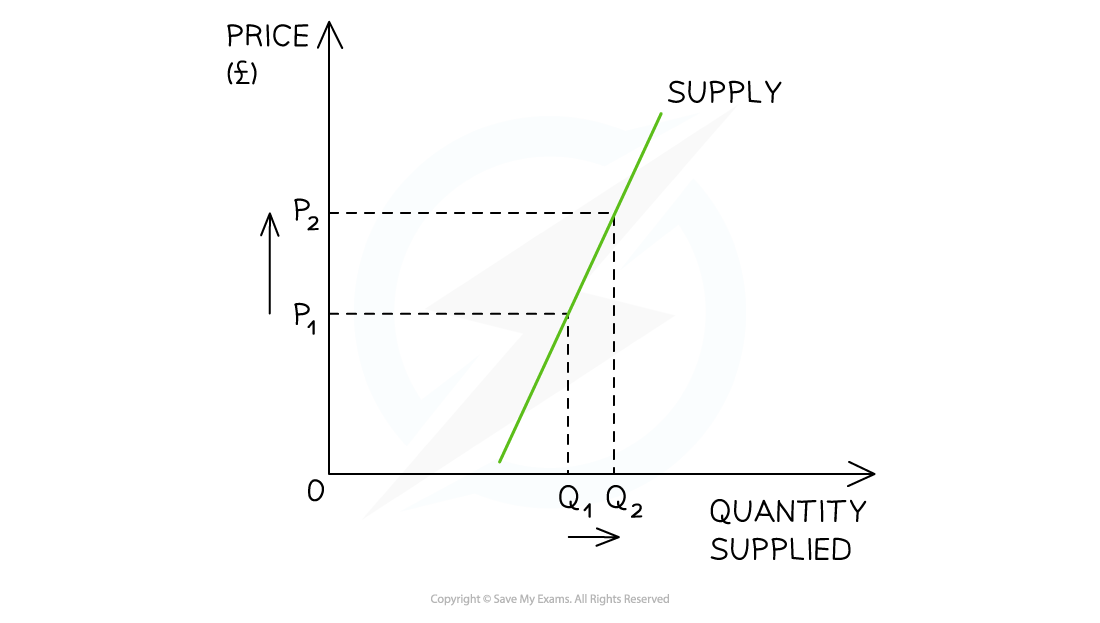 |
| 1 → ∞ Relatively Elastic | - The %∆ in QS is more than proportional to the %∆ in P (e.g t-shirts) | 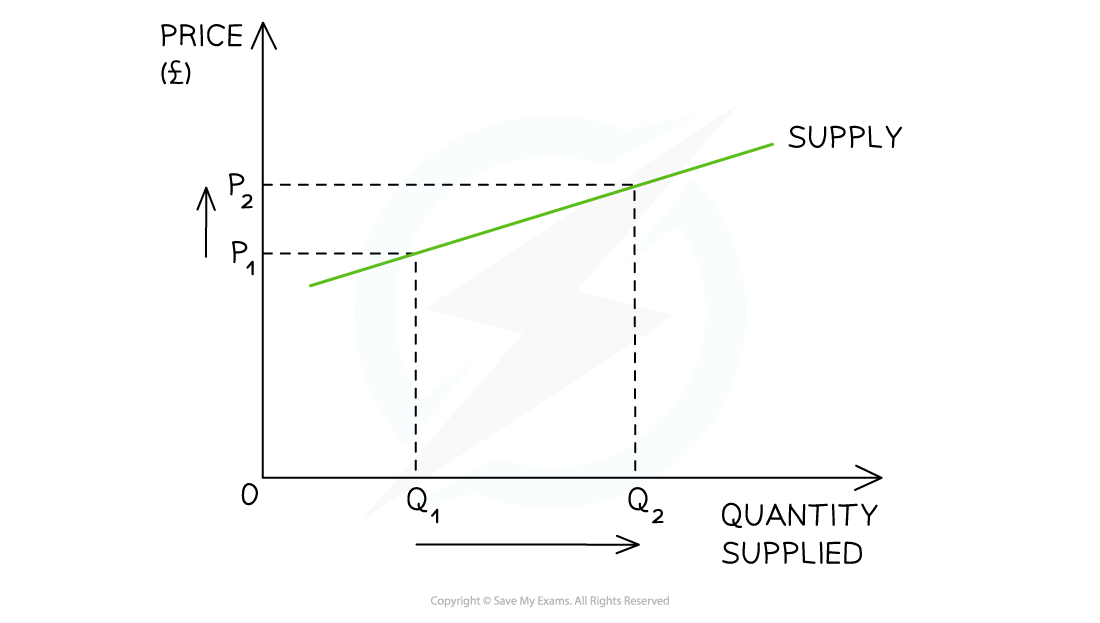 |
| ∞ Perfectly Elastic | - The %∆ in QS will fall to zero with any %∆ in P. However, supply is unlimited at a particular price. This is a very theoretical scenario | 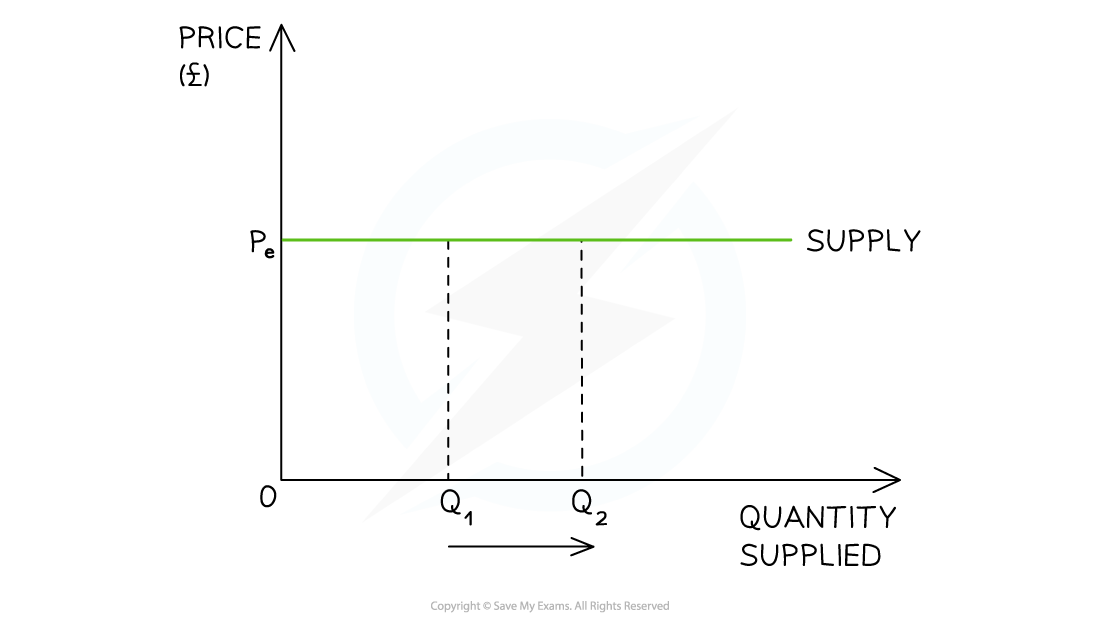 |
| 1 Unitary Elasticity | - Any supply curve that starts at the origin (e.g. S1, S2 or S3) has a PES value equal to 1. The %∆ in P = %∆ in QS | 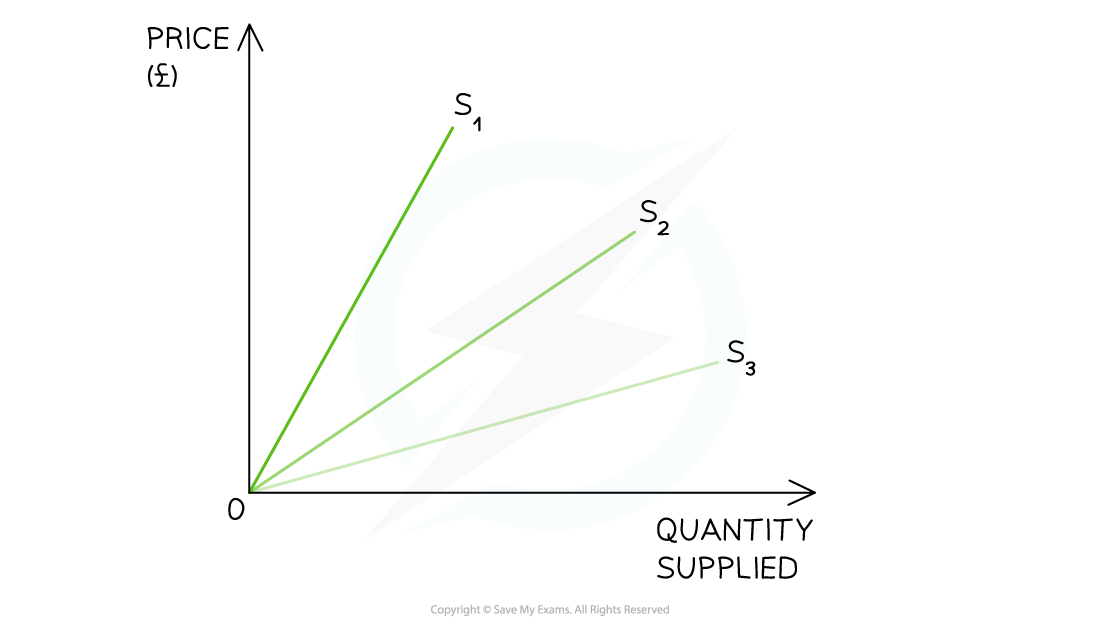 |
Was this revision note helpful?
Build on this topic