11 markeasy
(b)
Which one of the following is a diseconomy of scale?
Choose your answer
An increase in productivity
An increase in bureaucracy
A decrease in the cost of research and development
A decrease in government regulation
14 questions · 62 marks · ≈ 62 min · spans 14 of 16 topics
Assembled from the topic question banks — not an official Edexcel paperWhich one of the following is a diseconomy of scale?
Choose your answer
An increase in productivity
An increase in bureaucracy
A decrease in the cost of research and development
A decrease in government regulation
In 2018, the European Union (EU) trade bloc started to reduce agricultural subsidies to farmers within the EU.
Which one of the following diagrams shows the market for agricultural products following the removal of the subsidy?
Choose your answer
Market share by sales of rms in a market in Kuwait
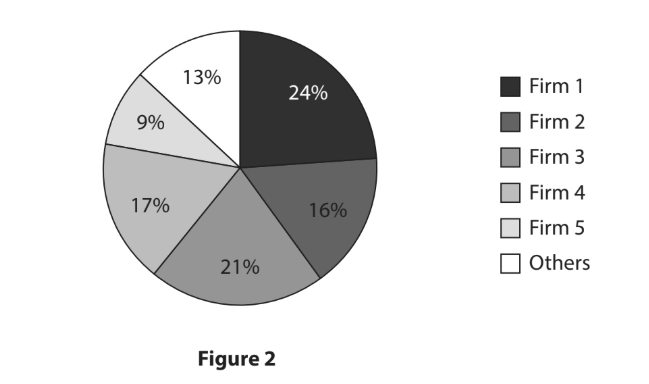
Which one of the following options is the most suitable term for the type of market shown in Figure 2?
Choose your answer
Monopoly
Oligopoly
Public sector
Labour
Describe one feature of a monopoly.
A firm employing 135 workers has a total output of 33,750 units each month.
What is the monthly labour productivity of the firm?
Choose your answer
$250
$4 556 250
250 units
4,556,250 units
Describe one reason why an entrepreneur is a factor of production.
State one factor that may affect the supply of labour.
In March 2023, as part of its supply‐side policy, the Italian Government announced business taxes would be reduced from 27% to 24% in January 2024.
Explain the likely impact on productivity of this change in business taxes for a country such as Italy.
Australia has a progressive income tax system. Individuals are allowed to earn $18200 before paying any tax. The rate of tax payable increases as income gets higher. In recent years, income tax has been the fastest growing source of government revenue in Australia.
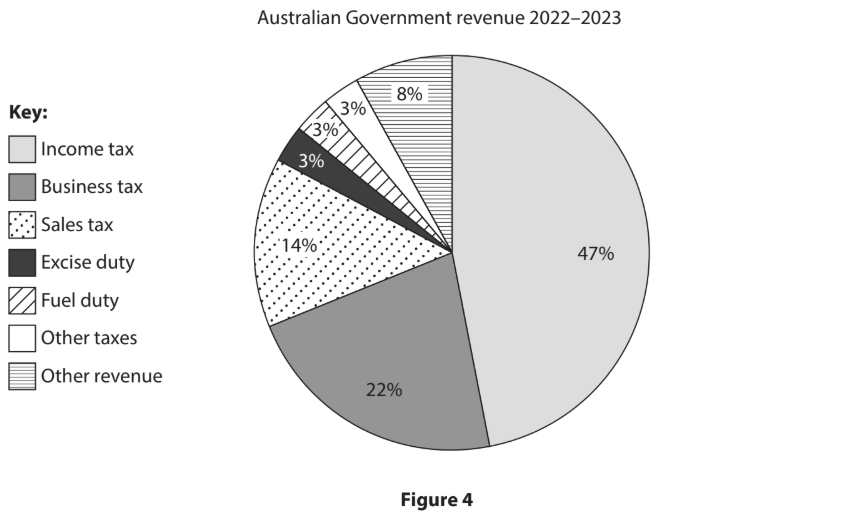
With reference to the data above and your knowledge of economics, assess whether income tax is a reliable source of government revenue for a country such as Australia.
Which one of the following describes voluntary unemployment?
Choose your answer
Unemployment caused by a lack of demand for a particular skill
Unemployment caused by changes in the business cycle
Unemployment caused by individuals choosing not to work
Unemployment caused by seasonal fluctuations in the demand for labour
A poor harvest has cut the Philippines' rice production by around 30%, creating a severe shortage with demand for rice significantly exceeding supply at the current price. Domestic rice producers are already operating at full capacity, and it will take at least one growing season before domestic supply can increase. Rice is a staple food that makes up around 40% of daily calorie intake for most Filipino households, including low-income households.
With reference to the information above and your knowledge of economics, evaluate whether relying on market forces, rather than government intervention, is the best way to resolve this shortage.
Define the term consumer.
Alfie provides a dog‐walking service to dog owners in his local area. After a successful first year he increased prices by 1.5% and quantity demanded fell by 1.1%.
Calculate, to two decimal places, the price elasticity of demand (PED) for Alfie’s dog‐walking service. You are advised to show your working.
What is meant by the term social costs?
What is meant by the term constant opportunity cost?
Lanterns is an English café, located just outside a town where there are few job opportunities. It was set up by sisters Jo and Fiona who, instead of aiming to make a profit, wanted to help young people in their local area. All their waiters and waitresses are under 25 and were previously inexperienced and unemployed.
At first, the café was popular but now there are a lot of complaints about the length of time it takes for orders to arrive. Fiona thinks they need to employ experienced waiters and waitresses and change their business aims to maximise their profits.
With reference to the data above and your knowledge of economics, assess whether Lanterns should change their business aims.
In December 2023, Argentina's new government devalued the peso by 54% in a single move, followed by smaller monthly devaluations. Monthly inflation initially jumped to 25.5% straight after the devaluation, but annual inflation for 2024 fell to 117.8%, down from 211.4% in 2023. Argentina's trade balance improved by 71.2% over this period, driven by a 16.2% fall in imports while exports fell by only 4.7%, and in 2024 the government recorded its first fiscal surplus in more than a decade.
Evaluate whether Argentina's peso devaluation has been beneficial for the country's economy.