Recruitment Documents (Edexcel IGCSE Business)
An introduction to recruitment
Spec point —
2.2.2· Recruitment and selection process
-
Recruitment is the process of attracting and identifying potential job candidates who are suitable for a particular role
- Recruitment activities include job advertising, job fairs, social media outreach and referrals from current employees
- The goal of recruitment is to create a pool of qualified candidates who can be considered for the role
-
Selection is the process of choosing the best candidate
- Selection activities often involve reviewing CVs and conducting interviews or assessment tasks
- The goal of selection is to hire the most suitable candidate for the job
Stages in the recruitment process
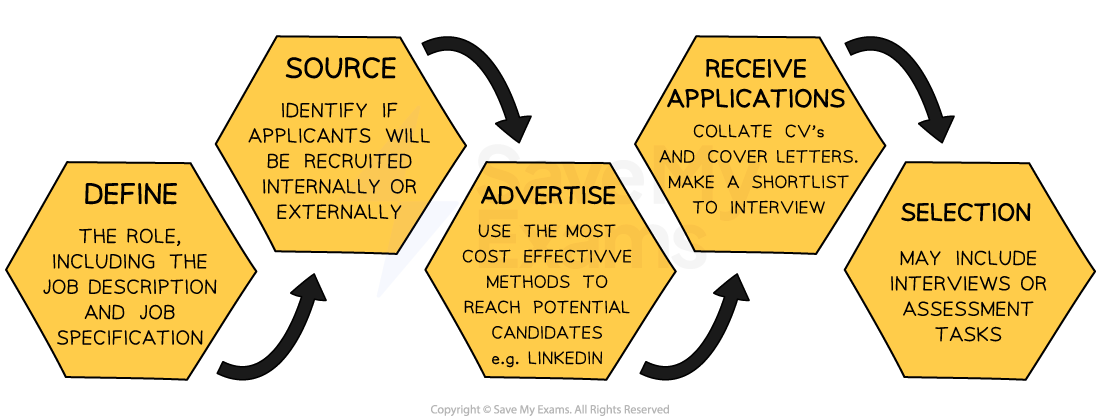
The process of employing a worker, from identifying the vacancy to selecting the right candidate for the role
-
The specific details of the recruitment process may vary slightly between businesses due to different factors, including
- The urgency of the role needing to be filled
- The budget involved in advertising the vacancy
- The nature of the role and the skills required, e.g. some roles require very specific skill assessments
- Preferences of management, e.g. preference of using CV's rather than application forms
- The time available for the process to occur, e.g. Google's recruitment process, usually takes 6–8 weeks
Comparing recruitment documents
Spec point —
2.2.2· Recruitment documents: • job description • person specification • application form • curriculum vitae (CV)/résumé.
Comparing recruitment documents
- The recruitment process must first identify the job roles that are needed and define the characteristics of the ideal candidates to fill vacancies
- Businesses use a range of documents in the recruitment process
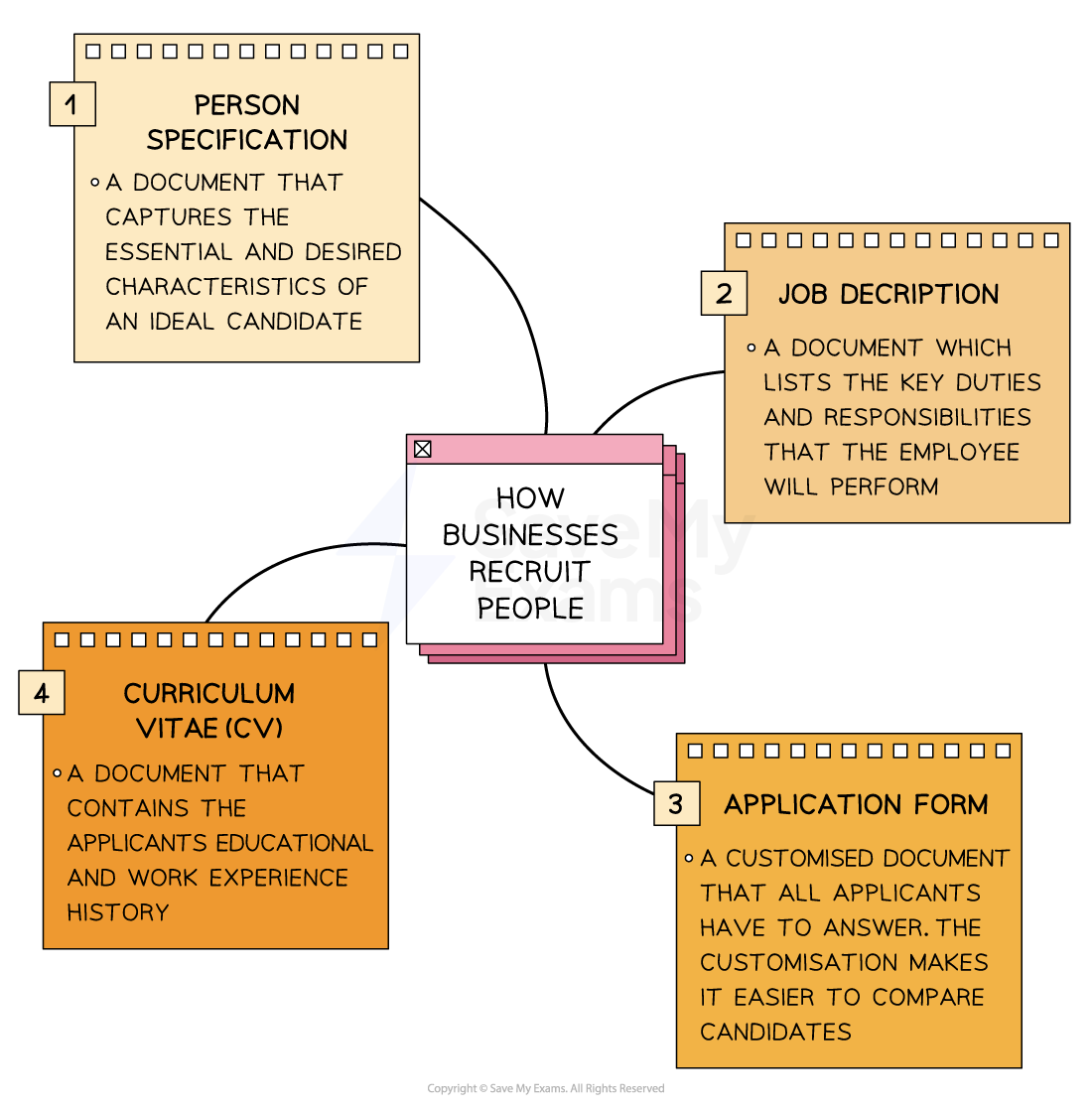
The job description, person specification and application form is written by the employer. The CV is written by the prospective employee
-
The recruitment documents are used throughout the process and play a very important part in helping the business choose the right candidate for the role
- Without detailed recruitment documentation, prospective candidates may lack the appropriate skills or qualifications needed for the role, or be misinformed about what the role consists of
Job description and person specification
- Before a business starts to look for new employees, it writes a person specification and a job description to determine the job role and ideal candidate to fill that role
Comparison of the person specification and job description
| Person specification | Job description |
|---|---|
| - Details the essential and desirable characteristics of the person suitable for the job, including - Qualifications - Experience - Skills such as the ability to drive or IT capabilities - Personal characteristics and attributes | - Details the features of the job, including - Duties - Hours and location of the job - Managerial or supervisory responsibilities - Pay and conditions |
Application forms and CVs
- Once a job is advertised, the business accepts applications from candidates via application form or Curriculum Vitae (CV)
Comparing application forms and CVs
| Application Form | Curriculum Vitae (CV) |
|---|---|
| - Application forms contain a series of standardised questions to which all candidates must respond - Name and contact details - Qualifications - Work experience - Positions of responsibility - Interests - A personal statement where the candidate explains why they would be suitable for the advertised role - The names and addresses of referees - Many application forms are now completed online | - A curriculum vitae is compiled by the applicant and may be standardised to apply for varied roles - CVs usually include similar information to that collected in an application form - Although it should be well laid-out and clear, there is no single acceptable format for CVs - An accompanying letter of application outlines - Why the applicant wants the job - Why they would be suitable for the advertised role |
| Benefits | Benefits |
| - All applicants provide identical information in the same format so they are easy to compare | - More applicants may apply because it is easier for candidates to prepare and adapt a standard CV |
| Drawbacks | Drawbacks |
| - Limited information can be expressed by candidates so key desirable attributes may not be identified | - Comparing different formats and content of CVs can take more time and lengthen the recruitment process |
Exam Hint You do not need to have an in-depth understanding of recruitment documentation for the exam, however you do need to know what they are and the differences between them
Was this revision note helpful?
Build on this topic