Legal Factors & Location (Edexcel IGCSE Business)
The impact of law on business location
Spec point —
1.4.1· legal controls and trade blocs.
-
Laws are rules created by the government of a country with the aim of regulating the actions of its citizens and businesses
- Regulation is the process of enforcing the laws that have been created and ensuring that businesses abide by them
-
Governments and local authorities can incentivise businesses to locate in particular areas
- In areas of high unemployment or industrial decline grants or reduced tax rates may be offered to businesses that create jobs or improve communities
-
In some cases, businesses are deterred from locating in particular areas
- E.g. In areas of outstanding natural beauty, strict bylaws or city ordinances may regulate the type of business activity that is permitted
- E.g. A country with strict environmental laws might not be an attractive location for a manufacturing company that produces a lot of waste
-
The presence or absence of laws can affect a business's choice of location in two ways
1. Less economically developed countries
-
Less economically developed countries often have fewer laws and less enforcement of their existing laws, which is likely to be attractive to some businesses
- Businesses enjoy lower costs as they have to meet fewer legal requirements, such as safe handling of waste material
- Labour can be paid very low rates as no minimum wages exists
- Employees and customers have less opportunity to pursue legal action
2. More economically developed countries
-
Developed economies with extensive laws can be attractive to businesses who desire to locate in region with
- Good infrastructure
- Highly-skilled workers
- High standards of living
Laws and their impact on location
| Type of law | Areas of impact | Examples |
|---|---|---|
| Employment law | - Pay & conditions - Equal treatment regardless of characteristics such as gender, race and disability - Employment contracts - Trade union rights | - In Norway employees have a legal right to generous overtime pay and benefit from generous periods of parental leave |
| Environmental law | - Emissions - Storage and disposal of waste - Storing and handling hazardous substances - Packaging - Water usage | - Since 2019, German businesses have been required to accept the return of all unwanted product packaging from customers |
| Consumer law | - Descriptions of products - Right to refund or replacement - Product safety - Advertising & sales promotion - Selling credit products | - To tackle rising levels of obesity in Brazil, the government introduced a law banning the advertisement and sales promotion of ultra-processed food products |
The influence of trade blocs on business location
Spec point —
1.4.1· legal controls and trade blocs.
-
A trading bloc is a group of countries that come together and agree to reduce or eliminate any barriers to trade that exist between them
- There are different levels of economic integration ranging from relatively low integration in a bilateral agreement to high integration in a monetary union, e.g. the Eurozone
- Globally, there were more than 420 regional trade agreements in effect in 2022
- Each subsequent type of trading bloc has increased levels of economic integration
-
Examples of trade blocs include the EU (European Union), USMCA (United States, Mexico, Canada) and ASEAN (Association of Southeast Asian Nations)
Major trade blocs in 2023
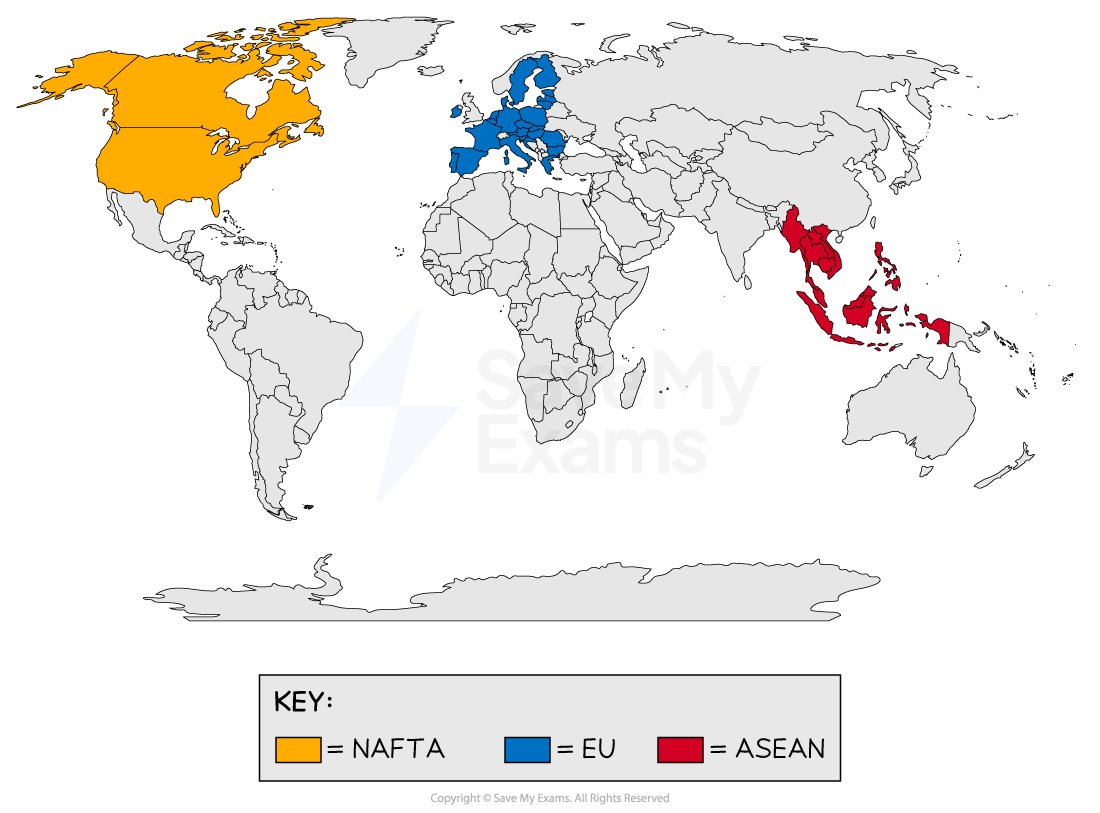
Major trade blocs include the EU, ASEAN and USMCA (previously NAFTA)
- A free trade area is a bloc in which countries agree to abolish trade restrictions between themselves but maintain their own restrictions with other countries
How a free trade area trading bloc works
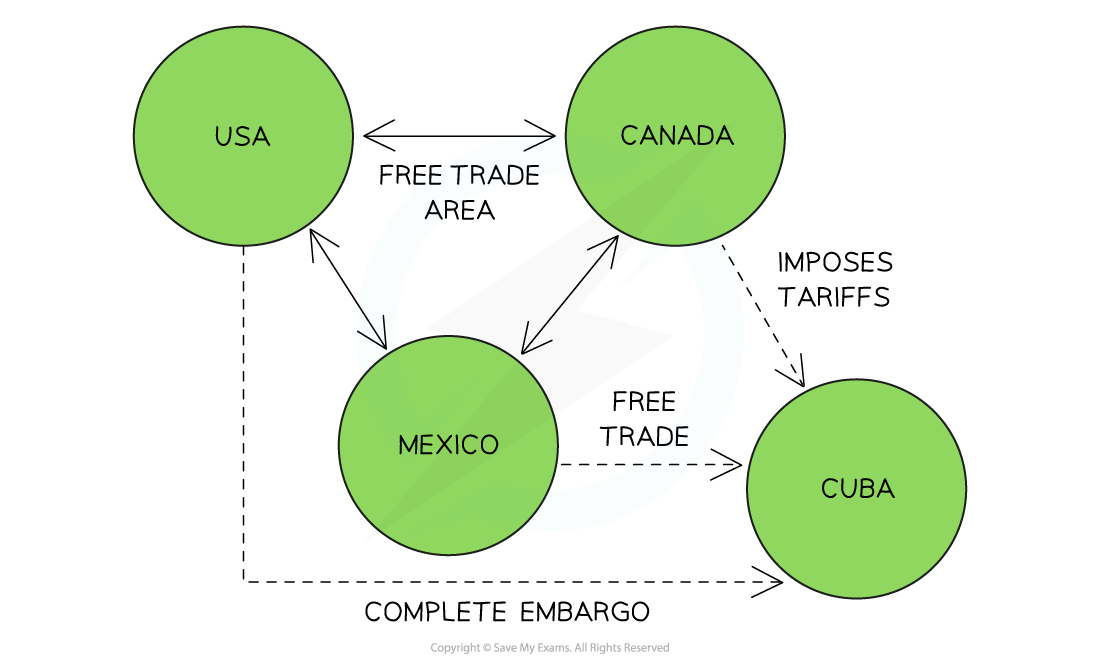
Mexico, Canada and the USA have a free trade agreement but can deal individually with Cuba as they see fit
-
Mexico, Canada and the USA have reduced or eliminated many trade restrictions between themselves
- The USA refuses to trade with Cuba and has placed a complete ban on all exports/imports to Cuba
- Canada trades with Cuba but imposes tariffs on all imports
- Mexico trades freely with Cuba
-
Businesses may look to locate their operations in a trade bloc country in order to avoid paying tariffs or other restrictions such as quotas
Exam Hint Trade blocs and other trading arrangements are often in the news. Using contemporary examples in your longer answers can improve their quality and support your analysis by giving it more depth.
Was this revision note helpful?
Build on this topic